
Blog
SKF blind hole bearing puller: TMBP, TMMP and TMMD series
Removing a bearing from a blind housing, with no access from behind, requires a specific tool. We explain how SKF TMBP, TMMD, TMIP and TMMP pullers work, which one fits each case and what data to send for a quote.
SKF bearings in Argentina: guide and quotes
Technical team at MR Accesorios Industriales · Updated on November 14, 2026
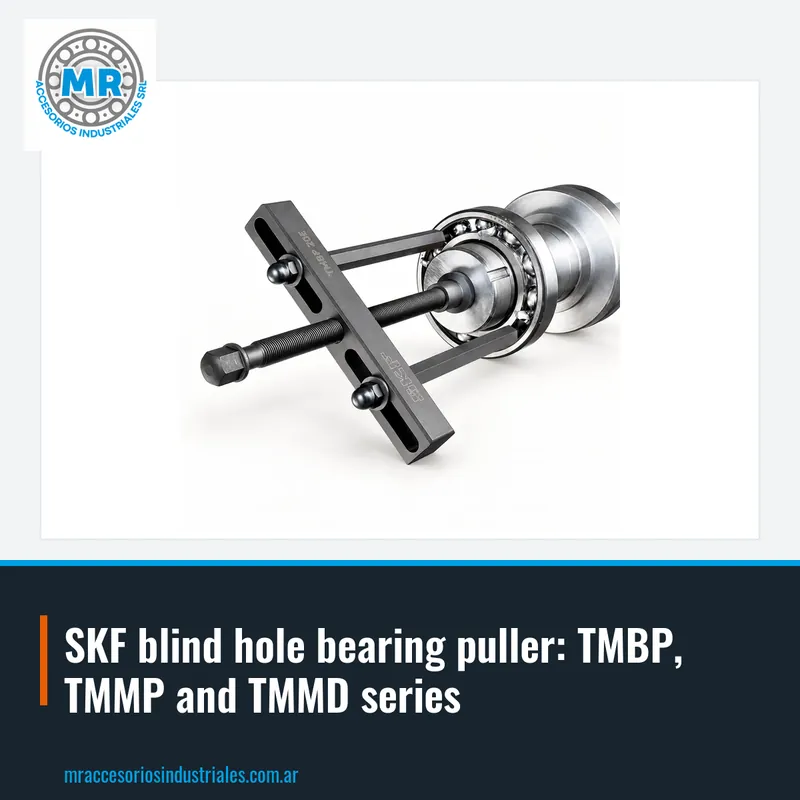
What a blind housing is and why it needs a special puller
An SKF blind hole bearing puller is the tool for removing a bearing left inside a box, cover or housing with no access from behind. In a blind housing the bearing cannot be pushed from the opposite side, and a standard jaw puller has nowhere to grip the part. That is why pullers that work from the front of the bearing are used.
The case comes up in gearboxes, electric motors, pumps and machines where dismantling the whole assembly would take a long time. There are two different situations and each needs its own tool. In the first, the shaft is still in place and the bearing is tight on both the shaft and the housing. In the second, the shaft has already come out and the bearing is left alone at the bottom of the housing.
Before choosing, check which of the two situations you have and measure the bearing bore, the outer diameter and the width. With that data and a photo of the assembly we tell you which puller is the right one. At MR we supply SKF pullers from the TMBP, TMMD, TMIP and TMMP series, and we quote the one your job needs.
How the TMBP blind housing puller works
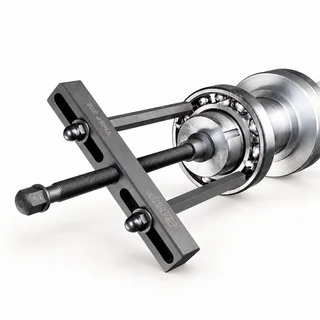
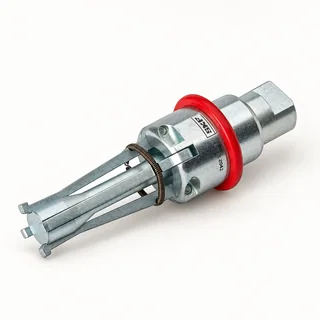
The TMBP 20E is a puller for blind housings designed for deep groove ball bearings that are still mounted on the shaft. It does not grip the bearing from behind: its adapters enter from the front, between the balls, and grip the outer ring raceway. To fit them, the bearing seal or shield is removed first.
The adapters are connected by rods to a crossbar, and the spindle works at the center of the crossbar. Turning it makes the spindle push against the shaft end while the crossbar pulls the bearing outward. All the force is applied through the thread, with no hammering or levers against the housing, and that protects the housing.
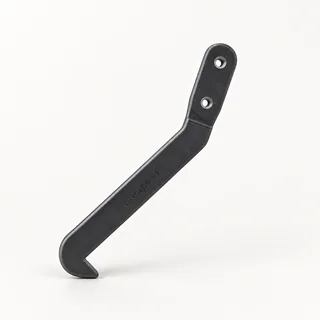
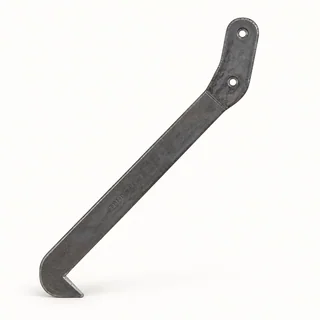
Code TMBP 7-A1 is a component of the TMBP series ordered separately to replace or complete the set. Because the puller pulls the outer ring through the balls, the bearing that comes out is not refitted: it is replaced with a new one. When requesting a quote, give the bearing code or its dimensions and we confirm the set.
TMMD 100 bearing puller: jaws that grip the raceway
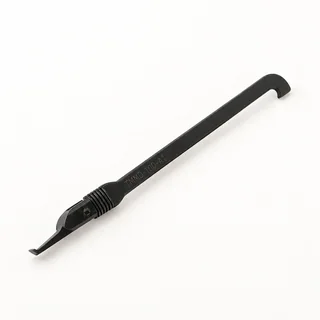
The TMMD 100 bearing puller solves a similar situation: a deep groove ball bearing tight on both the shaft and the housing. Its arms end in thin jaws that enter between the balls and grip the outer ring raceway. The spindle rests on the shaft and, when turned, the bearing comes out without dismantling the housing.
The TMMD 100 is used in the maintenance of electric motors, pumps and gearboxes, when there is no room behind the bearing for a standard puller. As with the TMBP, the bearing seal or shield must be removed before fitting the jaws. A bearing removed this way is discarded and a new one is fitted.
To order it, the code TMMD 100 is enough. If you are not sure whether your bearing falls within the puller's range, send us the bearing code and a photo of the assembly. We distribute genuine SKF tools and confirm the tool before quoting, so the order is right from the start.
When the shaft is already out: TMIP internal pullers
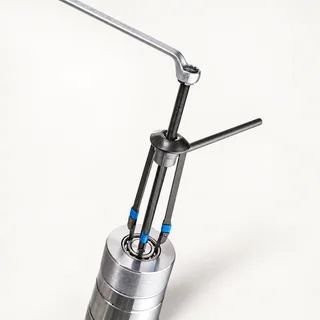
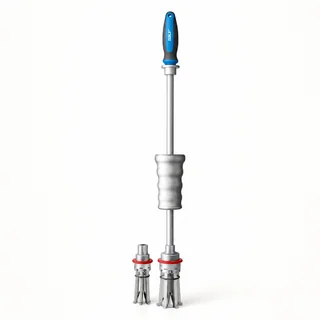
If the shaft has already been removed and the bearing is left alone at the bottom of the housing, the tool is an internal puller. Its expanding collet enters through the bearing bore, opens behind the inner ring and locks in place. The bearing is then removed with the slide hammer from the set, pulling in line with the housing.
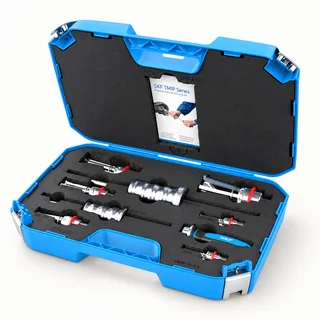
The TMIP series includes the TMIP 7-28 and TMIP 30-60 sets, chosen according to the bearing bore. The sets include collets of different sizes, and each collet works with specific bores. If in doubt, send us the bearing code or the bore measurement and we tell you which set is right.
With an internal puller the force passes through the inner ring, so the bearing should not be reused either. What is protected is the housing: the collet does not touch the housing and the slide hammer pull is in line, without levers. That matters on aluminum or cast iron covers, where a mark changes the seat for the new bearing.
TMMP jaw pullers: when they are enough
TMMP jaw pullers are the classic two- or three-arm jaw pullers. They work when the bearing, pulley or gear is on a shaft and there is room for the jaws to pass behind the part. They are not for blind housings, but they handle a good share of on-shaft removals.
The series includes TMMP 6, TMMP 10 and TMMP 15, as well as TMMP 2X170 and TMMP 3X230. They are chosen by the diameter of the part to be removed and by the reach needed from the shaft end to behind the part. With those two measurements and a photo we tell you the right code.
On a bearing tight on the shaft, the jaws must grip the inner ring. If only the outer ring can be gripped, the force passes through the balls and the bearing can no longer be reused. For more detail on choosing the size of an arm puller, see our note on TMMA mechanical pullers.
How to use the puller without damaging the housing or shaft
Before starting, clean the area, remove retainers and covers, and check that the puller matches the bearing. Protect the shaft center if the spindle will rest there, and center the tool properly. An off-center spindle pulls crooked and can mark the bearing seat or the shaft end.
Turn the spindle evenly, without hammering or sudden movements. If the bearing is very tight, apply penetrating oil at the joint with the housing and wait a few minutes. Do not use a hammer or lever on the puller, and never heat the housing with a direct flame: it deforms and loses the seat dimension.
A common mistake is forcing a tool that is not meant for that bearing. That breaks the jaws or adapters and leaves the bearing half out. Another mistake is refitting the bearing that was pulled through the balls: even if it looks sound, its raceways are marked and it will make noise before long.
How to order the SKF puller you need
To order the right puller, the first thing is to tell us whether the shaft is still in place or the bearing is left alone in the housing. That defines the series: TMBP or TMMD 100 with the shaft in place, TMIP without the shaft, and TMMP when the part can be gripped from behind. Then the measurements are needed.
Send us the bearing code, which identifies the bore, outer diameter and width, or the measurements taken with a caliper. Codes like TMBP 20E, TMMD 100 or TMMP 6 do not need to be decoded: give us the one on the old tool or the part measurements, and we quote the exact model or spare part.
You can write to us on WhatsApp or by email with a photo of the bearing and a ruler next to it as a size reference. With that we tell you the right SKF puller and send you the quote shortly. We distribute SKF tools and spare parts from Buenos Aires, Argentina.
Frequently asked questions
Which SKF puller do I use for a bearing in a blind housing?
If the shaft is still in place, a blind housing puller such as the TMBP 20E or the TMMD 100 bearing puller. If the shaft is already out and the bearing is left at the bottom, an internal puller from the TMIP series. Send us the bearing code and a photo and we tell you which one.
What is the difference between TMBP and TMMP?
TMBP are blind housing pullers: they grip the bearing from the front, at the raceway, and push against the shaft. TMMP are classic two- or three-arm jaw pullers, for parts that can be gripped from behind.
Can the bearing removed from a blind housing be reused?
It is not advisable. In these removals the force passes through the balls and the raceways are marked, even if it is not visible. The right thing is to fit a new bearing.
Does the TMMD 100 puller work for any bearing?
It is a puller for deep groove ball bearings. Whether it works for yours depends on the bearing size: send us the code and a photo of the assembly and we confirm it.
How do I order a spare part for my SKF TMBP puller?
Find the code engraved on the part, for example TMBP 7-A1, and send it to us on WhatsApp or by email. We quote the genuine SKF spare part.
Products with photos in the catalogue
Keep reading
- SKF Chains: Reliable Power Transmission for Industrial Applications
SKF roller chains offer strength and precision for power transmission in industrial machinery. Learn about the PHC series, ASA and BS standards, and how to identify the correct chain for your equipment.
- SKF tools for industrial maintenance: pullers, heaters, aligners and calibrated shims
SKF tools simplify bearing mounting and dismounting, shaft alignment and instrument calibration. Discover TMMA and TMHP pullers, induction heaters, TKSA aligners and calibrated shims.
- How to Choose SKF Bearings by Application: Load, Speed, Environment, and Mounting
Choosing the right SKF bearing requires analyzing load, speed, environment, and mounting. We explain the main types and how to get a quote with the exact code.
Continue here
- SKF
- Bearing pullers
- SKF tools
- How to remove a bearing without damaging the shaft: a practical guide to pullers
- SKF TMMA puller: how to choose the size and use it without damaging the shaft
- SKF TMHP hydraulic puller and TMMR reversible puller: selection and safe use guide
- Search for a code in the catalog
- Blog
Need a SKF quote?
Send us the SKF part number, the size or a photo of the part and we will get back to you with a quote.