
Product page
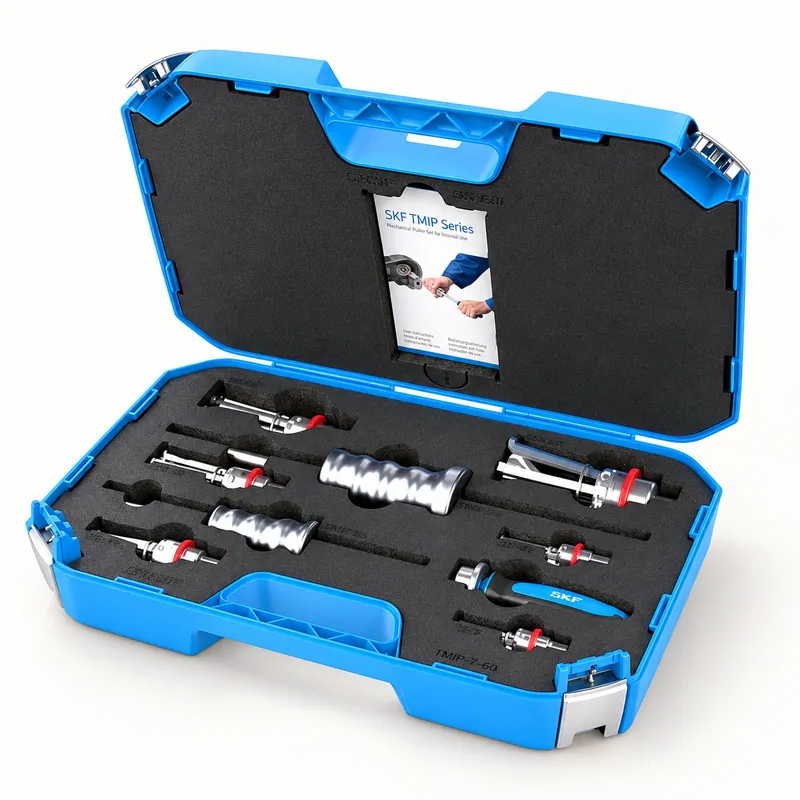
Mounting and maintenance tools SKF TMIP 7-28
- Manufacturer Part Number
- TMIP 7-28
- Brand
- SKFOfficial brand
- Category
- Mounting and maintenance tools
- Subcategory
- Mounting and maintenance tools

We respond promptly.
Request your quote via WhatsApp or email, with the quantity and time frame you need.
Can't find the exact model? Write to us with the part number or model you're looking for: we'll find it and quote it, even if it's not listed in the catalog.
Description
SKF TMIP 7-28 is a mounting and maintenance tools reference, within Mounting and maintenance tools. Request a quote for TMIP 7-28 via WhatsApp or email with the quantity you need; we respond promptly with lead time and equivalents.
The SKF TMIP internal puller is a tool designed to remove bearings that are blind-housed, that is, in cavities where there is no access from behind to push them out. It is used in industrial maintenance, factory and equipment repair tasks. MR Accesorios Industriales carries this line as an official brand, with the backing of a firm recognized in the field.
The TMIP series designation reads as a tool code. For example, TMIP 7-28 indicates a puller for a range of internal diameters, while TMIP 7-60 covers a larger range and TMIP 30-60 is aimed at larger sizes. The numbers are not exact bearing dimensions, but rather define the reach of the tool. To choose the correct model, always verify the bore diameter and the width of the bearing to be removed.
These pullers are used in industries such as food, cement, petrochemical, paper and in maintenance workshops. In Argentina, they are common in plants that need to remove bearings without damaging the housing or the shaft. They are also used in pumps, electric motors, gearboxes and transmission equipment. The ability to remove blind-housed bearings without disassembling the entire machine saves time and reduces the risk of damage.
To select the right puller, take into account the bore diameter, the depth and the type of bearing. The TMIP works with an expansion system that grips the inner ring of the bearing. It is important to lubricate the thread before use and apply force evenly. Correct alignment prevents the jaws from slipping or deforming. If the bearing is very tight, the housing can be heated slightly to facilitate removal.
As for equivalents, other brands offer similar tools, but each manufacturer has its own codes and ranges. There is no direct interchangeability between references from different brands; the technical specifications must always be compared. The SKF TMIP series is identified by its internal extraction system and its size ranges. To replace a tool, it is best to go by the diameter and the type of bearing, not only by the code.
If you need an internal puller for blind-housed bearings, send us the code or the bearing dimensions by WhatsApp. At MR Accesorios Industriales we advise you so you can choose the correct TMIP model and we send you the quote with no obligation.
This description provides guidance on the product type. Check the configuration and dimensions of this reference.
Dimensions
Dimensions and tolerances: Send us the part number via WhatsApp and we'll confirm dimensions, sealing, and internal clearance against the manufacturer's data sheet.
Frequently Asked Questions
- What does it mean for a bearing to be blind-housed?
- It means the bearing is mounted in a cavity with no access from the opposite side, so it cannot be pushed from behind. The TMIP internal puller allows it to be gripped from the front and removed without damaging the housing.
- How do I choose the right TMIP model for my bearing?
- You need to measure the bore diameter and the width of the bearing. Each TMIP model covers a range of sizes; for example, the TMIP 7-28 is suitable for internal diameters within that range. If you have doubts, ask us with the measurements.
- Does the SKF TMIP series have equivalents from other brands?
- There is no direct equivalence between codes from different brands. Each manufacturer defines its own ranges and extraction systems. To replace a tool, compare the technical specifications and the size range.