
Blog
SKF TMHP hydraulic puller and TMMR reversible puller: selection and safe use guide
When a mechanical puller is not enough and it is better to move to an SKF TMHP hydraulic puller, how to choose the model according to the part and the space, and what a TMMR reversible puller contributes.
SKF bearings in Argentina: guide and quotes
Technical team at MR Accesorios Industriales · Updated on November 14, 2026
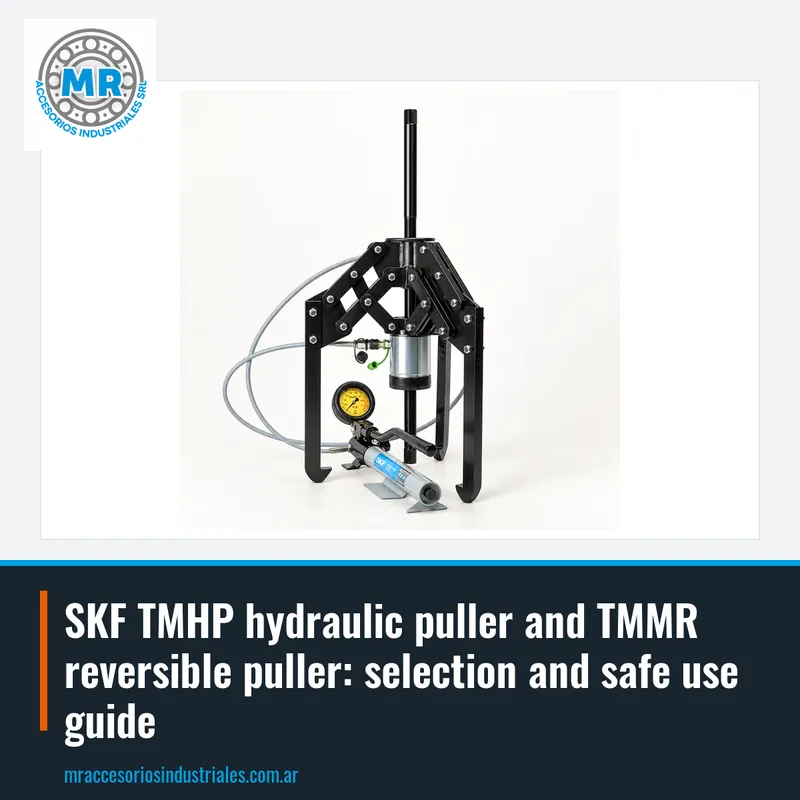
When an SKF TMHP hydraulic puller is needed
A mechanical jaw puller solves many disassembly jobs, but there are cases where manual force is not enough. Large parts, very tight fits or components seized by rust require controlled and constant effort. That is where an SKF TMHP hydraulic puller makes the difference. Its hydraulic cylinder generates the necessary force without blows or improvised levers.
In industrial maintenance, large bearings, pulleys, gears or wheels often remain firmly seated after years of service. Trying to remove them with a common puller can damage the shaft or the part itself. The SKF TMHP hydraulic puller applies force in line with the spindle, which reduces the risk of misalignment and breakage.
The TMHP series includes models such as TMHP 10E, TMHP 15/260, TMHP 30/170, TMHP 30/600 and TMHP 50/570. Each one adapts to different part sizes and working spaces. Before choosing, it is advisable to measure the part diameter, the available length and the fit. With that data, at MR we quote you the appropriate model.
How to choose the TMHP model according to the part and the space
The choice of the SKF TMHP hydraulic puller depends on two main factors: the size of the part to be extracted and the free space around it. The smaller models, such as TMHP 10E, are practical for work in reduced spaces. The larger ones, such as TMHP 50/570, are used on large-diameter or very tight parts.
The cylinder stroke must also be considered. If the part is far from the shaft end, a puller with greater travel is needed. With the part diameter, the required reach and how tight it is, we indicate which code of the TMHP series corresponds. At MR we work with SKF hydraulic pullers and help you define the model.
A common mistake is choosing a puller that is too small and forcing it. That can damage the spindle or the jaws. Another mistake is not checking that the jaws open enough to grip the part. Before quoting, measure the outer diameter, the width and the distance to the shaft end. With a photo and those measurements, we indicate the correct TMHP.
TMMR reversible puller: jaws that turn around
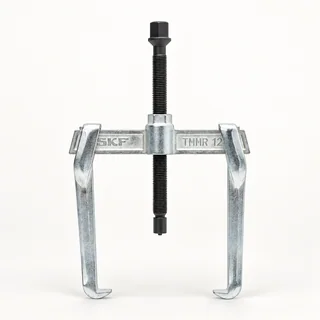
The TMMR reversible puller is another option from the SKF line for disassembly. Its main feature is that the jaws can be reversed to grip the part from the outside or the inside. That makes it very versatile when access is limited or the part has a central hole.
The models of the TMMR series, such as TMMR 40F, TMMR 80F, TMMR 160F, TMMR 250F and TMMR 350F, cover a wide range of sizes. Being reversible, they allow bearings, bushings or pulleys to be extracted from the inside when there is no outer edge to grip. This avoids having to disassemble more components of the equipment.
To choose a TMMR, you need to know whether the part will be gripped from the outside or the inside, and measure the corresponding diameter. It is also advisable to check the jaw width and the reach depth. If you have doubts, send us a photo of the part and we will quote you the appropriate TMMR reversible puller.
Working safely with a hydraulic puller
Using an SKF TMHP hydraulic puller requires following certain precautions. A blanket or protection should always be placed over the part and the puller to contain any projection. The maximum cylinder stroke must never be exceeded, because the equipment can be damaged and an accident caused.
The spindle must be perfectly aligned with the part axis. If it is crooked, the force is applied poorly and can break the puller or the part. You should also not stay in the extraction line: in the event of a sudden release, the part can fly out. Always stand to the side.
Before starting, it is advisable to clean the area and apply a penetrant if there is rust. If the part does not come out with normal force, the puller can be combined with controlled heat, but without exceeding the recommended temperature for the material. At MR we advise you on the safe use of SKF hydraulic pullers.
Combining the puller with heat when the part does not come out
When a bearing or part is very tight, heat can help expand the part to be removed and facilitate extraction. Heat is applied evenly to the part to be removed, never with a direct flame on a bearing or on the shaft, and carefully so as not to damage nearby components. The SKF TMHP hydraulic puller applies force while the heat does its work.
It is important to heat evenly and not overheat. Excessive heating can change the properties of the steel or damage seals and greases. Ideally, only the part to be extracted should be heated, not the shaft. Then the puller is operated slowly and constantly.
This technique is common in heavy machinery maintenance, such as reducers, pumps or mining equipment. If the part is very rusted, it is advisable to apply penetrant and let it act before heating. With an SKF TMHP hydraulic puller and controlled heat, many difficult disassembly jobs are solved.
Common mistakes when using hydraulic and reversible pullers
One of the most frequent mistakes is using a puller with jaws that do not close well on the part. If the jaws slip, force is lost and the part is damaged. You must check that the claws are well supported and that the spindle is centered.
Another mistake is ignoring the maximum stroke: if the cylinder reaches the stop and pumping continues, the equipment can be damaged. When the stroke is not enough, you must stop, return the cylinder and shim as indicated in the manual.
With TMMR reversible pullers, a typical mistake is reversing the jaws without checking that they are well secured. If they are loose, the jaws can come off during extraction. The assembly must always be checked before applying force. At MR we guide you to avoid these problems.
How to request a quote for an SKF TMHP or TMMR hydraulic puller
To quote an SKF TMHP hydraulic puller or a TMMR reversible one, the best thing is to send us the model code if you know it. For example, TMHP 30/170 or TMMR 160F. If you do not know the code, you can send a photo of the part to be extracted and the main measurements.
The most helpful data are the outer diameter of the part, the width, the distance to the shaft end and the free space around it. It is also advisable to indicate whether the part is very tight or if there is rust. With that information, we indicate the appropriate model and provide the quote.
You can write to us via WhatsApp or email. At MR we sell and distribute SKF TMHP hydraulic pullers and TMMR reversible pullers. We reply promptly with the proposal for your case.
Frequently asked questions
When is a hydraulic puller better than a mechanical one?
When the part is large, very tight or seized by rust. The hydraulic puller applies controlled and constant force, without blows, which reduces the risk of damaging the shaft or the part.
How do I choose the correct SKF TMHP hydraulic puller model?
Measure the part diameter, the width and the distance to the shaft end. Also consider the free space around it. With that data, at MR we advise you to choose between models such as TMHP 10E, TMHP 30/170 or TMHP 50/570.
What is the difference between a TMHP hydraulic puller and a TMMR reversible one?
The TMHP uses a hydraulic cylinder to generate force. The TMMR has reversible jaws that can be inverted to grip the part from the outside or the inside, which is useful when there is no outer edge to grip.
What precautions should I take when using a hydraulic puller?
Place a protective blanket, do not exceed the maximum stroke, align the spindle with the shaft and do not stay in the extraction line. If the part does not come out, you can combine with controlled heat.
How do I request a quote for an SKF TMHP or TMMR puller?
Write to us via WhatsApp or email with the model code, or send us a photo of the part and the measurements. We reply promptly with the proposal.
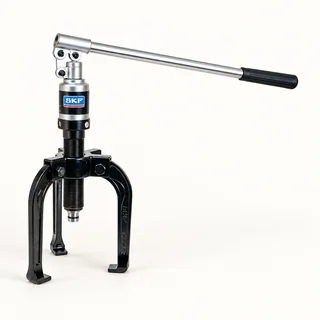
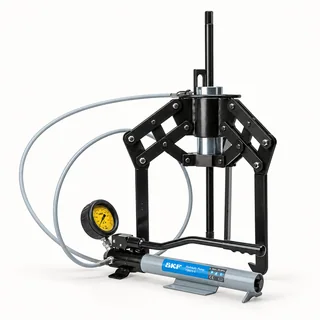
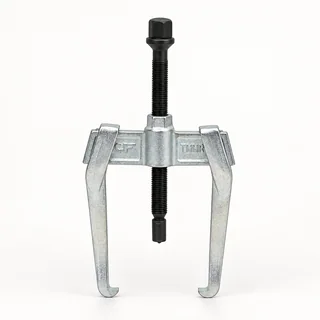
Products with photos in the catalogue
Keep reading
- SKF Chains: Reliable Power Transmission for Industrial Applications
SKF roller chains offer strength and precision for power transmission in industrial machinery. Learn about the PHC series, ASA and BS standards, and how to identify the correct chain for your equipment.
- SKF tools for industrial maintenance: pullers, heaters, aligners and calibrated shims
SKF tools simplify bearing mounting and dismounting, shaft alignment and instrument calibration. Discover TMMA and TMHP pullers, induction heaters, TKSA aligners and calibrated shims.
- How to Choose SKF Bearings by Application: Load, Speed, Environment, and Mounting
Choosing the right SKF bearing requires analyzing load, speed, environment, and mounting. We explain the main types and how to get a quote with the exact code.
Continue here
Need a SKF quote?
Send us the SKF part number, the size or a photo of the part and we will get back to you with a quote.