

RUADIGON guide
What Ruadigon makes and what sets it apart
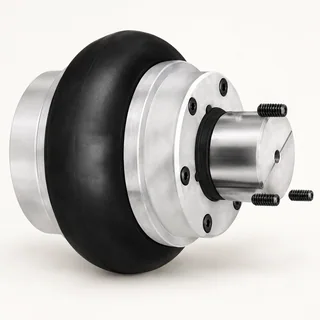
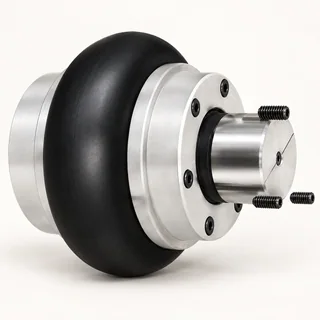
Ruadigon specializes in flexible couplings for power transmission. Its most widespread product is the coupling with elastic band, which transmits torque between shafts and absorbs misalignments, vibrations and shocks. This design protects the transmission and reduces noise, which is why it is widely used in industrial equipment.
Ruadigon couplings stand out for their robust construction and ease of assembly. The elastic band allows a certain angular and radial misalignment, and dampens pulsating loads. They are an option for applications where flexibility and vibration damping are needed without sacrificing durability.
Ruadigon lines sold by MR
At MR Accesorios Industriales we work with the Ruadigon couplings line, within the Power transmission category. We carry the X series with elastic band, in different sizes and hub configurations.
Couplings
The Couplings subcategory includes the models of the X series, both with elastic band and with normal or solid hubs. Each model is identified by an alphanumeric code that indicates the size and the type of hub.
Main Ruadigon series
The main Ruadigon series is the X series, which groups flexible couplings with elastic band. Within this series, the models differ by the number that follows the X, which indicates the coupling size.
X series · Elastic band
The elastic band is the rubber or elastomer element that joins the hubs and accommodates misalignment. X-1 · Banda elástica identifies the replacement band for model X-1.
X series · Normal hubs
The version with normal hubs is the standard configuration of the coupling. The hubs are the parts mounted on the shafts and joined by the elastic band. Examples: X-1 · Acople con mazas normales and X-2 · Acople con mazas normales.
X series · Solid hubs
The full hub has a larger body diameter than the normal hub and accommodates larger shaft diameters within the same model. The Ruadigon drawing shows a bore: “full” does not mean unmachined or unbored. Select it using the full-hub dimensions and shaft diameter in the manufacturer’s table.
How to read a Ruadigon code
Ruadigon codes follow a simple structure: the letter X indicates the series, and the number that follows indicates the coupling size. For example, X-1 is smaller than X-2, and so on.
In addition to the number, the code may include a description of the type of hub or the flexible element. For example, X-1 · Banda elástica indicates that the coupling includes the elastic band, while X-1 · Acople con mazas normales specifies the type of hub.
Example: X-1 · Banda elástica
The code X-1 · Banda elástica breaks down as follows: X is the series, 1 is the size, and Banda elástica indicates that the coupling includes the elastic band as the flexible element.
Example: X-2 · Acople con mazas normales
In X-2 · Acople con mazas normales, X is the series, 2 is the size (larger than X-1), and Acople con mazas normales indicates that the hubs are standard.
Example: X-3 · Acople con mazas llenas
X-3 · Acople con mazas llenas identifies model X-3 with this hub geometry. Check the bore and keyway against the shaft and the manufacturer’s table.
Frequent Ruadigon prefixes and suffixes
In Ruadigon codes, the main prefix is the letter X, which identifies the flexible coupling series. Differentiation is made by the size number and the description of the type of hub or flexible element.
It is important not to confuse Ruadigon nomenclature with that of other brands. For example, some catalogs use equivalents such as X-20 for X-1, X-25 for X-2 and X-30 for X-3. These equivalents are useful for comparison, but always verify the actual dimensions before replacing.
Applications by industry in Argentina
Ruadigon couplings are used in a wide variety of industries in Argentina. Their ability to absorb misalignments and vibrations makes them suitable for rotating equipment in demanding environments.
Metallurgy
In the metallurgical industry, Ruadigon couplings are used in pumps, fans and plant conveyors. The elastic band dampens shocks and protects the bearings.
Agriculture
In agriculture, they are used in irrigation pumps, augers and grain mixers. The flexibility of the coupling compensates for misalignments caused by equipment settling.
Naval
In naval applications, Ruadigon couplings are used in bilge pumps, fans and compressors. Resistance to moisture and vibration is key.
Oil
In the oil industry, they are used in transfer pumps and compressors. The elastic band dampens starts and pulsating loads.
Food
In food plants, Ruadigon couplings are used in sanitary pumps and conveyors. The elastic band reduces noise and prevents lubricant contamination.
Mining
In mining, they are used in conveyor belts and pumps. The ability to absorb pulsating loads protects motors and gearboxes.
Paper
In the paper industry, Ruadigon couplings are used in pulp pumps and rollers. The flexibility compensates for thermal expansion of the shafts.
Cement
In cement plants, they are used in fans, pumps and auxiliary conveyors. It is advisable to verify the working temperature of the elastic element.
Energy
In power generation, Ruadigon couplings are used in feed pumps and auxiliary fans. Reliability is essential.
Automotive
In the automotive industry, they are used in assembly lines and test benches. The precision and durability of the coupling ensure process quality.
Plastics
In plastics plants, Ruadigon couplings are used in pumps, blowers and auxiliary extrusion equipment. The elastic band absorbs process vibrations.
Refrigeration
In refrigeration plants, they are used in ammonia compressors and brine pumps. Resistance to low temperatures is important.
Sugar
In the sugar industry, Ruadigon couplings are used in juice pumps, fans and conveyors. The elastic band dampens pulsating loads.
How to choose the right Ruadigon
To choose the right Ruadigon coupling, consider the following criteria:
Load and torque: verify the nominal and maximum torque the coupling must transmit. The coupling size (X-1, X-2, etc.) is related to its capacity.
Rotation speed: make sure the coupling supports the equipment's RPM. Couplings with elastic band have speed limits depending on size.
Misalignment: evaluate the expected angular, radial and axial misalignment. The elastic band allows some flexibility, but it is not infinite.
Environment: if there is dust, moisture or extreme temperatures, verify that the elastic element is suitable for those conditions.
Assembly: consider the available space and ease of installation.
Equivalents and interchangeability
In the Ruadigon catalog, some models have equivalents with other codes. For example, X-1 is equivalent to X-20, X-2 to X-25 and X-3 to X-30. These equivalents are useful for identifying alternatives within the same brand.
When comparing with other brands, it is important to verify the actual dimensions: shaft diameter, overall length, hub type and torque capacity. Not all couplings with the same number are interchangeable. If you have doubts, ask us with the code of your current coupling.
Frequent mistakes when replacing or buying Ruadigon
One of the most common mistakes is choosing a coupling only by the series number without verifying the shaft diameters. Each size accepts certain shaft diameters, so you must confirm that the hub bore matches the shaft.
Another mistake is ignoring the type of hub. Solid hubs are not interchangeable with normal ones without modifying the assembly. Also, not replacing the elastic band when it is worn can damage the hubs.
It is also common not to consider the actual misalignment of the equipment. If the misalignment exceeds the coupling's capacity, the elastic band will wear prematurely.
Assembly, lubrication and maintenance
Assembling a Ruadigon coupling is simple: mount the hubs on the shafts, align the shafts and place the elastic band between them. It is important to respect the misalignment tolerances indicated by the manufacturer.
Couplings with elastic band do not require lubrication, which reduces maintenance. However, the elastic band should be inspected periodically for cracks, wear or deformation. If damage is observed, replace it immediately.
To extend service life, check shaft alignment from time to time and adjust if necessary. Avoid overloads and sudden shocks that could damage the band.
Why get a Ruadigon quote at MR Accesorios Industriales
We are official Ruadigon distributors in Argentina and since 1945 we have supplied the industry. From Buenos Aires, Argentina, we sell the Ruadigon coupling line with specialized technical advice.
Our online catalog lets you search by code or size, and our team helps you identify the right coupling for your application. If you have the code of a coupling from another brand or an unidentified part, we can look for the equivalent.
Get a quote for your Ruadigon coupling by WhatsApp or email with the code, size or a photo of the part. We will reply shortly with the right option for your equipment.
Frequently asked questions about RUADIGON
- What is a Ruadigon coupling?
- A Ruadigon coupling is a power transmission component that joins two shafts to transmit torque. The X series uses a flexible elastic band that absorbs misalignments, vibrations and shocks, protecting the transmission and reducing noise.
- How do I read the code of a Ruadigon coupling?
- The code consists of the letter X (series) followed by a number indicating the size. For example, X-1 is smaller than X-2. It may also include a description such as 'Banda elástica' or 'Acople con mazas normales' to specify the type.
- What do X-1, X-2, X-3 mean in Ruadigon?
- They are coupling sizes within the X series. The higher the number, the greater the torque transmission capacity and physical dimensions. For example, X-3 is larger than X-1 and X-2.
- Does Ruadigon have equivalents with other codes?
- Yes, some models have internal equivalents, such as X-1 equivalent to X-20, X-2 to X-25 and X-3 to X-30. These equivalents are useful for comparison, but always verify the actual dimensions before replacing.
- Do Ruadigon couplings need lubrication?
- No, couplings with elastic band do not require lubrication. The elastic band is the flexible element and does not need oil or grease maintenance. It should only be inspected periodically and replaced if worn.
- In which industries are Ruadigon couplings used?
- They are used in metallurgy, agriculture, naval, oil, food, mining, paper, cement, energy, automotive, plastics, refrigeration and sugar. They are common in pumps, fans, compressors and conveyors.
- How do I choose the right Ruadigon coupling?
- Consider the torque to be transmitted, the rotation speed, the expected misalignment, the working environment and the assembly space. With that data, you can select the right size and hub type.
- Where to buy Ruadigon couplings in Argentina?
- At MR Accesorios Industriales, official Ruadigon distributor in Buenos Aires, Argentina. Get a quote by WhatsApp or email with the code, size or a photo of the part and we will reply shortly.
Updated September 29, 2026