
Blog
Frequent failures in Ruadigon couplings: how to recognize them in time and prevent them
Ruadigon couplings are robust, but poor assembly or lack of maintenance can shorten their service life. We tell you the most common failures, how to detect them and what to do to avoid them.
RUADIGON catalog by part number
Technical team at MR Accesorios Industriales · Updated on October 17, 2026
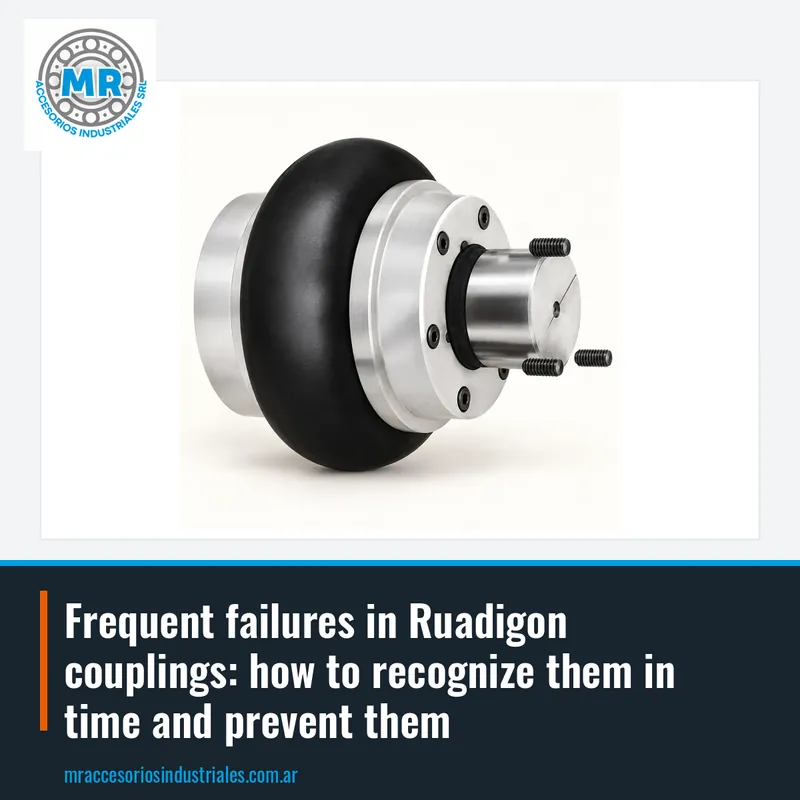
What are Ruadigon couplings and why do they fail?
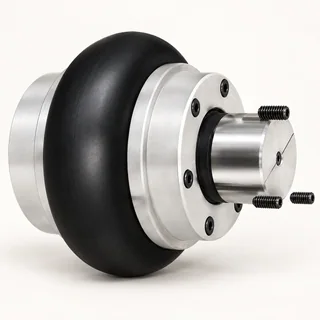
Ruadigon couplings are power transmission elements that join two shafts to transfer rotational motion, absorbing misalignments and vibrations. They are used in pumps, compressors, conveyors, agitators and all types of industrial machinery. Among the elastic band models are the X-2, X-4 and X-5. These couplings are robust and of simple design, but they are not exempt from failures if not installed or maintained correctly.
The most common failures in Ruadigon couplings usually originate from excessive misalignment between shafts, forced assembly, lack of lubrication in the fastening elements or natural wear of the elastic band. Operating conditions also influence: shock loads, frequent starts, extreme temperatures or environments with contaminants. Recognizing symptoms in time avoids unscheduled downtime and major damage to connected equipment.
To diagnose a failure in a Ruadigon coupling, observe the condition of the elastic band, the fastening screws, the hubs and the keyway. Abnormal noises, vibrations, increased temperature in the coupling area or presence of rubber dust are warning signs. In this guide we review the most frequent failures and how to prevent them with good assembly and maintenance practices.
Wear or breakage of the elastic band
The elastic band is the flexible element of the coupling that absorbs misalignments and dampens shocks. Over time, the rubber degrades due to fatigue, heat, contact with oils or chemicals, and loses elasticity. If the band cracks, deforms or breaks, the coupling stops transmitting correctly and vibrations and noises appear. In extreme cases, total breakage of the band can cause disconnection of the shafts and equipment stoppage.
To recognize this problem, visually inspect the band for cracks, cuts, hardening or material detachment. You can also measure the play between the band teeth and the hubs: if excessive, the band is worn. In Ruadigon couplings such as X-2, X-4 or X-5, the band is a standard spare part that can be replaced without changing the entire coupling, provided the hubs are in good condition.
Prevention involves respecting the alignment recommended by the manufacturer, avoiding overloads and controlling working temperature. It is also advisable to periodically check the condition of the band and replace it at the first signs of deterioration. If you need a new band for your Ruadigon coupling, send us the coupling code or a photo and we will quote the exact spare part.
Shaft misalignment: the most common cause of failure
Misalignment between connected shafts is the main cause of premature failures in elastic band couplings. It can be angular, parallel or a combination of both, and generates additional loads on the band and hubs. A well-installed Ruadigon coupling tolerates small misalignments, but if allowable values are exceeded, the band wears quickly and equipment bearings can be damaged.
Symptoms of misalignment include excessive vibration, metallic noise, uneven band wear and increased temperature in the hubs. To diagnose it, a dial indicator or laser aligner can be used. A visual inspection of band wear also gives clues about the type of misalignment.
Prevention consists of aligning the shafts precisely during assembly, using appropriate tools and verifying alignment after tightening the fastening screws. It is also important to check alignment periodically, especially if the machine moves or suffers shocks. Good alignment prolongs the life of the band and the entire transmission system.
Loosening of screws and slipping on the shaft
Ruadigon couplings are fixed to the shafts by set screws or keys, depending on the model. If these screws loosen, the hub can slip on the shaft, causing loss of transmission, vibrations and keyway wear. Slipping can also damage the shaft, leaving marks or burrs that hinder future assemblies.
To detect this problem, periodically check screw tightness and observe if there is relative movement between hub and shaft. Slip marks, metal dust near the keyway or knocking noises at start-up are clear signs. In couplings such as X-2, X-4 or X-5, screws must be tightened to the manufacturer's recommended torque and, if possible, use thread locker.
Prevention includes correct keyway sizing, cleaning contact surfaces before assembly and re-tightening after the first hours of operation. It is also advisable to verify that the shaft is not worn or out-of-round. If the hub has already slipped and damaged the shaft, it may be necessary to repair the shaft or replace the hub.
Fatigue or breakage of the hubs
The hubs of Ruadigon couplings are designed to withstand working loads. However, they can fail due to fatigue if subjected to repeated overloads, sudden shocks or severe misalignment. Cracks usually start at the corners of the keyway or at the screw holes, and can propagate to total breakage of the hub.
To recognize this type of failure, visually inspect the hubs for cracks, especially around the keyway and screws. Penetrant liquids can also be used to detect non-visible cracks. A broken hub can cause violent separation of the shafts, with risk to people and damage to equipment.
Prevention is based on not exceeding the coupling's load capacity, avoiding sudden starts and maintaining alignment within limits. It is also important to select the correct coupling for the application, considering torque, speed and type of load. If you have doubts about which Ruadigon coupling to use, consult us with your equipment data and we will advise you.
Problems due to contamination and lack of maintenance
Elastic band couplings are sensitive to contamination by dust, sand, water, oils or chemicals. These contaminants accelerate rubber aging, cause corrosion in the hubs and can obstruct the fastening screws. In very aggressive environments, the service life of the band is considerably reduced.
To prevent these problems, it is recommended to protect the coupling with guards or covers, and periodically clean the area with compressed air or a dry cloth. Also avoid contact with solvents or oils that degrade the rubber. If the coupling works outdoors, it should be covered.
Preventive maintenance includes regular visual inspections, checking screw tightness, verifying alignment and replacing the band when it shows signs of wear. A simple maintenance plan can prevent most failures and prolong the service life of the Ruadigon coupling.
How to order your Ruadigon coupling and avoid common mistakes
When ordering a Ruadigon coupling, it is essential to correctly identify the model and size. Elastic band couplings are designated with a letter and a number, such as X-2, X-4 or X-5, which indicates the size of the hub and band. You must also specify the shaft diameter, keyway and type of fastening. If you have the old coupling, a photo or the engraved code are very helpful.
A common mistake is ordering only the elastic band without verifying that it corresponds to the coupling size. Bands are not interchangeable between different sizes, and using an incorrect band can cause premature failures. Another mistake is not considering the actual misalignment of the installation: if misalignment is greater than allowable, no coupling will last long.
To get a quote for your Ruadigon coupling, send us via WhatsApp or email the coupling code, shaft measurements and a photo if possible. At MR we quote the complete coupling or the spare parts you need, and we indicate the best option for your application. We advise you on selection.
Frequently asked questions
How do I know if my Ruadigon coupling is failing?
The most common symptoms are excessive vibration, abnormal noises, increased temperature in the coupling area, visible wear of the elastic band or loosening of screws. If you notice any of these signs, it is advisable to inspect the coupling and correct the cause.
How often should I check the Ruadigon coupling?
It is advisable to perform a periodic visual inspection and a more detailed check according to operating hours. In aggressive environments or with heavy loads, the frequency should be higher.
Can I replace only the elastic band of my Ruadigon coupling?
Yes, the elastic band is a standard spare part and can be replaced without changing the hubs, provided they are in good condition. It is important to use the correct size band for your coupling model.
What data do I need to order a Ruadigon coupling?
You need the coupling code (for example, X-2, X-4 or X-5), the shaft diameters, the keyway and the type of fastening. If you have the old coupling, a photo helps identify the exact model.
Does MR sell original Ruadigon couplings?
Yes, MR is an official Ruadigon distributor and sells couplings and spare parts. You can consult us via WhatsApp or email and we will quote what you need.
Products with photos in the catalogue
Keep reading
- Ruadigon in Argentina: complete guide to elastic couplings
Ruadigon is a brand of elastic couplings sold in Argentina. In this guide we review its product lines, typical applications, and how to get a quote by code.
- Ruadigon Codes: How to Read Coupling Designations
Practical guide to interpreting Ruadigon codes on elastic couplings. Understand the structure, prefixes, suffixes and real examples to order the correct replacement part.
- Ruadigon Couplings: Where They Are Used, How to Select Them, Installation and Maintenance to Make Them Last
Ruadigon elastic couplings are a reliable solution for transmitting power between shafts, absorbing misalignments and vibrations. In this guide we explain how to choose them according to the application, install them correctly and maintain them to extend their service life.
Continue here
Need a quote?
Send us the code, size or a photo of the part and we'll quote you shortly.