
Blog
How to choose a Ruadigon coupling for your industrial application
Ruadigon elastic band couplings absorb vibrations and misalignments in industrial drives. Learn how to select the correct model based on load, speed, environment and mounting.
RUADIGON catalog by part number
Technical team at MR Accesorios Industriales · Updated on October 9, 2026
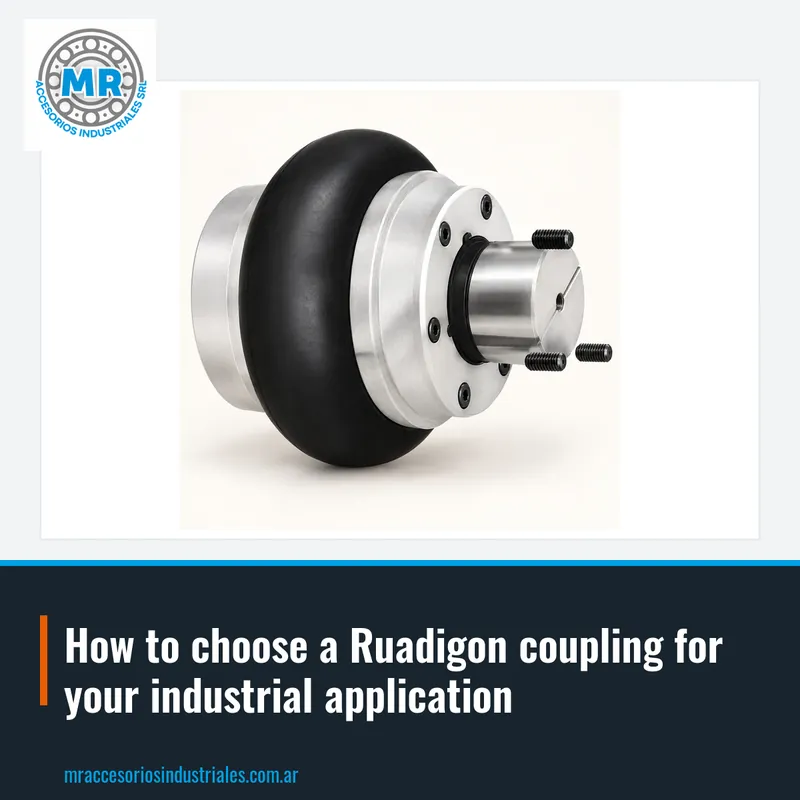
What is a Ruadigon coupling and what is it for
A Ruadigon coupling is a transmission element that joins two shafts to transfer power from a motor to a machine. In particular, Ruadigon elastic band couplings incorporate a flexible rubber element that absorbs vibrations and small misalignments. This protects the bearings and reduces wear throughout the kinematic chain. They are a robust solution for equipment that starts under load or experiences torque shocks.
These couplings are used in pumps, compressors, fans, conveyors, mixers and agricultural machinery. In Argentine industry they appear in food plants, cold storage facilities, steel mills and plastic factories. Their simple design allows quick mounting without special tools.
MR is an official Ruadigon distributor, so we sell their genuine couplings. When choosing a Ruadigon coupling, it is key to identify the exact model and shaft dimensions. With that information, we quote the correct coupling for your application.
Elastic band couplings: models X-7, X-1 and X-6
Within the Ruadigon line, elastic band couplings are identified with codes such as X-7 · Banda elástica, X-1 · Banda elástica and X-6 · Banda elástica. Each model corresponds to a hub size and a specific torque capacity. The elastic band is the component that wears with use and is replaced periodically. Therefore, it is advisable to have the complete code of the coupling and the band identified.
The choice between one model and another depends on the torque to be transmitted and the diameter of the shafts to be coupled. That is why it is not advisable to choose by visual similarity: two couplings that look the same may have different hub sizes. When in doubt, the safest approach is to start from the code of the coupling already mounted.
To order a Ruadigon coupling, it is advisable to send a photo of the identification plate or the old coupling. You can also measure the shaft diameter and the distance between hub centers. With that data, the MR team indicates the exact model and quotes the coupling and the spare elastic band. This way you avoid ordering errors and unnecessary downtime.
How load influences coupling selection
The load that the coupling must transmit is the first selection criterion. An undersized coupling breaks or wears the elastic band in a short time. An oversized coupling takes up more space and can transmit unwanted vibrations. Therefore, it is important to know the nominal torque and starting torque of the equipment.
In applications with heavy loads or sudden starts, such as mills or crushers, a coupling with greater absorption capacity is recommended. In contrast, for light and constant loads, a model sized for the nominal torque is sufficient.
When quoting a Ruadigon coupling, indicate the motor power in HP or kW and the working RPM. It is also useful to know whether the equipment starts unloaded or under load. With that data, we guide you on the appropriate model. You do not need to calculate the exact torque: power and speed are enough for an initial selection.
Rotation speed and its effect on the coupling
Rotation speed is another determining factor. The higher the RPM, the greater the centrifugal force on the elastic band and the hubs. Each coupling model has a maximum speed limit. Exceeding that limit causes vibrations, heating and premature wear of the band.
In high-speed applications, such as centrifugal pumps or screw compressors, it must be verified that the coupling is balanced. It is also important that the hubs are well aligned and that the keys are correctly fitted. Careless mounting generates vibrations that are transmitted to the bearings.
When ordering a coupling, report the RPM of the motor and the machine. If there is a reducer or speed variator, it is also advisable to mention it. With that data, we confirm whether the chosen model is suitable for that speed. In case of doubt, we suggest the higher model for greater safety.
Working environment: temperature, humidity and chemical agents
The environment where the coupling works influences the service life of the elastic band. The natural or synthetic rubber of the band resists humidity and most oils well, but not strong solvents or extreme temperatures. In environments with acids or aggressive hydrocarbons, a special band material must be evaluated.
In cold storage facilities or refrigeration plants, low temperature can harden the rubber and reduce its elasticity. In contrast, in steel mills or foundries, excessive heat accelerates aging of the band. For these cases, it is recommended to inspect the band more frequently and keep spare parts on hand. The elastic band is a consumable that is changed at each scheduled maintenance.
When quoting a Ruadigon coupling, mention whether the equipment is outdoors, in a humid environment or near heat sources. Also whether there is contact with chemical products. With that information, we indicate which coupling is suitable for those conditions. This way you extend the life of the coupling and avoid unexpected downtime.
Mounting and alignment: keys to correct operation
Mounting a Ruadigon elastic band coupling is simple, but requires attention to alignment. The shafts must be as aligned as possible, both angularly and in parallel. The elastic band tolerates small misalignments, but excessive misalignment wears it quickly and generates vibrations. It is recommended to use a dial indicator or a straightedge to verify alignment before tightening the hubs.
The hubs are fixed to the shafts by keys and set screws. It is important that the keys are well seated and that the set screws are tightened with the appropriate wrench. When placing the band, do not force the band with pointed tools, because it damages it and loses elasticity.
A common mistake is mounting the coupling with the hubs too far apart or too close together. The distance between hubs must be the one indicated by the manufacturer for each model. Mounting out of specification forces the band and shortens its service life. When ordering a Ruadigon coupling, consult the recommended mounting distance for your model.
How to order your Ruadigon coupling from MR
To quote a Ruadigon coupling, send via WhatsApp or email the coupling code or a photo of the part. If you do not have the code, measure the shaft diameter and the distance between hub centers. Also indicate the motor power and RPM. With that data, we quote the coupling and the spare elastic band.
MR is an official Ruadigon distributor, so we sell genuine couplings. We work with elastic band models, including X-7 · Banda elástica, X-1 · Banda elástica and X-6 · Banda elástica. If you need a coupling for a special application, we indicate the appropriate alternative within the brand.
Send your inquiry to our WhatsApp or email from Buenos Aires, Argentina. We respond promptly with the quote. Do not forget to include all the equipment data to avoid delays. A well-chosen and well-mounted coupling saves you downtime and protects the entire drive.
Frequently asked questions
What is a Ruadigon elastic band coupling?
It is a flexible coupling that joins two shafts by means of metal hubs and an elastic rubber band. It absorbs vibrations and misalignments, protecting the bearings and the motor. It is used in pumps, compressors, fans and conveyors.
How do I know which Ruadigon coupling model I need?
You need to know the torque to be transmitted, the motor power and RPM, and the shaft diameter. With that data, at MR we indicate whether an X-7, X-1 or X-6 corresponds. You can also send a photo of the old coupling to identify it.
How often is the elastic band of the Ruadigon coupling changed?
It depends on working hours, load and environment. It is recommended to inspect the band at each scheduled stop and change it if it shows cracks, deformations or loss of elasticity. Changing it in time prevents major breakages.
Do how to choose Ruadigon coupling tolerate shaft misalignment?
Yes, they tolerate small angular and parallel misalignments thanks to the elastic band. But excessive misalignment wears the band and generates vibrations. It is always advisable to align the shafts as best as possible before mounting the coupling.
Does MR sell original how to choose Ruadigon coupling?
Yes, MR is an official Ruadigon distributor. We sell genuine couplings. You can quote via WhatsApp or email by sending the code or the dimensions of your coupling.
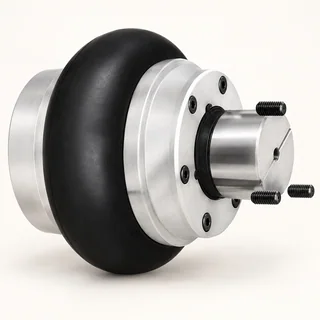
Products with photos in the catalogue
Keep reading
- Ruadigon in Argentina: complete guide to elastic couplings
Ruadigon is a brand of elastic couplings sold in Argentina. In this guide we review its product lines, typical applications, and how to get a quote by code.
- Ruadigon Codes: How to Read Coupling Designations
Practical guide to interpreting Ruadigon codes on elastic couplings. Understand the structure, prefixes, suffixes and real examples to order the correct replacement part.
- Ruadigon Couplings: Where They Are Used, How to Select Them, Installation and Maintenance to Make Them Last
Ruadigon elastic couplings are a reliable solution for transmitting power between shafts, absorbing misalignments and vibrations. In this guide we explain how to choose them according to the application, install them correctly and maintain them to extend their service life.
Continue here
Need a quote?
Send us the code, size or a photo of the part and we'll quote you shortly.