

MR guide
What is the MR brand and what makes it stand out
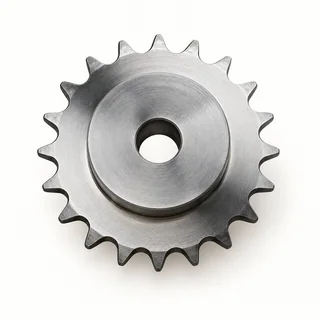
MR offers sprockets and chain wheels for roller chain drives. Sprockets are toothed wheels that mesh with chains and transmit motion between parallel shafts. They are made of SAE 1045 steel, a general-purpose steel with good mechanical strength, suitable for low and medium speed applications.
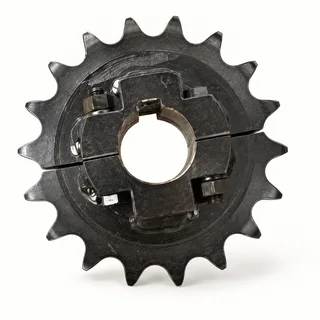
The brand stands out for offering sprockets in standard pitches of 3/8", 1/2", 5/8" and 3/4". These pitches correspond to standard ANSI roller chains. MR sprockets come in three main configurations: simple, double and disc. Simple ones have a single toothed crown and hub for mounting on the shaft. Double ones have two crowns in one piece, for double-strand chains that transmit more power. Discs have no hub and are mounted on a bushing, plate or flange.
In Argentine industry, MR sprockets are used in conveyors, elevators, agricultural machinery, packaging equipment and material handling systems. Their designation by pitch and number of teeth allows quick identification of the part compatible with a given chain.
MR lines distributed by MR Accesorios Industriales
MR Accesorios Industriales distributes the MR power transmission line, specifically the subcategory Sprockets and chain wheels. Within this subcategory, the catalog includes MR simple, double and disc sprockets, each with its photo and technical data sheet.
Products are grouped into series according to their type: simple sprockets, double sprockets and disc sprockets. Each series covers different pitches and numbers of teeth to suit the needs of each drive.
Main MR series
MR sprocket series differ by their configuration and pitch. Below are the main series available in the MR Accesorios Industriales catalog.
DISCO Series
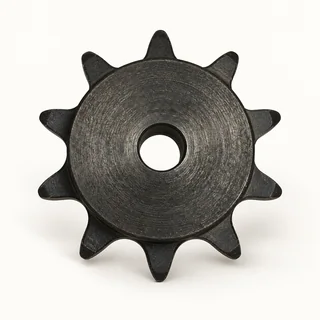
The DISCO series corresponds to sprockets without hub, with a flat and compact profile, which are mounted on a bushing, plate or flange. They are useful where a thin toothed wheel is needed. The discs in the catalog are pitch 1/2", with different numbers of teeth, such as Z8, Z9, Z10 and Z12.
Example codes: Disco 1/2" Z8 and Disco 1/2" Z9.
How to read an MR code
The designation of an MR sprocket consists of three elements: the sprocket type, the pitch in inches and the number of teeth. The type can be "Simple sprocket", "Double sprocket" or "Disc". The pitch indicates the distance between centers of two consecutive pins of the compatible chain. The number of teeth is expressed with the letter Z followed by a number.
For example, Piñón simple 1/2" Z8 is a simple sprocket with pitch 1/2" and 8 teeth. Disco 1/2" Z10 is a disc with pitch 1/2" and 10 teeth. This structure allows quick identification of the part and verification of its compatibility with the chain and the desired transmission ratio.
Example: Piñón simple 1/2" Z8
This code indicates a simple sprocket with a single toothed crown, with hub, for chain with pitch 1/2" and 8 teeth. It is suitable for low-speed drives where a moderate reduction ratio is needed.
Example: Disco 1/2" Z10
This code indicates a disc without hub, for chain with pitch 1/2" and 10 teeth. It is mounted on a bushing, plate or flange.
Frequent MR prefixes and suffixes
In MR nomenclature, prefixes indicate the sprocket type: "Simple sprocket", "Double sprocket" or "Disc". The suffix Z followed by a number indicates the number of teeth.
It is important to respect the exact pitch when replacing a sprocket: a chain with pitch 1/2" is not compatible with a sprocket with pitch 5/8", even if they have the same number of teeth.
Applications by industry in Argentina
MR sprockets are used in a wide variety of industries in Argentina. Below are the main applications by sector.
Metallurgical
In the metallurgical industry, MR sprockets are used in scrap conveyors, roller tables and part handling lines. Simple and double sprockets with pitch 1/2" and 5/8" are chosen to withstand medium loads and environments with metal dust.
Agricultural
In agriculture, MR sprockets are present in seeders, harvesters, augers and grain elevators. Discs with pitch 1/2" are common due to their ease of mounting on agricultural machinery shafts.
Naval
In the naval industry, MR sprockets are used in deck equipment and auxiliary conveyors. Because it is a corrosive environment, it is advisable to keep them lubricated and protected.
Oil
In the oil sector, MR sprockets are used in auxiliary drives for pumps, compressors and service equipment. For higher loads, pitch 3/4", the largest in the line, is chosen.
Food
In the food industry, MR sprockets are used in belt conveyors, washers and packaging lines. Simple sprockets with pitch 1/2" are chosen for light drives, with food-grade lubricants when the process requires it.
Mining
In mining, MR sprockets are used in conveyor belts and feeders. Double sprockets with pitch 3/4" are used for demanding loads and abrasive conditions.
Paper
In the paper industry, MR sprockets are found in paper machine rollers, winders and cutting systems. Simple sprockets with pitch 5/8" are preferred for their balance between strength and precision.
Cement
In cement plants, MR sprockets are used in bucket elevators, clinker conveyors and auxiliary equipment. Sprockets with pitch 3/4" are chosen for their load capacity.
Energy
In the energy sector, MR sprockets are used in biomass conveyors, pumps and auxiliary transmission systems. Sprockets with pitch 1/2" and 5/8" with good dimensional precision are required.
Automotive
In the automotive industry, MR sprockets are used in assembly lines, part conveyors and painting equipment. Discs with pitch 1/2" are chosen for their versatility and easy replacement.
Plastics
In the plastics industry, MR sprockets are used in part conveyors and raw material feeding systems. Simple sprockets with pitch 1/2" that withstand moderate loads and environments with debris are preferred.
Refrigeration
In refrigeration plants, MR sprockets are used in slaughter and packing line conveyors. Adequate lubrication and protection against moisture and temperature changes are recommended.
Sugar
In the sugar industry, MR sprockets are used in cane conveyors and auxiliary equipment. Double sprockets with pitch 3/4" are used for demanding loads and continuous operation.
How to choose the correct MR sprocket
To choose an MR sprocket, first define the pitch of the chain you will use. The standard pitches are 3/8", 1/2", 5/8" and 3/4". The pitch must exactly match that of the chain; otherwise, the mesh will be defective and cause premature wear.
Then, determine the number of teeth needed according to the desired transmission ratio. More teeth on the driven sprocket reduce speed and increase torque; fewer teeth do the opposite. Consider the available space and shaft diameter to choose between simple, double or disc sprocket.
Evaluate the working conditions: load, speed, temperature and presence of contaminants. For heavy loads or abrasive environments, prefer larger pitch sprockets. For light applications, a disc with pitch 1/2" may be sufficient.
Check the mounting type: simple and double sprockets have a hub for fixing with key or set screw; discs require a bushing or adapter. Make sure the shaft diameter is compatible with the sprocket bore.
Equivalents and interchangeability
MR sprockets follow the ANSI standard for roller chains, so they are compatible with ANSI roller chains of the same pitch. When replacing a sprocket of another brand, in addition to pitch and number of teeth, you must match the type, bore and hub.
When comparing equivalents, check the pitch, number of teeth, sprocket type (simple, double or disc) and bore diameter. It is not enough for the pitch to match: the number of teeth defines the transmission ratio and the pitch diameter.
If you have a sprocket of another brand and need an MR replacement, send the code or a photo of the part to MR Accesorios Industriales. The technical team will help you identify the correct equivalent.
Common mistakes when replacing or buying MR sprockets
One of the most common mistakes is confusing the chain pitch. A sprocket with pitch 1/2" does not work with a chain with pitch 5/8", even if the number of teeth is the same. Always verify the pitch stamped on the chain or measure the distance between pins.
Another mistake is not considering the sprocket type. A disc has no hub, so it needs a bushing or adapter; if you buy a disc thinking it has a hub, you will have mounting problems.
It is also common to choose the wrong number of teeth. If you change the number of teeth without adjusting the transmission ratio, you can alter the speed or torque of the machine. Calculate the ratio before buying.
Finally, not verifying the bore diameter can lead to a sprocket that does not fit the shaft. Measure the shaft accurately and consult the sprocket's technical data sheet before buying.
Mounting, lubrication and maintenance
Mounting an MR sprocket should be done with the shaft clean and free of burrs. If the sprocket has a keyway, make sure the key fits correctly and is not loose. For sprockets with set screws, apply adequate torque to prevent loosening during operation.
Lubrication is key to prolonging the life of the sprocket and chain. Use a suitable lubricant for chains, applied in the mesh area. In dusty or humid environments, increase lubrication frequency and clean the chain periodically.
Periodically check tooth wear. If you observe hook-shaped teeth or reduced thickness, it is time to replace the sprocket. A worn sprocket accelerates chain wear and can cause transmission failures.
Store sprockets in a dry place protected from corrosion. If they will not be used for a long time, apply a protective oil layer.
Why get a quote for MR sprockets at MR Accesorios Industriales
MR Accesorios Industriales distributes the MR line of sprockets and chain wheels with an online catalog with photo and technical data sheet. You can search by code, pitch or number of teeth and get a quote via WhatsApp.
We are in Buenos Aires, Argentina, and have worked with Argentine industry since 1945. Our technical team advises you on selecting the correct sprocket and finding equivalents.
Get a quote for your MR sprockets via WhatsApp or email with the code, measurement or a photo of the part. We will respond promptly.
Frequently asked questions about MR
- What does the Z mean in MR sprockets?
- The Z indicates the number of teeth on the sprocket. For example, Z8 means 8 teeth. It is a key data point for calculating the transmission ratio and verifying compatibility with the chain.
- How do I know what chain pitch my MR sprocket uses?
- The pitch is indicated in the sprocket code, for example 1/2" or 5/8". You can also measure the distance between centers of two consecutive pins of the chain. The standard pitches are 3/8", 1/2", 5/8" and 3/4".
- Can I use an MR sprocket with a chain of another brand?
- Yes, as long as the pitch matches. MR sprockets follow the ANSI standard, so they work with standard roller chains of other brands of the same pitch; the number of teeth does not depend on the chain.
- What is the difference between simple, double and disc sprocket?
- The simple sprocket has one toothed crown and hub. The double has two crowns in one piece, for double-strand chains that transmit more power. The disc has no hub and is mounted on a bushing, plate or flange.
- How do I order an MR sprocket if I don't have the code?
- You can send a photo of the part or the measurements: pitch, number of teeth, bore diameter and sprocket type. At MR Accesorios Industriales we help you identify the correct code.
- Do MR sprockets come with a keyway?
- Simple and double sprockets have a hub for fixing to the shaft with key or set screw. Discs have no hub and are mounted on a bushing, plate or flange. Check the technical data sheet for each code.
- What maintenance does an MR sprocket need?
- Periodic lubrication of the chain and sprocket, cleaning of debris and checking tooth wear. If the teeth look hook-shaped, it is time to replace the sprocket.
- What is the MR brand of sprockets?
- MR is the brand of sprockets and chain wheels for chain transmission that MR Accesorios Industriales distributes in Argentina, in pitches 3/8", 1/2", 5/8" and 3/4". Get a quote by code, pitch or number of teeth.
Updated September 29, 2026