
Blog
Seals for oil pumps and compressors: a guide for Neuquén and Vaca Muerta
Which seal goes at each point of oil and gas pumps and compressors, how to measure and order it without mistakes, and which materials suit each fluid.
Technical team at MR Accesorios Industriales · Updated on November 13, 2026
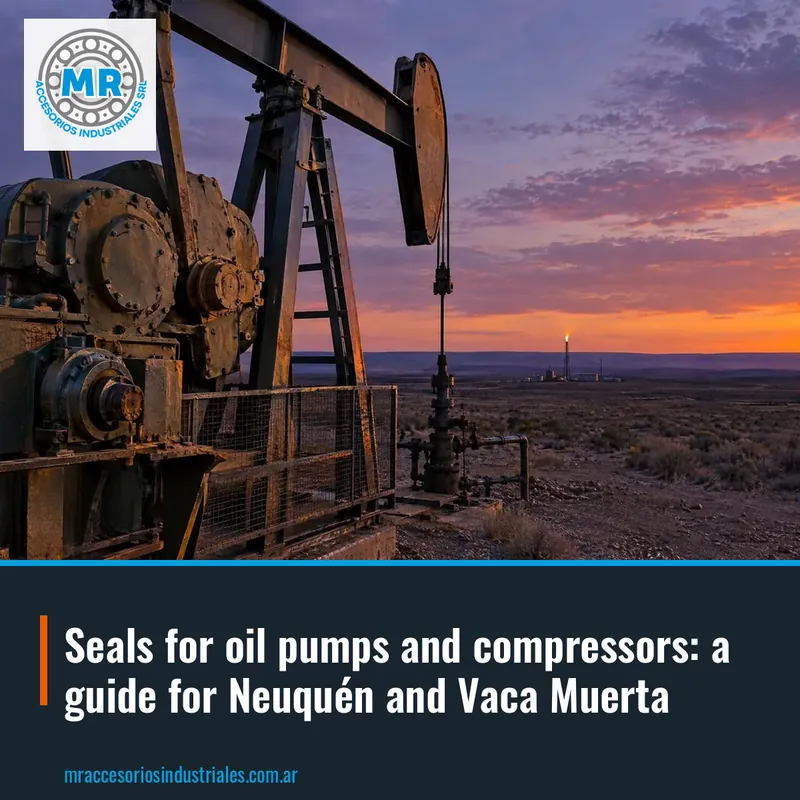
Which seal goes at each point of a pump or compressor
In the process, injection and transfer pumps operating in Neuquén and Vaca Muerta, the radial shaft seal is the part that seals the shaft against the housing and prevents the pumped fluid from escaping to the outside. It also keeps contamination from entering from outside, which is critical at sites with dust, mud and formation water. In gas compressors, the seal performs the same function on shafts that rotate at high speed and are exposed to light hydrocarbons and condensates.
A typical point is the centrifugal pump shaft, where the seal works in direct contact with the product or with a barrier fluid. In positive displacement pumps, such as gear or screw pumps, seals seal the shaft ends and withstand differential pressures. In reciprocating compressors, seals are located on the crankshaft and on the rods, where they must tolerate axial movement and high temperatures.
In addition to the radial shaft seal, many pieces of equipment add a V-ring as external protection. This auxiliary seal is mounted on the shaft, outside the main seal, and acts as a centrifugal deflector: it rotates with the shaft and expels water, mud or dust before they reach the seal lip. On shafts already marked by the lip, a wear sleeve is used to restore the support surface without replacing the entire shaft.
How to measure a seal for pumps and compressors
To order a seal for an oil pump or compressor, the first step is to identify the three basic dimensions: shaft diameter, housing diameter and width. These dimensions are usually engraved on the outer face of the seal, in millimeters, in the order shaft × housing × width. For example, a 40 × 62 × 7 seal seals a 40 mm shaft in a 62 mm housing with a width of 7 mm.
If the seal is damaged or illegible, the shaft can be measured with a caliper and the housing with an inside micrometer. The width is measured on the old seal or directly in the housing bore. It is important not to round the measurements: a 39.95 mm shaft is not the same as a 40 mm one, and a worn housing may require a seal with a special tolerance or a wear sleeve.
In equipment from Neuquén and Vaca Muerta, many pumps and compressors are imported and use inch seals. In those cases, measurements are expressed in fractions or decimals of an inch, such as 1.500 × 2.500 × 0.375. When requesting a quote, it is best to send the measurements in millimeters and also a photo of the old part, because the engraved code may not match the current catalog.
Lip material according to fluid and temperature
The lip material of the seal defines compatibility with the fluid being sealed. In pumps handling crude oil, formation water or mixtures with gas, nitrile (NBR) is a common option due to its resistance to hydrocarbons and moderate cost. However, in the presence of sour gas (H2S) or high temperatures, materials such as fluoroelastomer (FKM or Viton®) are usually chosen, as they better withstand chemical degradation.
In gas compressors, where there are light hydrocarbons such as methane and ethane, nitrile can harden or swell over time. For this reason, in those applications fluorinated elastomers or even PTFE for the lips are preferred, as they offer low friction and good chemical resistance. Material choice also depends on shaft speed: the higher the speed, the more frictional heat and the more demand on the compound.
A common mistake is to order a seal based only on measurements and forget the material. If the original seal was FKM and is replaced with NBR, it may fail within weeks. When requesting a quote, it is best to state the fluid the equipment handles and, if known, the operating temperature. With that data, the right material can be recommended without risking a plant shutdown.
Installing seals without damaging the lip
Installing a seal in an oil pump or compressor is a delicate operation. The seal lip is a fine, precise contact surface: if it is scratched, cut or deformed during installation, the seal immediately loses effectiveness. Therefore, before installing, the shaft and housing must be checked: they must be clean, free of burrs, scratches and rust.
To install the seal, it is recommended to use an installation sleeve or mandrel that presses evenly on the outer face, never on the lip. If the seal goes in crooked, the lip does not seat properly and can cause leaks. On shafts with keyways or threads, the area should be covered with a thin sheet or tape to prevent the lip from being damaged as it passes over those edges.
In Neuquén applications, where equipment works outdoors, it is common for the shaft to have corrosion or pitting. In those cases, a wear sleeve is the most practical solution: it slides over the damaged shaft and provides a new surface for the lip. The seal is mounted on the sleeve, and the assembly is sealed without the need to disassemble the entire equipment.
DBH radial shaft seals for operation in Neuquén
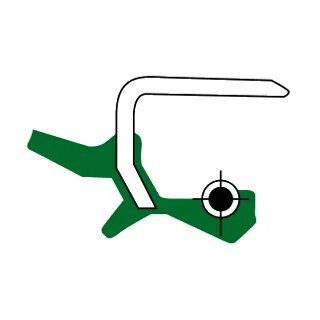
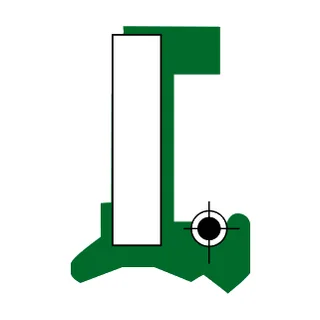
DBH radial shaft seals are an option for oil and gas pumps and compressors. In the Neuquén and Vaca Muerta operation, where equipment is exposed to aggressive fluids and severe service conditions, choosing the right seal directly impacts equipment reliability.
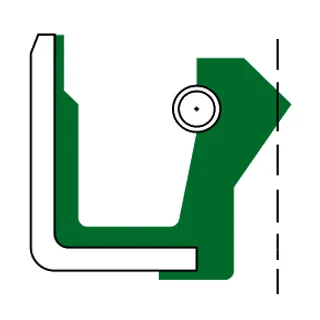
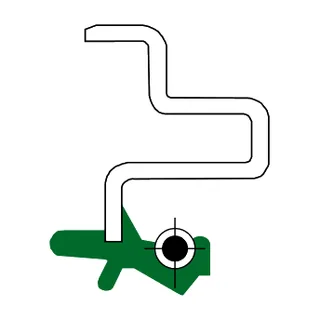
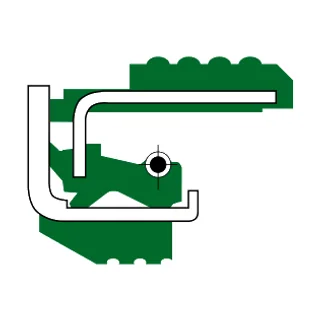
Some examples of DBH radial shaft seal codes from the catalog are 5999, 8888, 8969 and 8987. They are only examples: the exact reference depends on the measurements and material of each piece of equipment.
When ordering a DBH seal for a pump or compressor, it is best to send the code engraved on the old part or, if it cannot be read, the three measurements and a photo. With that information, the equivalent seal in the DBH catalog can be identified and quoted. V-rings and wear sleeves are also available to complete shaft sealing.
When to use a V-ring and wear sleeve
The V-ring is an auxiliary seal mounted on the shaft, outside the main seal, and rotates with it. Its function is to protect the radial shaft seal from external contamination: water, mud, dust and fluid splashes. At Neuquén sites, where equipment is outdoors and there is a lot of suspended dust, the V-ring extends the life of the main seal.
The V-ring is made of elastomer and is stretched to mount on the shaft. It does not require a machined housing: it rests axially against a flat surface, such as the housing cover or the impeller hub. As it rotates, its flexible lip expels contaminants by centrifugal force. It is a simple and economical solution to improve sealing in pumps and compressors.
The wear sleeve, on the other hand, is used when the shaft is already marked by the seal lip. It is a thin steel sleeve that slides over the damaged area and provides a new, polished surface. It is fixed by interference or with an anaerobic adhesive. By mounting the seal on the sleeve, sealing is restored without replacing the shaft, which saves time and maintenance cost.
How to order seals for oil pumps and compressors
To get a quote for a seal for an oil and gas pump or compressor, the most practical way is to send the code engraved on the old part via WhatsApp. If the code cannot be read, the three measurements (shaft, housing, width) and a photo of the seal can be sent. It is also advisable to state the fluid the equipment handles and, if known, the operating temperature.
At MR we supply DBH radial shaft seals and other seals for the oil industry. We work with codes such as 5999, 8888, 8969 and 8987, among many others. If the original seal is from another brand, the DBH equivalent can be requested based on the measurements or the reference code.
For inquiries from Neuquén, Vaca Muerta or any other area, you can write via WhatsApp or email. It is recommended to send a clear photo of the part and, if possible, the brand and engraved code. With that data, the correct seal is identified and the quote is sent promptly.
Frequently asked questions
How do I measure a seal for an oil pump?
Measure the shaft diameter, housing diameter and width, in millimeters. If the old seal is legible, those measurements are usually engraved on the outer face. If not, use a caliper and an inside micrometer. Send the three measurements and a photo via WhatsApp to get a quote.
Which seal material is suitable for sour gas?
For gas with H2S or high temperatures, a fluorinated elastomer such as FKM or Viton® is recommended. Nitrile (NBR) is suitable for crude oil and formation water at moderate temperatures. State the fluid and temperature when requesting a quote to choose the right material.
What is a V-ring and what is it for?
The V-ring is an auxiliary seal mounted on the shaft, outside the main seal. It rotates with the shaft and expels water, mud and dust by centrifugal force. It protects the radial shaft seal and extends its service life on outdoor equipment.
How do I restore a shaft marked by the seal lip?
A wear sleeve is used: a thin steel sleeve that slides over the damaged area and provides a new surface for the lip. It is fixed by interference or with anaerobic adhesive. The seal is then mounted on the sleeve.
Can I order a DBH seal by cross-referencing another brand?
Yes. Send the original brand code or the three measurements (shaft, housing, width) and a photo. With that data, the equivalent DBH seal is identified and quoted.
Products with photos in the catalogue



Keep reading
- DBH seals in Argentina: complete product guide and how to quote them
Discover the DBH radial seal line we distribute in Argentina, their typical applications and how to request a quote with the exact code.
- DBH Codes: Guide to Reading Radial Seal Designations
Understanding DBH seal nomenclature helps you order the correct part. We explain the code structure, what prefixes and suffixes indicate, and how to use real examples for your inquiry.
- DBH Oil Seals: Applications, Selection, Installation and Maintenance for Long Life
DBH radial oil seals are critical components in industrial equipment. In this guide, we cover where they are used, how to choose the right model, and what installation and maintenance care extends their service life.
Continue here
Need a DBH quote?
Send us the DBH part number, the size or a photo of the part and we will get back to you with a quote.