
Blog
How to read DIAMOND chain codes: structure, examples and what data to send
What a DIAMOND chain code says, how it relates to pitch in roller chains, how conveyor chains differ and what data to send for a quote.
DIAMOND catalog by part number
Technical team at MR Accesorios Industriales · Updated on October 18, 2026
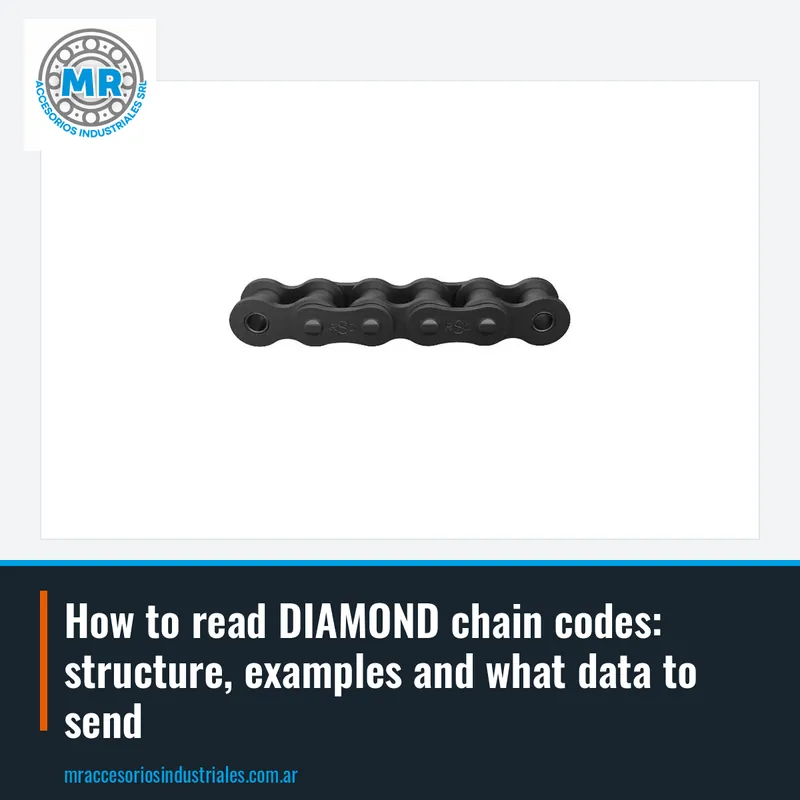
How to read DIAMOND chain codes: the general idea
Knowing how to read DIAMOND chain codes is what separates an order resolved in one message from one full of back-and-forth questions. The code sums up what type of chain it is and, in roller chains, points to the pitch. With the full designation, at MR Accesorios Industriales, Buenos Aires, Argentina, we quote the exact chain without guessing. In this article we go over how it is put together, with real examples of what we sell.
The DIAMOND chains we sell and distribute fall into two types: roller chains for transmission and conveyor chains. Both use short codes made of numbers and letters, but they are not read the same way. That is why the first step is to know which of the two groups the part in your hand belongs to. Then you interpret the code within that group.
A practical starting point: the code is stamped on the chain plates or appears on the box and in the machine documentation. If the chain is very worn and the stamping cannot be read, there is still a way, because with a photo and the measured pitch we can identify it. The important thing is not to assume the code from memory, since one letter difference means another chain.
DIAMOND roller chains: the number in the code and the pitch
In ANSI-numbered roller chains, the first digits of the code indicate the pitch, that is, the distance between the centers of two consecutive pins. The count is in eighths of an inch: a 40 corresponds to four eighths, or half an inch, and a 60 to six eighths, or three quarters of an inch. The codes 40LG and 60LG are two DIAMOND roller chains that start with those numbers. Knowing this lets you quickly check whether the chain you are going to order fits the sprocket.
The pitch is the data that cannot be changed: two chains of different pitch do not mesh on the same sprocket, even if they look alike at first glance. So, before ordering, measure the pitch with a ruler or caliper across several links and divide by the number. Compare the result with the number in the code. If they match, you already have half the identification done.
The number, however, does not say everything. Two chains with the same pitch can differ in width, in plate thickness or in manufacturing variant. That is where the letters that accompany the number come in, in codes such as 40LG, 60LG or 200H, which we look at in the next section. Never order a chain by the number alone if the original machine used a variant with letters.
The letters in the code: why they cannot be ignored
After the number, DIAMOND codes carry letters, as in 40LG, 60LG or 200H. Those letters distinguish one variant from another within the same pitch, and their meaning should not be deduced from memory or by analogy with other brands. Each manufacturer builds its own nomenclature, and the same letter can mean different things depending on the brand. So the simple rule is to copy the full code, letters included.
In practice, this avoids the most common mistake: ordering “a 60 chain” and receiving a variant different from the one the equipment had. If your chain says 60LG, the order is 60LG, not 60. The same applies to 200H, where the final letter is part of the designation and cannot be omitted. With the full code, at MR we quote it as is.
When the code cannot be read, there is another way: send a side and front photo of the chain, the measured pitch and, if you have it, the inner width between plates. With that data we identify the chain and confirm the designation before quoting. It is an identification job that we resolve from the photo and the measurements you send us.
DIAMOND conveyor chains: a different code logic
DIAMOND conveyor chains, such as S81X, 43SB and 63SB, have codes that do not follow the pitch numbering of transmission roller chains. They are chains designed to move material, not to transmit power between two shafts. That is why they are identified with another combination of letters and numbers, which refers to a chain series.
That difference has a practical consequence: it is no use applying the eighths-of-an-inch rule to a conveyor code. An 43SB is not a transmission 43 chain, but a conveyor chain of its own series. You also do not need to decipher the letters: it is enough to copy the code exactly as it appears on the chain or in the equipment sheet.
What is worth noting on a conveyor chain is how it is used: whether it has attachment fittings, how many links the run has and how it closes. That data accompanies the code when you order a conveyor replacement. With the code and that description, the quote comes out without back-and-forth.
Where to find the code and how to copy it correctly
The safest place to read the code is the chain itself: many carry the brand and designation stamped on the outer plates, although with use and grease they become hard to see. Clean with a cloth and look from the side, with raking light. If it does not appear, check the original box, the delivery note from a previous purchase or the equipment documentation.
When copying the code, respect everything: numbers, letters and hyphens. A typical confusion is mixing the letter O with zero, or I with one, especially on worn stampings. What matters is to transcribe exactly what the part says and not what it seems it should say. Taking a sharp photo of the plate avoids the problem.
If you have to replace several chains on the same equipment, note the code of each one separately, with the place where it is mounted. It is common for a machine to carry chains of different pitch or different variants at each stage. Building the list before writing saves a round-trip query and reduces the risk of mixing parts.
Multi-strand chains and chains with attachments
In ANSI numbering, when a roller chain has more than one strand, the pitch number is completed with a hyphen and the number of strands. A double or triple chain of the same pitch keeps the basic dimensions of the single one, but has longer pins to join the strands. That is why a single-strand sprocket does not work for a multi-strand chain: it needs teeth for the corresponding number of strands.
Codes ending in letters can indicate manufacturing variants within the same pitch. MR's criterion is to read the full code, compare it with the part and confirm it before quoting. If the letter changes between two chains of the same pitch, treat them as different chains until confirmed otherwise.
If what you have is a chain with attachments, such as plates with extensions or extended pins, the base code identifies the chain and the attachments are described separately. Send the code, a photo of the attachment and the measurement of the run. That way the complete order is built, instead of ordering the chain without its attachments and discovering it at assembly.
What data to send to quote a DIAMOND chain
The ideal order carries five data points: the full code, the type of chain (transmission or conveyor), the measured pitch, the number of links or the length, and the quantity of chains. With that data it is enough to quote almost any chain. If something is missing, a photo usually fills the gap.
It also helps to say which equipment it goes on: a plant conveyor, an elevator, a transmission from a gearbox or a motor. It is not to complicate the order, but to check that the code you noted makes sense in that application. If you noted a conveyor chain such as S81X for a transmission between shafts, that is a signal to review the code before ordering.
Write to us on WhatsApp or by email with the code, the measurement or a photo of the chain, and we will reply shortly with the quote. MR Accesorios Industriales sells and distributes DIAMOND chains from Buenos Aires, Argentina, and also handles the power transmission your equipment uses. Send the designation exactly as it appears on the part and we will handle the rest.
Frequently asked questions
How is a DIAMOND chain code read?
In roller chains, the first digits correspond to the pitch in eighths of an inch and the final letters distinguish the variant, as in 40LG or 60LG. In conveyor chains, such as S81X or 63SB, the code identifies a series of its own. The safest thing is to copy the full designation exactly as it is on the chain.
What does the 40 or 60 mean in a roller chain?
It is the pitch expressed in eighths of an inch: 40 equals half an inch and 60 equals three quarters of an inch. It is the distance between the centers of two consecutive pins, and it must match the sprocket pitch.
Can I order the chain by the number alone, without the letters?
It is not advisable. The letters distinguish variants within the same pitch, so 60LG and 60 are not the same. To quote the correct chain, send the full code.
How do I identify a chain if the code is worn off?
Send a side and front photo, the pitch measured across several links, the inner width between plates and the number of links. With that data we identify the chain and confirm the designation before quoting.
What data do I send to quote a DIAMOND chain?
The full code, the type of chain (transmission or conveyor), the pitch, the number of links or the length and the quantity of chains. You can send them on WhatsApp or by email, and we will reply shortly.
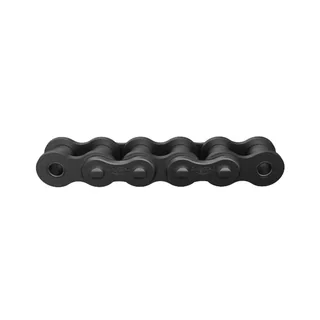
Products with photos in the catalogue
Keep reading
- How to identify a DIAMOND chain by its code and choose the right one
Learn about the DIAMOND chain lines we supply in Argentina: roller chains and conveyor chains. We explain what each one is for and how to quote them by code.
- GUMMI Couplings: Vibration Absorption and Reliable Power Transmission for Industry
GUMMI elastic couplings absorb vibrations and misalignments, protect machinery, and ensure reliable power transmission. Learn about their configurations and how to choose the right model.
- Tsubaki industrial chains: quality, durability and performance for demanding applications
Discover the types of Tsubaki chains we supply: roller, conveyor, leaf, freewheels, couplings and torque limiters. We help you choose the right one for your application.
Continue here
Need a quote?
Send us the code, size or a photo of the part and we'll quote you shortly.