
Blog
How to align pulleys with a laser: a step-by-step maintenance guide
Pulley misalignment wears out belts, pulleys and bearings. We explain how to detect it and correct it with a laser pulley aligner.
SKF bearings in Argentina: guide and quotes
Technical team at MR Accesorios Industriales · Updated on November 14, 2026

Why align pulleys: the misalignment problem
When the pulleys in a belt drive are not aligned, the belt enters the groove at an angle. This makes the belt flanks rub unevenly against the groove walls, and wear accelerates. Before long, noise, vibration and heat appear in the drive area. The belt can turn over or even come off the pulley during operation.
Misalignment also puts stress on the bearings of the motor and the driven machine. Radial and axial loads are no longer distributed as they should be, and the bearings work under strain. Over time, this leads to premature failures and unplanned downtime. That is why aligning pulleys is not a minor detail: it is a preventive maintenance task that protects the entire drive.
In Argentine industry, this problem appears in pumps, compressors, fans, conveyors and any equipment that uses V-belts, toothed belts or Poly-V belts. Often the worn belt is replaced without correcting the cause, and the new belt fails again. A laser pulley aligner lets you see the misalignment on the spot and correct it before it causes greater damage.
Types of pulley and belt misalignment
Pulley misalignment takes three basic forms, and they often appear combined. The first is parallel misalignment or offset: the pulleys are in different planes, meaning one is further forward or further back than the other. The belt enters the groove at a lateral angle and rubs against one of the walls.
The second is horizontal angular misalignment: seen from above, the motor is rotated relative to the driven machine. The shafts are not parallel to each other, and the belt is loaded more on one side. The third is vertical angular misalignment or twist: one shaft is tilted relative to the other, as if the motor were "drooping" to one side. This is usually corrected with shims under the motor feet.
Each type of misalignment leaves its mark on the belt and the pulleys. You see flanks worn on one side only, groove walls worn unevenly, or belts that turn over. Identifying the type of misalignment is the first step to correcting it properly.
The traditional straightedge or string method and its limits
For years, pulley alignment was done by resting a straightedge or a taut string against the faces of the pulleys. The idea is for the straightedge to touch both pulleys at four points, so that they are aligned. It is a simple method that any workshop can use, but it has important limitations. It depends on the eye of the person measuring, and accuracy varies greatly from one person to another.
In addition, the straightedge method fails when the pulleys do not have the same rim width. If one pulley is wider than the other, the straightedge does not rest properly and the reading is misleading. It also becomes difficult with long center distances, where the straightedge flexes or the string sags under its own weight. In those cases, alignment is left to chance.
The laser pulley aligner reduces these limitations. It does not depend on the operator's eyesight and covers longer center distances than a straightedge. It also shows in real time how alignment changes as you move the motor, which greatly speeds up correction. That is why it has become a standard tool in industrial maintenance.
How a laser pulley aligner works
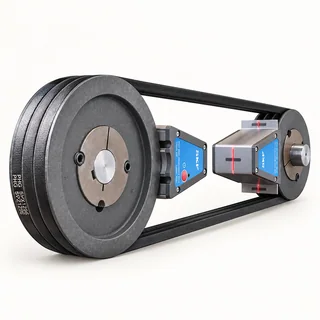
A laser pulley aligner has two units that are attached, one to each pulley. One unit emits a laser line and the other receives it or displays it on its reference targets. Depending on the model, the units rest on the pulley face or directly in the grooves. The laser projects a line that immediately shows whether there is misalignment and of what type.
When you move the motor or adjust its feet, the laser line shifts across the targets. This lets you correct angular misalignment and offset in real time, without the need to measure with a straightedge or make calculations. The operator sees exactly how much remains to be corrected and in which direction. It is a much faster and more repeatable method than the traditional one.
SKF TKBA series pulley aligners, such as models TKBA 10, TKBA 11, TKBA 21, TKBA 31 and TKBA 40, are designed for this work. The model is chosen according to the type of drive and the size of the pulleys. At MR we supply these aligners and help you choose the right one for your equipment.
Step by step to align pulleys with a laser
Before starting, lock out the equipment and follow your plant's safety procedures. Check groove wear and belt condition: if a pulley is worn or damaged, it must be replaced before aligning. Mount the laser aligner units on each pulley according to the manufacturer's instructions. Make sure they are firm and properly seated.
The recommended correction order is: first twist, then horizontal angle, and finally offset. Twist is corrected with shims under the motor feet. Horizontal angle is corrected by rotating the motor with the base's jacking screws. Offset is corrected by moving the motor on its base or shifting the pulley on the shaft.
After correcting, tension the belt according to the manufacturer's specifications. When tensioning, the motor usually moves a little, so recheck alignment with the laser. If necessary, adjust again. This final step is key: many drives end up misaligned precisely because they are tensioned without re-measuring.
Common mistakes and what you gain from good alignment
One of the most common mistakes is aligning by eye and trusting that "it's fine". Another is over-tensioning the belt to hide a misalignment problem: that only adds load to the bearings. Another mistake is replacing only one belt of a set, which leaves the assembly with uneven tensions. And not checking after tensioning is another classic that ruins the work.
A conceptual mistake is using the pulley aligner for directly coupled shafts. Shaft aligners are made for that, and they work on a different principle. The pulley aligner is intended for belt drives, not for rigid or flexible couplings. Using the wrong tool leads to erroneous conclusions.
With pulleys properly aligned, belts and pulleys last longer, noise and vibration decrease, and there is less unplanned downtime. Maintenance becomes more predictable and bearings work under better conditions. In short, laser alignment translates into fewer failures and less downtime.
Which aligner to choose and how to get a quote at MR
SKF TKBA series pulley aligners are recommended according to the type of drive. The series codes are TKBA 10, TKBA 11, TKBA 21, TKBA 31 and TKBA 40. The model is chosen according to the type of belt, the size of the pulleys and the center distance. At MR we help you choose the correct model for your application.
To get a quote, send us your drive data by WhatsApp or email: belt type (V-belt, toothed or Poly-V), pulley diameter and center distance. With that information we tell you which aligner is suitable. You can also send a photo of the drive if you do not have all the data at hand.
At MR we sell and distribute SKF pulley aligners in Buenos Aires, Argentina. If you already know which model you need, send us the code and we will quote it promptly. Our technical team guides you in choosing and correctly using the tool.
Frequently asked questions
What is a laser pulley aligner?
It is a maintenance tool that uses a laser to show the misalignment between two pulleys in a belt drive. It consists of two units that are attached to the pulleys: one emits the laser line and the other receives it or displays it on targets. It lets you see in real time whether there is parallel misalignment, angular misalignment or twist, and correct it by moving the motor.
How do you use a laser pulley aligner?
The two units are mounted on the pulleys, one emitting and one receiving. The laser is turned on and the line is observed on the targets. Then twist is corrected first with shims, then horizontal angle with the jacking screws, and finally offset. The belt is tensioned and alignment is checked again.
What types of pulley misalignment are there?
There are three basic types: parallel misalignment or offset (the pulleys are in different planes), horizontal angular (the motor is rotated when seen from above) and vertical angular or twist (one shaft is tilted relative to the other). They often appear combined and all of them wear out the belt and pulleys prematurely.
What is the difference between a pulley aligner and a shaft aligner?
The pulley aligner is designed for belt drives and rests on the pulleys. The shaft aligner is used for direct couplings between shafts, such as in coupled pumps or motors. Using the wrong aligner leads to incorrect measurements.
Where can I buy an SKF laser pulley aligner in Argentina?
At MR Accesorios Industriales, in Buenos Aires, Argentina, we sell and distribute SKF TKBA series pulley aligners. You can get a quote by WhatsApp or email by sending the belt type, pulley diameter and center distance, or directly the code of the model you need.
Products with photos in the catalogue




Keep reading
- SKF Chains: Reliable Power Transmission for Industrial Applications
SKF roller chains offer strength and precision for power transmission in industrial machinery. Learn about the PHC series, ASA and BS standards, and how to identify the correct chain for your equipment.
- SKF tools for industrial maintenance: pullers, heaters, aligners and calibrated shims
SKF tools simplify bearing mounting and dismounting, shaft alignment and instrument calibration. Discover TMMA and TMHP pullers, induction heaters, TKSA aligners and calibrated shims.
- How to Choose SKF Bearings by Application: Load, Speed, Environment, and Mounting
Choosing the right SKF bearing requires analyzing load, speed, environment, and mounting. We explain the main types and how to get a quote with the exact code.
Continue here
Need a SKF quote?
Send us the SKF part number, the size or a photo of the part and we will get back to you with a quote.