
Blog
Hot bearing mounting: induction heater, oil bath or heating plate
Oil bath, heating plate or induction heater: we compare the three methods for hot mounting bearings, with their risks, and tell you which is best depending on bearing size and workplace.
SKF bearings in Argentina: guide and quotes
Technical team at MR Accesorios Industriales · Updated on November 14, 2026
Why a bearing is heated for mounting
Hot bearing mounting is used when the bearing has an interference fit on the shaft: the bore is slightly smaller than the seat and it will not go in cold. Heating the bearing expands the bore and the part slides to its stop without blows. When it cools, it sits firm on the shaft and ready to work.
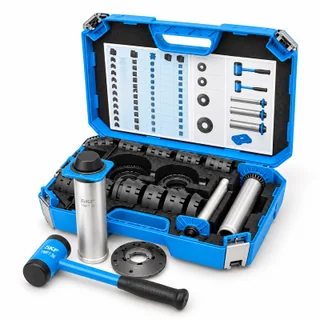
On small bearings, mounting can be done cold with a mounting tool, such as the TMFT 36, which pushes the correct ring with a sleeve and an impact ring. As the bearing grows, the required force rises and cold mounting stops being practical. There it is better to heat, which is gentler on the bearing and the shaft.
There are three common ways to heat a bearing: the oil bath, the heating plate and the induction heater. All three seek the same thing, an even and controlled temperature, but they differ in safety, cleanliness and time. In this note we compare them so you can choose the method according to your bearings and your workplace.
Oil bath: the traditional method
The oil bath is the method with which bearings were mounted for decades. The bearing is submerged in clean oil inside a container that is heated, and it takes temperature evenly. It must rest on a grid or be hung, without touching the bottom, because the bottom of the container is hotter than the oil.
Its disadvantages explain why it is used less and less. Working with hot oil brings risk of burns and fire, and forces you to wait for the whole bath to reach temperature. The oil degrades with heating, collects dirt and can contaminate the new bearing. It also leaves a residue that must be disposed of properly.
Nor does it work for any bearing. Sealed or capped bearings that come greased are not submerged, because the oil washes or alters their grease. And a bearing that comes out dripping oil is uncomfortable and slippery to carry to the shaft. If your workshop still uses the bath, check the temperature with a thermometer and renew the oil often.
Electric heating plate: for small bearings
The heating plate is an electric surface with a thermostat on which bearings are placed. It handles small parts well and allows heating several at once, for example when assembling a batch of motors. It is clean, uses no oil and takes up little space on the workbench.
Its limit is that it heats by contact, from one side only. For the bearing to take temperature evenly it must be turned during heating, and it is better to measure on the bearing instead of relying only on the plate thermostat. With large parts the process becomes slow and heat reaches the inner ring unevenly.
It also requires operator attention. A forgotten bearing on the plate keeps rising in temperature, and a part placed on a dirty plate picks up that dirt. As a resource for small bearings it is valid. For medium and large bearings, or when there are many mountings, it falls short.
Induction heater: heats the part, not the equipment
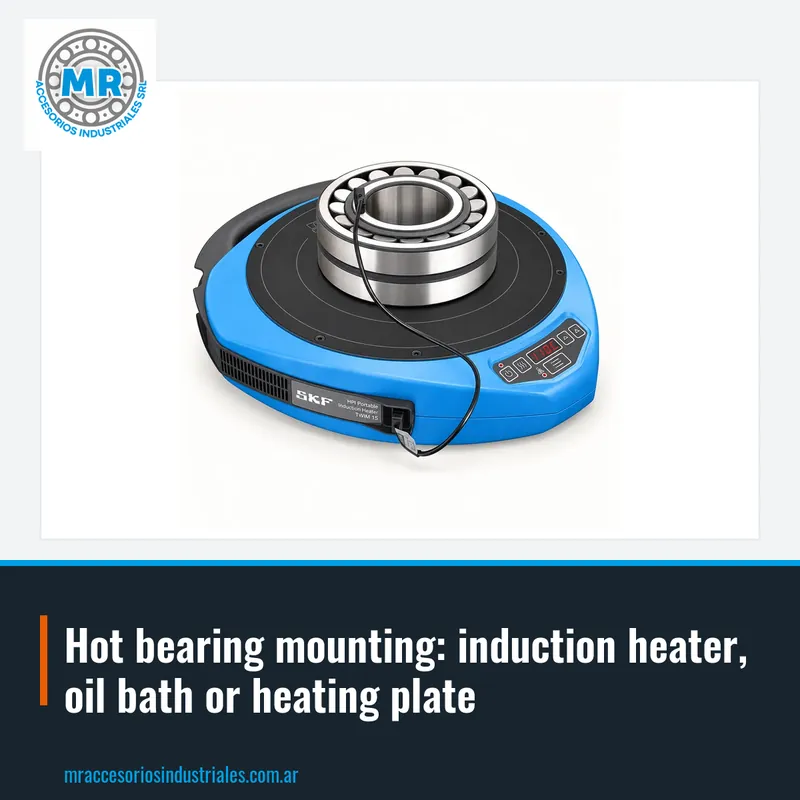
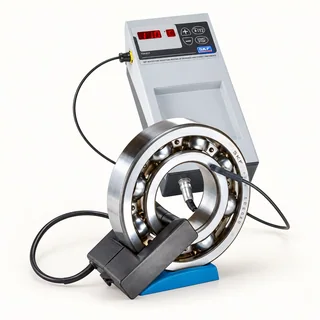
The induction heater works with a magnetic field that induces current in the bearing itself. What heats is the part, not the equipment or the environment. There is no oil or flame, the bearing comes out clean and dry, and heating is quick even on medium and large parts.
Control is its other advantage. A magnetic probe placed on the inner ring measures the actual temperature, and the equipment stops the cycle when it reaches the set value. At the end, the heater demagnetizes the bearing, so it does not attract metal particles. The operator does not have to watch the clock or the thermometer.
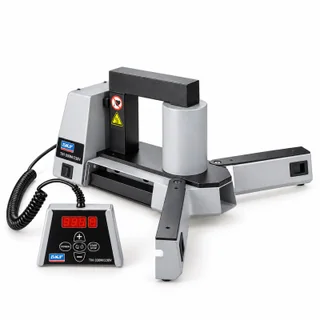
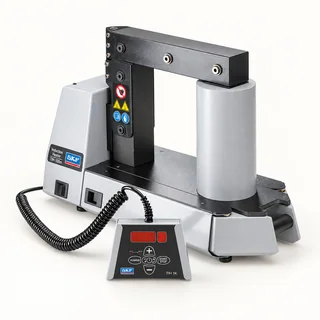
There are equipment options for each way of working. Bench heaters, such as the TIH 030M/230V and the TIH 100M/230V, stay in the workshop and receive the bearing on their yoke. Portable ones, such as the TMBH 1 and the TWIM 15/230V, are taken next to the machine, so the bearing does not cool on the way.
Which method is best according to the bearing and the place
For small bearings and few mountings per month, cold mounting with a tool or a heating plate is enough. When the bearings are medium or large, induction is the method that heats evenly in a reasonable time. And if mountings are frequent, the induction heater organizes the work: the same procedure and the same temperature every time.
The type of bearing also decides. Sealed or capped bearings that come greased do not go into the oil bath, and have a lower temperature limit, given by the manufacturer. With induction and probe that limit is set on the equipment and respected without relying on the eye. On open bearings, induction also avoids contaminating the part before greasing it.
Finally, look at where the mounting is done. In the workshop, a bench heater covers most cases. In the field, on a machine that cannot be moved, a portable one that heats the part next to the shaft is better. The oil bath, on the other hand, is difficult to move and to use safely outside the workshop.
Mounting temperature and what is never done
Most mountings are done with the bearing at about 110 °C. That temperature expands the bore enough for it to enter the shaft without effort. It is not advisable to exceed 125 °C, because the bearing steel and its lubricant can be altered. This applies to all three methods: what changes is how easy it is to control the temperature.
What is never done is heating with a direct flame. The torch heats unevenly, leaves zones much hotter than others, can change the hardness of the steel and burns the lubricant. A bearing heated this way can look fine and fail shortly after. Nor is it overheated to gain margin: excess temperature damages the part.
The other mistake is hitting the bearing to make it finish entering. If the part stops halfway on the seat, it is because it cooled or because it did not reach temperature. The right thing is to remove it, heat it again and mount it in one go, pushing against the stop and holding it until it grips. Always with thermal protection gloves and without rushing.
How to get a quote for a bearing heater at MR
At MR we market and distribute SKF induction heaters, bench and portable, and cold mounting tools. To recommend equipment we need to know which bearings you mount. Send us the code of the largest and the smallest bearing: those two data define the heater size.
It also helps to know how many mountings you do per month, whether the work is in the workshop or in the field and what voltage is available in your plant. A motor workshop that mounts bearings every day is not the same as a plant that changes a few at each shutdown. With that information we indicate the model and its accessories.
Write to us by WhatsApp or email with the codes, or with a photo of the bearing and the workplace. We will reply promptly with the quote for the heater that corresponds to your case. We work with genuine SKF product, from Buenos Aires, Argentina.
Frequently asked questions
At what temperature is a bearing mounted hot?
Most mountings are done at about 110 °C and it is not advisable to exceed 125 °C. Sealed or capped bearings that come greased have a lower limit, given by the manufacturer.
Can a bearing be heated in oil?
Yes, the oil bath is the traditional method and heats evenly, but it has risk of burns and fire, can contaminate the bearing and does not work for sealed ones. That is why induction is preferred today.
What is a bearing heating plate for?
To heat small bearings, even several at once. The part must be turned and the temperature measured on the bearing. For medium or large parts it is slow.
Why is a torch not used to mount bearings?
Because the direct flame heats unevenly, can change the hardness of the steel and burns the lubricant. The bearing is damaged even if it is not noticeable at first sight.
Which induction heater is best for field work?
A portable one, such as the TMBH 1 or the TWIM 15/230V, which is taken next to the machine. Send us the code of the largest and the smallest bearing and we will indicate the equipment.
Products with photos in the catalogue

Keep reading
- SKF Chains: Reliable Power Transmission for Industrial Applications
SKF roller chains offer strength and precision for power transmission in industrial machinery. Learn about the PHC series, ASA and BS standards, and how to identify the correct chain for your equipment.
- SKF tools for industrial maintenance: pullers, heaters, aligners and calibrated shims
SKF tools simplify bearing mounting and dismounting, shaft alignment and instrument calibration. Discover TMMA and TMHP pullers, induction heaters, TKSA aligners and calibrated shims.
- How to Choose SKF Bearings by Application: Load, Speed, Environment, and Mounting
Choosing the right SKF bearing requires analyzing load, speed, environment, and mounting. We explain the main types and how to get a quote with the exact code.
Continue here
- SKF
- Induction heaters
- SKF tools
- How an induction bearing heater works and at what temperature a bearing is mounted
- SKF TIH heater: how to choose between TIH 030M, TIH 100M and TIH 220M
- Accessories for SKF TIH heater: TIH P20 probe, TIH RC remote control and spare parts
- Search for a code in the catalog
- Blog
Need a SKF quote?
Send us the SKF part number, the size or a photo of the part and we will get back to you with a quote.