
Blog
DIAMOND chain assembly and disassembly: tools, steps and common errors that shorten service life
A practical guide to assembling and disassembling DIAMOND roller and conveyor chains without damaging components: which tools to use, what to measure and what to avoid.
DIAMOND catalog by part number
Technical team at MR Accesorios Industriales · Updated on November 11, 2026
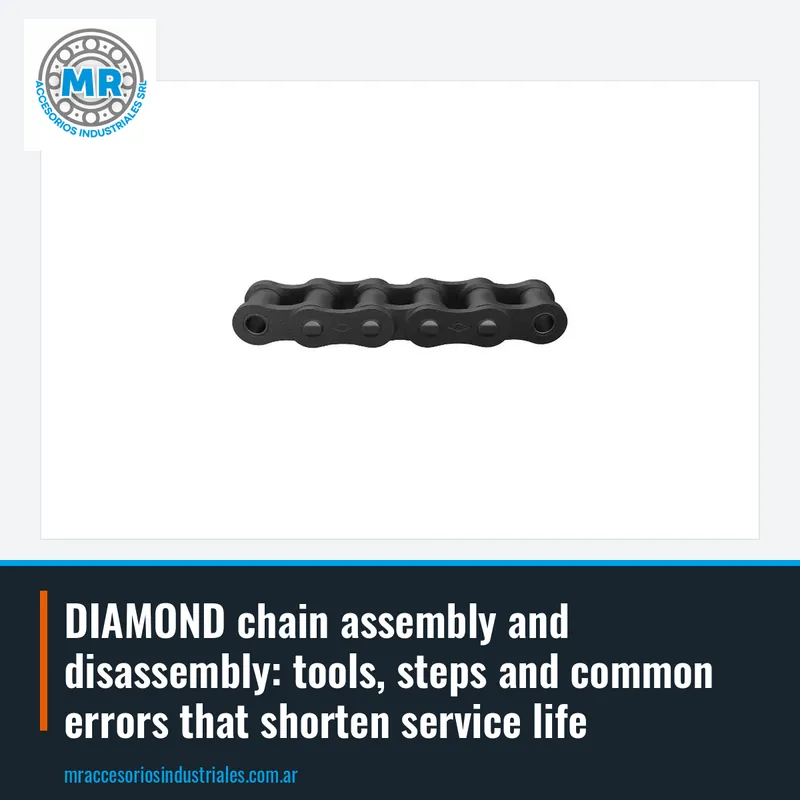
What you need to assemble or disassemble a DIAMOND chain
Before working on a DIAMOND chain drive, it is best to gather the right tools so you do not damage links or joints. For roller chains such as 40LG or 60LG, the most practical tool is a chain breaker that pushes the pin in a controlled way. Pliers for external retaining clips, open-end wrenches and a caliper to check pitch and wear are also used.
On conveyor chains such as S81X or 43SB, a spare section of links is often needed to adjust length. Field assembly usually requires a clean table or surface, good lighting and fastening elements to keep the chain aligned. Never strike the pins directly with a hammer: this deforms the metal and compromises the joint.
If you are going to replace a complete chain, measure the pitch and inner width to confirm the model before disassembling. If the code stamped on the side plates has worn off, that is not a problem. Send us a photo of the chain and the sprocket, along with the center distance, and we will quote the exact replacement.
How to disassemble a DIAMOND roller chain without damaging it
To disassemble a roller chain such as 200H, first locate the connecting link or the detachable link. If it has an external retaining clip, remove it with fine pliers and then take off the cover plate. If it is a press-fit link, use the chain breaker to push the pin out evenly, without tilting the tool.
When the chain is very worn or rusty, the pins may be stuck. In that case, apply a penetrating oil and let it act before forcing. Never heat the chain with a torch: heat alters the surface treatment of the links and reduces strength. If the pin does not come out with the chain breaker, check that the tip of the push pin is the correct diameter.
Once the chain is separated, inspect the inner and outer links. If you see cracks, wear in the holes or loose rollers, it is best to replace the entire section. On conveyor chains such as 63SB, pay attention to the bolts and connecting plates before forcing any part.
Step-by-step assembly of a DIAMOND roller chain
To assemble a DIAMOND roller chain, first route it over the sprockets and join the ends with the connecting link. If you use a press-fit link, insert the pins into the plate holes and press with the chain breaker until they are flush. Then install the cover plate and the retaining clip, checking that the clip is properly seated in the groove.
On chains such as 40LG or 60LG, the connecting link usually comes with a spring clip. That clip must be installed with the opening facing backward relative to the direction of rotation, so that centrifugal force does not dislodge it. If the chain operates in a vibrating environment, you can use a riveted link, which is safer for heavy-duty applications.
After assembly, turn it manually several revolutions to verify that there are no tight spots or rubbing. Adjust tension according to the recommendation for the type of drive. If the chain is too tight, pin and bushing wear accelerates; if it is too loose, it can jump a tooth.
Assembly of DIAMOND conveyor chains: specific considerations
DIAMOND conveyor chains, such as S81X or 43SB, are usually installed in long sections and with attachments such as flights, pushers or guides. Before joining the ends, verify that all links are oriented the same way and that the attachments match the conveyor pitch. A twisted chain or mispositioned attachments create uneven loads.
In these cases, the connecting link may be riveted or use a bolt and nut. If it is riveted, use a suitable riveting tool so as not to deform the pin. If it uses a bolt, tighten the nut to the specified torque and install a lock or jam nut to prevent it from loosening under vibration.
After assembly, run the conveyor empty and observe how the chain enters the sprockets. If the chain tends to climb or come off, check shaft alignment and the condition of the teeth. Incorrect alignment is the most common cause of premature failure in conveyor chains.
Common errors that shorten the service life of a DIAMOND chain
One of the most frequent errors when assembling DIAMOND chains is using the wrong connecting link. Each series has a specific pitch and width; if you mix links from different series, the chain will not seat properly on the sprocket and will wear quickly. Always check the code stamped on the plates, such as 40LG or 60LG.
Another common error is over-riveting the connecting pins. If the rivet is too tight, the link loses mobility and creates a tight spot that overloads neighboring links. If it is too loose, the pin can come out while running. The riveting tool must have the correct die for the pin diameter.
Another mistake is not lubricating the new chain before the first start-up. It should be well lubricated at the articulation points. In dusty or humid environments, inadequate lubrication accelerates wear and can cause seizure.
How to identify your DIAMOND chain model to order spare parts
To order a DIAMOND chain, the most useful thing is to read the code stamped on the side plates. For example, a roller chain may say 40LG or 200H, and a conveyor chain S81X or 63SB. If the code is not legible, measure the pitch (distance between centers of two consecutive pins) and the inner width between plates.
With those two measurements you can identify the corresponding ANSI or metric series. Standard roller chains follow the ANSI standard: series 40 has a pitch of 1/2 inch, 50 of 5/8, 60 of 3/4 and 80 of 1 inch. Conveyor chains may have special pitches and attachments, so it is best to send a photo of the complete link.
If you have the sprocket, count the teeth and measure the outside diameter. That helps confirm the chain pitch. It is also useful to know the number of links or the total length. With that data we will quote the exact DIAMOND chain for your application, without the need to bring a sample.
When to replace the DIAMOND chain instead of repairing it
A DIAMOND chain can be repaired by replacing a damaged section, but if wear is widespread it is best to replace it completely. To evaluate wear, measure chain elongation over a section of several links. If elongation exceeds what is allowed for that series, the chain no longer seats properly on the sprocket and wears the teeth.
On conveyor chains such as S81X, wear shows in the bushings and plates. If the rollers do not turn freely or there are visible cracks, it is time to replace. Repairing an old chain with new links creates pitch differences that accelerate failure.
Whenever you replace the chain, check the condition of the sprockets. A sprocket with hook-shaped teeth or uneven wear ruins a new chain in a short time. If the sprocket is worn, we will also quote the replacement so that the drive remains matched.
Frequently asked questions
How do you disassemble a DIAMOND chain without special tools?
You can use a punch and a small hammer, but it is easy to damage the pin or plate. It is best to use a chain breaker, which pushes the pin in a controlled way. If the chain has a retaining-clip link, you only need fine pliers to remove the clip.
What is the difference between a press-fit connecting link and a riveted one?
The press-fit link is assembled by pressing the pins and installing a safety clip. It is practical for maintenance. The riveted link is secured by deforming the end of the pin, which makes it safer for applications with vibration or heavy loads.
How do I know which DIAMOND chain my machine uses?
Look for the code stamped on the side plates, such as 40LG or 60LG. If it is not legible, measure the pitch between pins and the inner width. With that data you can identify the ANSI series. You can also send us a photo of the chain and sprocket, and we will help you identify it.
Can I join two sections of DIAMOND chain from different series?
It is not recommended. Each series has a specific pitch and width, and mixing sections from different series creates a weak point that wears quickly and can damage the sprocket. Always use links from the same series and, if possible, the same brand.
How often should a DIAMOND chain be lubricated?
It depends on the working conditions: load, speed, temperature and the presence of dust or moisture. In dusty or humid environments, lubricate more frequently and use a suitable chain lubricant. If you have doubts, write to us and we will guide you.
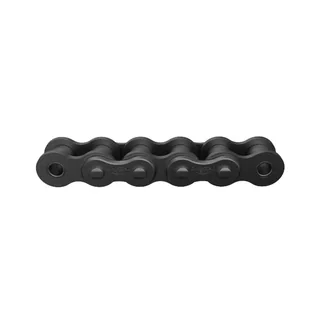
Products with photos in the catalogue
Keep reading
- How to identify a DIAMOND chain by its code and choose the right one
Learn about the DIAMOND chain lines we supply in Argentina: roller chains and conveyor chains. We explain what each one is for and how to quote them by code.
- How to read DIAMOND chain codes: structure, examples and what data to send
What a DIAMOND chain code says, how it relates to pitch in roller chains, how conveyor chains differ and what data to send for a quote.
- Where DIAMOND chain is used and how to choose it for your equipment
We review typical applications of DIAMOND chains in Argentine industry, how to identify the correct model and what care extends their useful life.
Continue here
Need a DIAMOND quote?
Send us the DIAMOND part number, the size or a photo of the part and we will get back to you with a quote.