
Blog
Where DIAMOND chain is used and how to choose it for your equipment
We review typical applications of DIAMOND chains in Argentine industry, how to identify the correct model and what care extends their useful life.
DIAMOND catalog by part number
Technical team at MR Accesorios Industriales · Updated on October 26, 2026
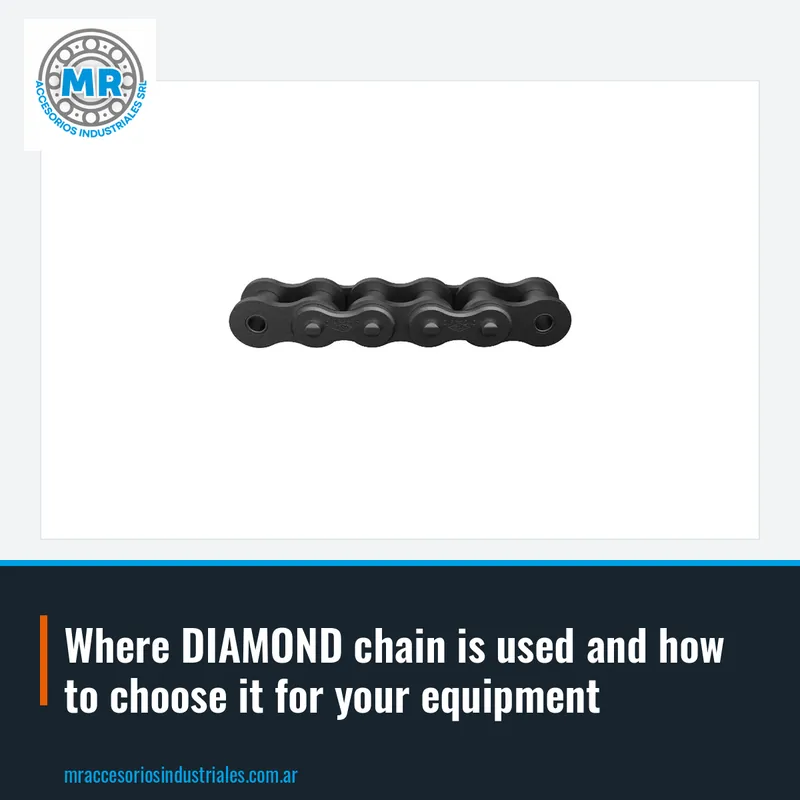
What is a DIAMOND chain and what is it for
DIAMOND chains are power transmission elements used in countless machines and industrial equipment. Their main function is to transmit motion and force between separated shafts, maintaining a constant speed ratio. Unlike belts, they do not slip and withstand high loads without stretching. That is why they are the chosen option in drives that require precision and durability.
In Argentine industry you find them in conveyors, elevators, agricultural machinery, packaging equipment, production lines and material handling systems. They are also used in dusty and humid environments, where chain selection and maintenance matter even more.
Within what we distribute from DIAMOND there are two main groups: standard roller chains and conveyor chains. The former are used to transmit power between sprockets, while the latter are designed to drag or move loads on guides or roller paths. At MR we distribute both lines and help you identify the exact model according to the equipment and application.
DIAMOND roller chains: applications and selection
DIAMOND roller chains are the most common in power transmissions. They are identified by the pitch, which is the distance between centers of two consecutive pins, and by the inner width between plates. For example, 40LG, 60LG and 200H are DIAMOND roller chain codes you can consult us about.
To choose the correct chain you must look at the pitch, the number of strands and the type of link. A single chain has one row of rollers, but there are double or triple versions to transmit more power. The number of strands and the type of link depend on the power and the space available in the transmission.
A common mistake is to order the chain only by length or by roller diameter. It is always better to measure the pitch and inner width, or directly read the code stamped on the side plates. If the chain is very worn and unreadable, send us a photo with a ruler next to it and we will help you identify it. At MR we quote the exact DIAMOND chain for your equipment, without hassle.
DIAMOND conveyor chains: how to identify them
DIAMOND conveyor chains are designed to move materials or products along a line. Unlike standard roller chains, they usually have wider plates, flanges or attachments to hold the load. They are used in slat conveyors, bucket elevators, continuous furnaces, paint lines and sorting systems.
To identify a conveyor chain you must look at the pitch, plate width and type of attachment. Some DIAMOND conveyor chain codes are S81X, 43SB and 63SB; with the code or the measurements of your current chain we quote the corresponding one.
An important detail is that these chains usually work with special sprockets or toothed wheels, which are not always the same as those for standard roller chains. Therefore, when ordering a conveyor chain it is advisable to also check the condition of the sprockets and, if necessary, quote them together. At MR we distribute DIAMOND conveyor chains and advise you on the correct model.
Assembly and maintenance of DIAMOND chains
Correct assembly is key for the DIAMOND chain to last. The chain must have an adequate sag or catenary: neither too tight nor too loose. Excessive tension generates loads on the rollers and bushings, while a loose chain can jump the sprocket teeth or hit the structure. The adequate sag depends on the center distance and the position of the transmission.
Lubrication is the other determining factor. Chains in service need periodic re-lubrication. The type of lubricant depends on the speed and working temperature: light oils for high speeds, greases or heavy oils for low speeds and high loads. In dusty or dirty environments, clean the chain before lubricating to avoid forming an abrasive paste.
A frequent mistake is to join a new chain with a link from another brand or another pitch. Although it may seem similar, the tolerances do not match and premature wear points are generated. Always use DIAMOND connecting links of the same pitch and series. If you have doubts about assembly or maintenance, at MR we guide you with the basic care for your application.
How to order a DIAMOND chain without mistakes
To quote a DIAMOND chain we need some basic data. The most practical is to send the complete code if you have it, for example 40LG or S81X. If you do not have it, measure the pitch (distance between centers of two pins) and the inner width between plates. With these two measurements we can already identify the series and size. A photo of the old chain next to a ruler or a reference object also helps.
In addition to the code, it is advisable to indicate the number of links or the total length you need. If the chain works with sprockets, also send us the number of teeth or the outer diameter of the sprocket to verify compatibility. For conveyor chains, indicate if it has welded attachments or flanges.
A common mistake is to order a chain by the equipment brand and not by the chain code. Although we can search for equivalences by application, it is much safer to start from the code or measurements. At MR we quote the DIAMOND chain you need and, if you have doubts, we ask for the right data to avoid mistakes.
Advantages of using DIAMOND chains in your equipment
When the transmission already uses DIAMOND chains, replacing with the same code avoids pitch and measurement errors. A well-chosen, well-assembled and well-lubricated chain reduces wear and extends the useful life of the entire transmission.
Another advantage is that there are roller chains and conveyor chains, which allows solving both power transmission and load dragging with the same brand.
At MR, from Buenos Aires, Argentina, we help you choose the correct model and quote the section you need. If your equipment already uses DIAMOND chains, keeping the same brand simplifies replacement with existing sprockets.
Frequent questions about DIAMOND chains
Many inquiries come from chains that break or stretch prematurely. In most cases the problem is not the chain itself, but poor shaft alignment, worn sprockets or lack of lubrication. Before replacing the chain, it is advisable to check the entire transmission system to avoid repeating the failure. At MR we guide you on what to check.
Another frequent doubt is whether a DIAMOND chain can be used with sprockets of another brand. In general yes, as long as the sprockets are in good condition and have the same pitch as the chain. If in doubt, send us the chain and sprocket data and we will verify it.
We are also asked about special chains. There are applications that require chains with welded attachments, extended pins or special materials. In those cases, we ask for a sample or a drawing and look for the alternative within the DIAMOND line or other brands we work with. We always respond promptly with a concrete proposal.
Frequently asked questions
How do I know which DIAMOND chain my machine uses?
The easiest way is to read the code stamped on the side plates of the old chain. If it is unreadable, measure the pitch (distance between centers of two pins) and the inner width. With that data we identify the exact model.
Are DIAMOND chains compatible with sprockets of another brand?
In general yes, as long as the sprockets have the same pitch as the chain and are in good condition. Send us the data and we will verify it.
How often should a DIAMOND chain be lubricated?
It depends on speed, load and working environment. In dusty or humid environments, check lubrication more frequently. Tell us your application and we will guide you.
Can I order a DIAMOND chain cut to size?
Indicate the code and the total length or number of links you need and we will quote it.
What should I do if the chain stretches or breaks frequently?
First check shaft alignment, sprocket condition and lubrication. If the system is fine, the chain may be undersized for the load. At MR we help you evaluate whether to move to a larger pitch or double-strand chain.
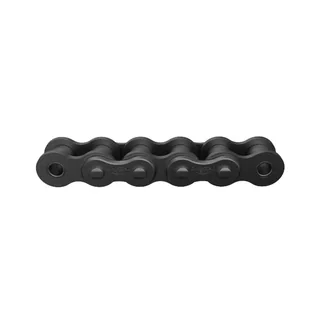
Products with photos in the catalogue
Keep reading
- How to identify a DIAMOND chain by its code and choose the right one
Learn about the DIAMOND chain lines we supply in Argentina: roller chains and conveyor chains. We explain what each one is for and how to quote them by code.
- How to read DIAMOND chain codes: structure, examples and what data to send
What a DIAMOND chain code says, how it relates to pitch in roller chains, how conveyor chains differ and what data to send for a quote.
- GUMMI Couplings: Vibration Absorption and Reliable Power Transmission for Industry
GUMMI elastic couplings absorb vibrations and misalignments, protect machinery, and ensure reliable power transmission. Learn about their configurations and how to choose the right model.
Continue here
Need a DIAMOND quote?
Send us the DIAMOND part number, the size or a photo of the part and we will get back to you with a quote.