



TSUBAKI guide
What Tsubaki manufactures and what it stands out for
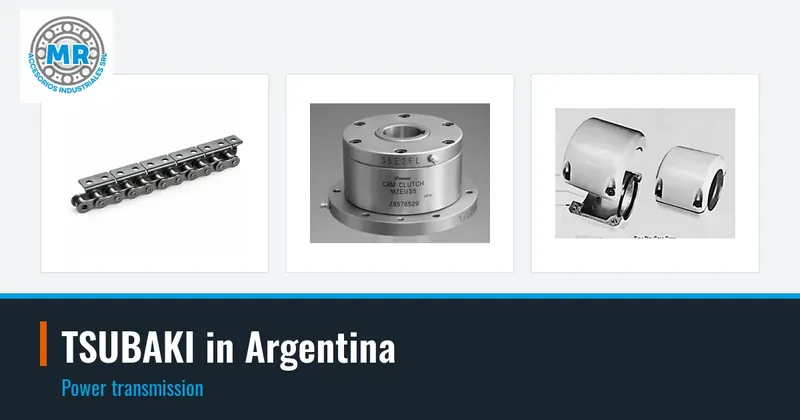
Tsubaki is a brand specialized in power transmission: it manufactures roller chains, conveyor chains, leaf chains, freewheels, couplings and torque limiters. Its products are used in industrial machines, conveying equipment and production lines where motion and force need to be transmitted reliably.
In the chain sector, Tsubaki stands out for the variety of pitches and configurations: from single-strand to multiple-strand chains, with anti-corrosion and heavy-duty options. Freewheels allow rotation in one direction and lock reverse motion, while chain couplings absorb misalignments and vibrations. Torque limiters protect the transmission against overloads.
In Argentina, Tsubaki products are present in industries such as food, metallurgy, mining, cement, automotive and paper, among others. Their robust design makes them suitable for maintenance and new projects.
Tsubaki lines distributed by MR
MR Accesorios Industriales distributes Tsubaki products in the Power transmission category, with the following subcategories:
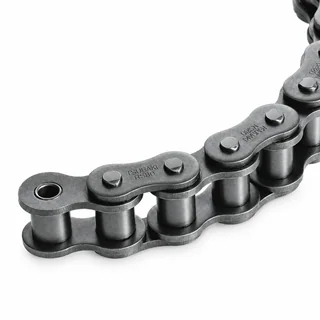
Roller chains
Includes RS, RF and other series, for power transmission in industrial machines.
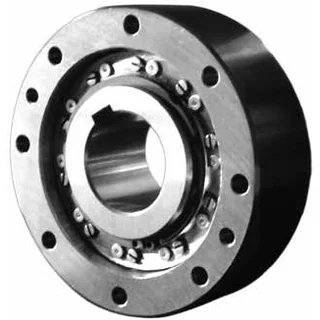
Freewheels
One-way rotation mechanisms to prevent reverse motion and control advances.
Conveyor chains
Chains for material movement in conveyors and elevators.
Leaf chains
Chains with articulated plates for high loads and low speeds.
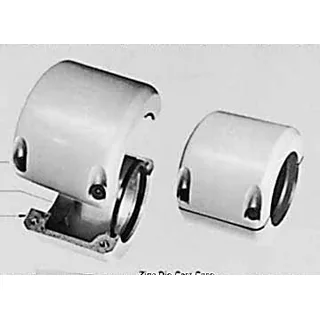
Couplings
Roller chain couplings to join shafts and absorb small misalignments.
Torque limiters
Safety devices that disengage the transmission under overloads.
Main Tsubaki series
Tsubaki organizes its products into series identified by letters and numbers. These are some of the series in the MR catalog:
RS series (roller chains)
Standard roller chain according to ANSI standard. The number indicates the pitch and the suffix the number of strands. Examples: RS25, RS35.
RF series (conveyor and roller chains)
Conveyor chain for material movement. Includes variants such as RF204, RF205 and RF450BR. Examples: RF204, RF06B.
MZEU series (freewheels)
Cam freewheel with shaft mounting. The -K suffix indicates mounting configuration. Examples: MZEU12-K, MZEU15-K.
BR series (freewheels)
Cam freewheel from the BR line. Examples: BR15HT-R31A, BR18HT-R38A.
BREU series (freewheels)
Cam freewheel from the BREU line, with mounting variants. Examples: BREU30-K, BREU35-K.
BL series (leaf chains)
Leaf chain from the BL series, with higher capacity than the AL series. Examples: BL 422, BL 423.
CR series (couplings)
Roller chain coupling. Examples: CR3812, CR4014.
AL series (leaf chains)
Leaf chain from the AL series, the light line of leaf chains. Examples: AL 422, AL 444.
BB series (freewheels)
Compact freewheel from the BB line. Examples: BB15, BB17.
How to read a Tsubaki code
Tsubaki codes combine letters that identify the series and numbers that indicate size, pitch or configuration. Knowing the structure helps you order the correct replacement.
Example: RS25-1
RS identifies the roller chain series; 25 indicates the pitch according to ANSI standard; the -1 suffix indicates it is single-strand. If it were -2 it would be double-strand.
Example: MZEU12-K E1+E2
MZEU is the cam freewheel line; 12 is the size; K and E1+E2 are line variants that define the exact configuration of the unit, so it is best to always order the complete code.
Example: CR4014
CR identifies roller chain coupling; the first two digits (40) correspond to the chain size and the last two (14) to the number of teeth on the hubs. Suffixes such as K or H, in CR4014K or CR4014H, identify coupling variants.
Example: BL 422
BL identifies heavy series leaf chain; in 422 the first digit corresponds to the size (pitch) and the next two to the plate assembly (2 x 2).
Frequent Tsubaki prefixes and suffixes
Suffixes in Tsubaki codes provide key information about the product configuration. These are some of the most common:
-1, -2, -3, -4
Indicate the number of strands in roller chains. For example, RS25-1 is single, RS25-2 double.
-K
In freewheels, identifies a line variant. For example, MZEU12-K.
-NP
In roller chains, indicates nickel-plated chain, with anti-corrosion protection. For example, RS08B-NP-1.
-R
In conveyor chains, distinguishes a series variant. For example, RFD03100-R.
E1+E2, E2+E3
In freewheels, identify unit variants; it is best to always order the complete code.
Applications by industry in Argentina
Tsubaki products are used in a wide variety of industries in Argentina. These are some of the most relevant:
Metallurgy
Roller and leaf chains for furnace drives, roller tables and scrap conveyors.
Agriculture
Chains for harvesters, augers, grain elevators and processing equipment.
Naval
Chains and couplings for cranes, deck equipment and auxiliary conveyors.
Oil
High-strength chains for pumps, drilling rigs and extraction equipment.
Food
Conveyor and roller chains with anti-corrosion options for packaging and processing lines.
Mining
Leaf and conveyor chains for feeders, elevators and mineral conveyors.
Paper
Chains for roll conveyors, drying systems and pulp handling.
Cement
Conveyor and leaf chains for bucket elevators and conveyors.
Energy
Chains and couplings for conveyors and auxiliary transmission systems in power plants.
Automotive
Roller chains for assembly lines, conveyors and painting equipment.
Plastics
Chains for part conveyors and mold transport systems.
Cold storage
Conveyor and roller chains for slaughter lines, cold rooms and packaging.
Sugar
Chains for cane conveyors and process equipment.
How to choose the right Tsubaki
Selecting the right Tsubaki component requires evaluating several application factors. These are the main criteria:
Load and torque
Determine the power to transmit and dynamic loads. For chains, consider the pitch and number of strands; for couplings, the nominal torque.
Speed
Roller chains have speed limits depending on pitch. For high speeds, choose small pitches and adequate lubrication.
Environment
If there is humidity, washdowns or chemicals, use chains with anti-corrosion protection, such as nickel-plated ones (-NP suffix). In dusty environments, consider special seals.
Mounting
Check shaft diameter, available space and mounting method. For freewheels, the complete code with suffixes defines the configuration.
Maintenance
Choose products that allow simple lubrication and adjustment. Leaf chains also need lubrication and periodic inspection of elongation.
Equivalences and interchangeability
Many Tsubaki chains and components follow international standards (ANSI, BS, ISO), which allows comparing dimensions and performance with those of other brands.
If you have a code from another brand or an unidentified part, we can help you find the equivalent Tsubaki. Send us the code, a photo or the main measurements (pitch, width, shaft diameter) and we will advise you.
Common mistakes when replacing or buying Tsubaki
When ordering a Tsubaki replacement, it is common to make mistakes that can cause delays or failures. These are the most frequent:
Confusing the chain pitch
Chains from similar series have different pitches: an RS25 is not an RS35. Check the complete code before ordering.
Forgetting the strand suffix
An RS25-1 chain is not the same as an RS25-2. The suffix indicates the number of strands and affects load capacity.
Not considering the environment
In applications with washdown or humidity, a standard chain rusts quickly. Use nickel-plated (-NP) or anti-corrosion variants.
Ordering only the series number
For freewheels, the complete code with suffixes such as E1+E2 is essential to identify the exact unit.
Mounting, lubrication and maintenance
Correct mounting and adequate maintenance extend the service life of Tsubaki components. These are the recommended practices:
Chain mounting
Align the sprockets and adjust tension according to specifications. A chain that is too tight or too loose wears prematurely.
Lubrication
Lubricate roller chains periodically with suitable oil or grease. In dusty environments, use lubricants that do not retain particles.
Inspection
Check chain elongation, roller wear and link condition. Replace before failures occur.
Freewheels
Respect the lubrication indicated by the manufacturer and do not disassemble freewheels. If there is noise or torque loss, replace the complete unit.
Why get a Tsubaki quote at MR Accesorios Industriales
MR Accesorios Industriales is an Argentine company with a history since 1945, specialized in power transmission and industrial components. We distribute Tsubaki products with personalized technical support.
You can search for Tsubaki codes in our online catalog and send us your inquiry via WhatsApp or email. If you have the code, measurement or a photo of the part, we will quote you promptly.
Frequently asked questions about TSUBAKI
- Where to buy Tsubaki chains in Argentina?
- At MR Accesorios Industriales we distribute Tsubaki chains in Buenos Aires, Argentina. You can check our online catalog and get a quote via WhatsApp or email with the code or measurement.
- How to read the code of a Tsubaki chain?
- The code combines series letters and pitch numbers. For example, RS25-1 indicates RS series roller chain, pitch 25, single strand. The -2 suffix would be double strand.
- What does the -NP suffix mean in Tsubaki chains?
- The -NP suffix indicates nickel-plated chain, with anti-corrosion protection. It is used in environments with humidity, washdowns or chemical agents, such as food plants or cold storage facilities.
- Does Tsubaki have freewheels?
- Yes, Tsubaki manufactures cam freewheels in series such as MZEU, BR, BREU and BB. They allow rotation in one direction and lock reverse motion in conveyors and elevators.
- What is a Tsubaki CR series coupling?
- It is a roller chain coupling that joins two shafts and absorbs small misalignments. In the code, the first two digits indicate the chain size and the last two the number of teeth on the hubs, for example CR4014.
- How to order a Tsubaki freewheel?
- You need the complete code, including suffixes such as -K and combinations E1+E2, which identify the exact unit. Send us the code or a photo of the nameplate.
- Does Tsubaki have chains for the food industry?
- Yes, Tsubaki offers roller and conveyor chains with anti-corrosion options, such as nickel-plated ones (-NP suffix), for humid and washdown environments.
- How do I coordinate delivery of Tsubaki products to the interior?
- Write to us via WhatsApp or email with your location and the part code, and we will tell you how to coordinate delivery from Buenos Aires, Argentina.
Updated September 29, 2026