
Blog
Common failures in Tsubaki products: how to recognize them in time and prevent them
Failures in Tsubaki chains, freewheels, and couplings often give warning before stopping production. We explain how to detect them and what to do to avoid them.
TSUBAKI catalog by part number
Technical team at MR Accesorios Industriales · Updated on October 15, 2026
How to recognize a worn Tsubaki roller chain
Roller chains such as RS60 or RS25 are the heart of many industrial drives, and their progressive wear is the most common failure. The first symptom is pitch elongation: the chain stretches and no longer seats properly on the sprockets. If, when measuring several links, you notice that the distance between pin centers exceeds the normal value, it is time to inspect.
Another typical sign is wear on the side plates and rollers. The rollers lose their cylindrical shape, flatten or crack, and the plates may show friction marks against the guides or teeth. If the chain jams when turning or becomes stiff in some sections, it is because the internal grease dried out or became contaminated.
To prevent this, check the tension and alignment between sprockets: a misaligned chain runs crooked and wears the tooth flanks. Lubricate with the appropriate oil or grease according to speed and load, and clean the chain before regreasing. If you detect stiff links or broken rollers, do not wait for it to break: replace the entire chain and also check the sprockets, because a worn sprocket ruins a new chain in a short time.
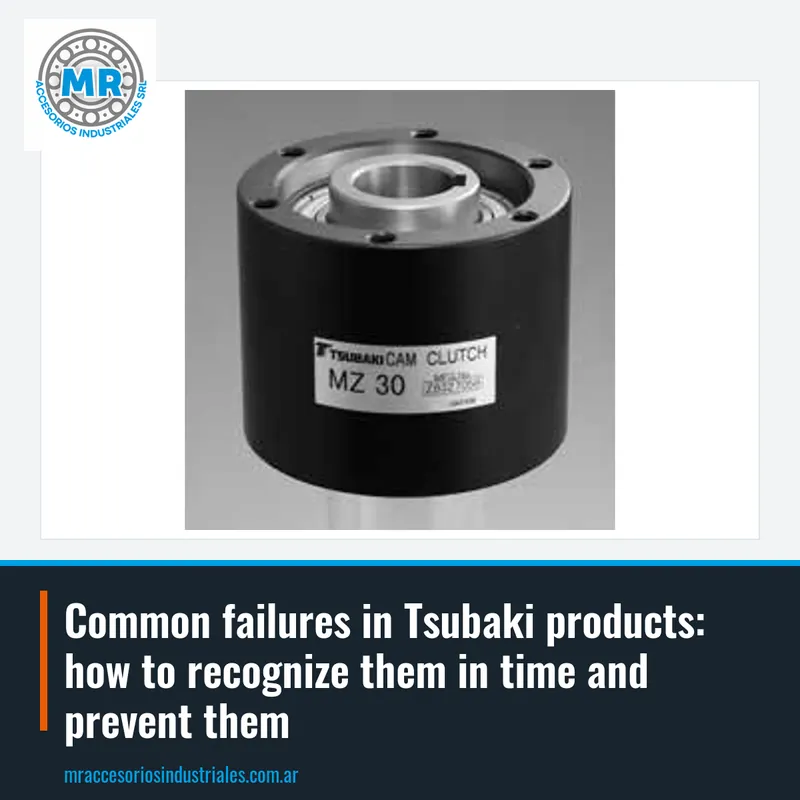
Tsubaki freewheels: failures due to installation and overload
Freewheels such as MZ17 or MZ35 allow rotation in one direction and lock in the opposite direction, so their failure usually manifests as loss of the locking function: the shaft rotates freely in both directions or jams completely. This may be due to broken springs, worn cams, or races with indentation marks. Another frequent failure is intermittent slipping, which feels like knocking or sudden release under load.
Incorrect installation is a common cause of premature failures. If the freewheel is installed forced, with blows, or without respecting the direction of rotation, the internal components are damaged immediately. Overload or sudden starts also generate torque peaks that exceed the mechanism's capacity. In applications with frequent reversals, wear concentrates on the cams and races, and vibrations or dry noises appear.
To prevent this, respect the maximum torque indicated for each model and verify that the housing and shaft have the correct tolerances. Install the freewheel with suitable tools, without hammering on the outer race, and make sure the locking direction matches that of the application.
Tsubaki conveyor chains: wear on links and pins
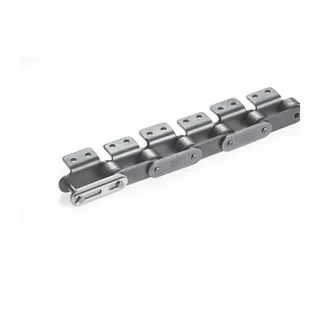
Conveyor chains such as M 28 or M 56 work under demanding conditions: heavy loads, abrasive environments, and variable speeds. The most common failure is wear on pins and bushings, which causes pitch elongation and loss of synchronization with the sprockets. This is noticeable when the chain starts jumping teeth or hitting the structure. Cracks in the plates also appear due to fatigue, especially at the attachment points.
Another typical failure is breakage of the rollers that support the chain on the slide rails. If the rollers jam or wear unevenly, the chain deviates and rubs against the guides, generating heat and greater wear.
To prevent this, check the lubrication of pins and rollers as often as the work rate requires. Check chain tension: neither too loose, which causes impacts, nor too tight, which overloads the links. Align the sprockets and rails, and clean the chain to avoid accumulation of material that acts as an abrasive. If you notice deformed links or protruding pins, replace the damaged section before it breaks.
Tsubaki leaf chains: fatigue and plate breakage
Leaf chains such as BL 544 or BL 823 are used in lifting and traction applications where safety is critical. Their most dangerous failure is fatigue breakage of the plates, which usually starts at the edges of the pin holes. Cracks progress with each load cycle and can end in sudden breakage. That is why it is key to visually inspect the plates for cracks, deformations, or corrosion marks.
Another frequent failure is wear on pins and plate holes, which creates play between links and reduces the assembly's strength. If the chain elongates irregularly, the load is distributed poorly and some links bear more tension than others. Breakage at the connecting ends can also appear if attachments are welded or fixed without respecting the original design.
To prevent this, respect the working load indicated for each chain and avoid sudden impacts or jerks. Periodically check the condition of pins and plates, paying attention to the areas of greatest tension. Lubricate the articulation points with a suitable lubricant and protect the chain from corrosion if it works outdoors. At any sign of fatigue, replace the entire chain: individual links are not repaired.
Tsubaki chain couplings: misalignment and wear
Chain couplings such as CR4016 or CR5016 connect two shafts with two sprockets wrapped by a double chain, and tolerate small misalignments. The most common failure is wear of the chain and sprocket teeth, which manifests as play when turning, vibrations, noises, and loss of smoothness in the drive. If wear advances, the coupling loses the ability to compensate for misalignments and transmits radial loads to the shaft bearings.
Excessive misalignment between shafts is the main cause of premature failures. Although the coupling tolerates some angular or parallel misalignment, exceeding the limits causes accelerated wear of the chain and sprocket teeth. Incorrect tightening of the fastening screws can also cause slipping between hub and shaft, with the consequent wear of keys and keyways.
To prevent this, check shaft alignment with a dial indicator or laser system before installing the coupling. Respect the screw tightening torque, keep the coupling chain lubricated, and periodically check its condition: if it has excessive play, damaged rollers, or worn teeth, replace it. Use the protective cover to retain lubricant and prevent contaminants from entering and accelerating wear. A well-maintained coupling protects the entire drive.
Tsubaki torque limiters: calibration and disc wear
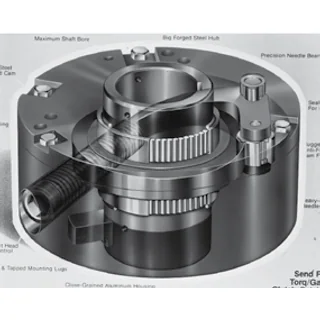
Torque limiters protect machinery against overloads by disconnecting the drive when a preset torque is exceeded. Their most common failure is loss of calibration: the limiter slips under normal loads or does not disconnect when it should. This may be due to fatigued springs, worn friction discs, or contamination with oil or grease on the contact surfaces.
Another frequent failure is wear of the friction discs, which reduces the coefficient of friction and causes the limiter to disconnect early. If the mechanism overheats due to repeated slipping, the discs can crystallize and lose effectiveness. Vibrations or noises can also appear if the discs do not seat uniformly or if there is misalignment during installation.
To prevent this, respect the calibration torque indicated by the manufacturer and do not modify it unnecessarily. Periodically check the condition of the discs and springs, and clean the friction surfaces with a suitable solvent. If the limiter actuated due to overload, verify the cause before restarting it.
Preventive maintenance: keys to extending service life
Preventive maintenance is the best tool to avoid failures in any Tsubaki component. Visually inspect chains, freewheels, and couplings at every scheduled stop: look for wear, cracks, corrosion, abnormal noises, or vibrations. Measure chain elongation with a caliper or ruler, and compare with the allowable values.
Adequate lubrication is essential: use the recommended lubricant for each type of chain or mechanism, and apply the right amount. Excess grease attracts dust and forms an abrasive paste; lack of lubricant accelerates wear due to friction.
Finally, train maintenance personnel in the correct installation and adjustment techniques. Poor installation is the cause of many premature failures: misalignment, incorrect tension, impacts when installing bearings or freewheels, and tightening outside specification. If you have doubts about the condition of a component, send us the code, size, or a photo via WhatsApp or email: we will respond promptly and quote the Tsubaki replacement part you need.
Frequently asked questions
How do I know if a Tsubaki chain is worn and needs to be replaced?
Measure pitch elongation between several links: if it exceeds the allowable value for the chain type, it must be replaced. Also check if the rollers are broken, if the plates have cracks, or if the chain jams when flexing. At any of these signs, it is best to replace it completely and check the sprockets.
What causes premature wear in a Tsubaki freewheel?
The most common causes are forced installation with blows, overload or sudden starts, and lack of lubrication or entry of contaminants. Misalignment between shafts or the use of incorrect tolerances in the housing also has an influence. Respect the maximum torque and verify the locking direction before installing it.
How often should a Tsubaki conveyor chain be lubricated?
It depends on speed, load, and work environment. In general, it is recommended to lubricate pins and rollers as often as necessary to maintain a continuous lubricant film. In dusty or humid environments, the frequency should be higher. Visually check the lubrication condition and adjust the schedule according to the wear observed.
Can a broken Tsubaki leaf chain be repaired?
Repairing loose links or welding broken plates is not recommended. The leaf chain works with critical loads and any repair compromises its strength. If you detect cracks, worn pins, or breakage, replace the entire chain with a new one of the same code and check the condition of the connecting attachments.
How do I avoid failures in a Tsubaki coupling due to misalignment?
Before installing the coupling, align the shafts with a dial indicator or laser system, respecting the angular and parallel misalignment limits of the model. Tighten the screws to the indicated torque and keep the coupling chain lubricated. If you notice vibrations or noises, check the alignment and the wear of the chain and teeth.
Products with photos in the catalogue
Keep reading
- Tsubaki industrial chains: quality, durability and performance for demanding applications
Discover the types of Tsubaki chains we supply: roller, conveyor, leaf, freewheels, couplings and torque limiters. We help you choose the right one for your application.
- How to Read Tsubaki Codes: Designation Structure, Prefixes, Suffixes, and Real Examples
Practical guide to interpreting the nomenclature of Tsubaki chains, freewheels, couplings, and other products. With real examples and tips for requesting quotes.
- Tsubaki by industry: where it is used, how to select it, assembly and maintenance to make it last
We review the most common Tsubaki applications in Argentine industry, selection criteria according to component type, and good assembly and maintenance practices to extend service life.
Continue here
Need a quote?
Send us the code, size or a photo of the part and we'll quote you shortly.