
Blog
Tsubaki chain assembly and disassembly: tools, steps and common mistakes
Learn to assemble and disassemble Tsubaki chains safely, with the right tools and avoiding mistakes that shorten their service life.
TSUBAKI catalog by part number
Technical team at MR Accesorios Industriales · Updated on October 24, 2026
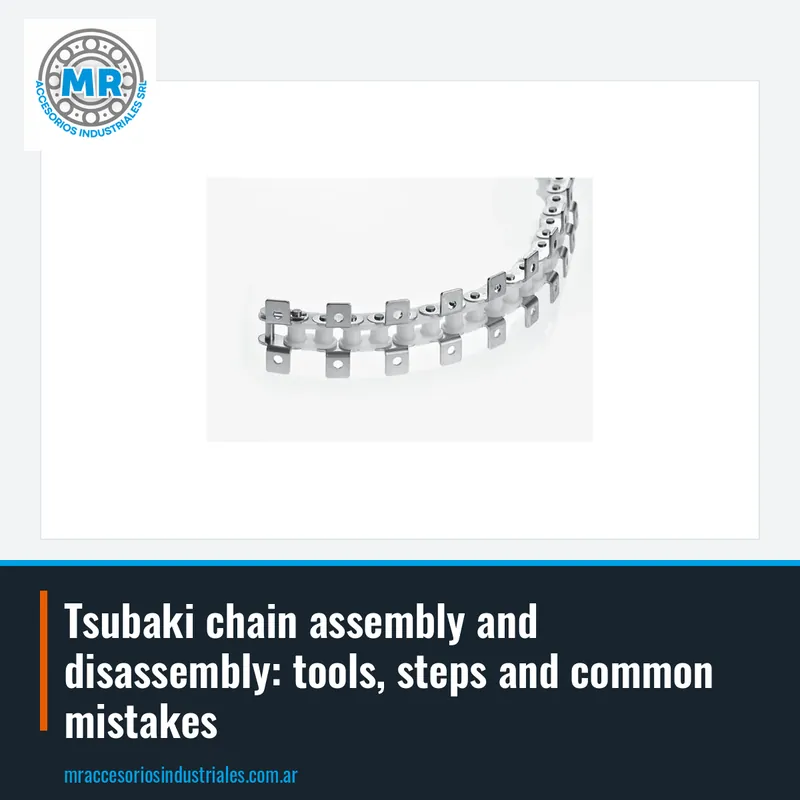
Tools needed to assemble and disassemble Tsubaki chains
To work with Tsubaki chains you need specific tools that prevent damage to the links and facilitate the process. A chain breaker, also called a link extractor, is essential to remove pins without deforming the plates. It is also advisable to have a wear gauge to check chain elongation before deciding whether to replace it. Fixed or socket wrenches of the correct size help tighten the joints without forcing the components.
For roller chains such as RS40 or RS60, the extractor must match the chain pitch for a neat job. For conveyor chains such as M 20 or M 40, which are usually heavier, it is recommended to use higher-capacity tools and supports that keep the chain aligned. Leaf chains such as BL 466 require special extractors due to their multi-plate design.
In addition to tools, it is key to have safety elements such as gloves and eye protection. Before starting, verify that the machine is off and locked to prevent accidental starts. If you don't have the right tool, don't improvise with pliers or hammers: you can damage the links and compromise the chain's service life. At MR we advise you on which tool is best for each type of Tsubaki chain.
Steps to assemble a Tsubaki chain correctly
Assembling a Tsubaki chain begins with verifying that the length is correct for the application. If the chain is new, it may come with a connecting link or require joining with a pin. For roller chains such as WK-2, the connecting link is placed and secured with the corresponding clip. It is important that the clip is oriented in the direction of travel to prevent it from coming off.
For conveyor chains such as M 56, assembly may require the use of tensioners to provide adequate tension. A chain that is too tight generates excessive loads on the bearings and accelerates wear. Conversely, a loose chain can jump the sprocket teeth and cause failures. Correct tension is verified by measuring the sag at the center of the span between sprockets.
For leaf chains such as BL 646, assembly is more delicate because the plates must be perfectly aligned. It is recommended to use guides or supports that keep the chain in position during assembly. After mounting, manually turn the system to check for hard spots or rubbing. If you notice any irregularity, check the alignment of the sprockets and the tension before starting up.
How to disassemble a Tsubaki chain without damaging components
Disassembling a Tsubaki chain requires patience and the right tools to avoid ruining links that still work. First, loosen the tensioner or move the shaft to give the chain slack. Then, identify the connecting link or the point where you will extract the pin. With the extractor, push the pin out in a controlled manner, without hitting.
For roller chains such as RS60, if the pin is very tight, you can use penetrating lubricant to facilitate extraction. Never use excessive heat, because you can alter the heat treatment of the components. For conveyor chains such as M 20, which are usually heavy, a robust extractor is needed and sometimes an assistant to hold the chain.
After disassembly, clean the components and check the condition of the links, pins and rollers. If you are going to reuse the chain, measure wear with a caliper or specific gauge. If elongation exceeds the manufacturer's recommended limit, it is time to replace it. At MR we help you identify the correct code for your Tsubaki chain so you order the exact replacement.
Common mistakes that shorten the service life of Tsubaki chains
One of the most frequent mistakes is mounting the chain with incorrect tension. A chain that is too tight works under stress and prematurely wears the pins and bushings. A loose chain knocks and can cause fatigue in the plates. Correct tension is achieved by following the manufacturer's recommendations for each application and checking periodically.
Another common mistake is not correctly aligning the sprockets. If the sprockets are not in the same plane, the chain receives lateral loads that accelerate wear on the flanks and can cause breakage. Use a straightedge or laser to verify alignment before tensioning the chain. It is also important that the sprockets have the same pitch as the chain, for example, an RS40 with sprockets for half-inch pitch.
Lack of lubrication is another factor that reduces service life. Tsubaki chains need lubricant at the articulation points to minimize friction and wear. Apply the appropriate lubricant according to speed and working environment. Avoid using heavy greases on high-speed chains, because they can trap contaminants. A regular lubrication plan is key to prolonging chain life.
Preventive maintenance of Tsubaki chains
Preventive maintenance begins with periodic visual inspections to detect signs of wear, corrosion or damage to the links. Check that there are no seized links that do not articulate freely. In roller chains such as WK-2, verify that the rollers turn without difficulty. In conveyor chains such as M 40, check the condition of the pins and plates.
Measuring elongation is essential to decide when to replace the chain. Use a wear gauge or caliper to compare the length of a chain section with the original length. If elongation exceeds the recommended maximum value, the chain no longer fits the sprockets properly and can damage them. It is more economical to replace the chain in time than to have to change the sprockets as well.
In addition to the chain, check the condition of the sprockets. If the teeth are worn or deformed, they accelerate wear of the new chain. In some cases, it is advisable to replace the chain and sprockets at the same time to ensure optimal operation. At MR we advise you on the Tsubaki parts you need for your transmission or conveyor system.
Assembly particularities according to the type of Tsubaki chain
Tsubaki roller chains, such as RS40 or RS60, are the most common in power transmissions. Their assembly is relatively simple, but requires attention to the connecting clip and tension. In high-speed applications, it is recommended to use riveted joints instead of clips for greater safety. Disassembly of these chains is done with extractors specific to the corresponding pitch.
Tsubaki conveyor chains, such as M 56 or M 20, are used in material transport systems. Their assembly may require assembling long sections and using hydraulic or mechanical tensioners. It is important that the chain supports are well aligned and that there are no obstacles in the path. Disassembly is done in sections, loosening the joints and removing the chain carefully.
Tsubaki leaf chains, such as BL 844, are used in lifting and traction applications. Their assembly requires that the plates be perfectly parallel and that the pins be well secured. Disassembly is done with special extractors that push the pins without damaging the plates. These chains usually work with high loads, so any assembly error can be dangerous.
When to replace the Tsubaki chain
The decision to replace a Tsubaki chain is based on measured wear and the general condition of the components. If elongation exceeds the recommended limit, the chain no longer meshes properly with the sprockets and can jump. It is also replaced if there are broken links, loose pins or severe corrosion. In those cases, continuing to use the chain can damage other system components.
In roller chains such as RS60, a clear sign of wear is visible elongation and noise during operation. In conveyor chains such as M 40, wear manifests as difficulty in maintaining tension and wear on the sprocket teeth. In leaf chains such as BL 466, plate fatigue can cause sudden breakage, so frequent inspections are recommended.
When replacing, it is essential to request the correct Tsubaki chain code. If you have doubts, take a photo of the chain and sprockets, and send it to MR via WhatsApp or email. With that information, we quote the exact chain and indicate the steps for correct assembly. Don't let wear go: a chain in poor condition can stop your production and cause major damage.
Frequently asked questions
What tool do I need to disassemble a Tsubaki chain?
You need a link extractor sized to the chain pitch. For heavy chains, such as conveyor chains, a robust extractor and supports to keep the chain aligned are recommended.
How do I know if my Tsubaki chain is too tight?
Correct tension is verified by measuring the sag at the center of the span between sprockets. If the sag is less than recommended, the chain is too tight and may wear prematurely.
How often should I lubricate a Tsubaki chain?
It depends on speed and working environment. In general, it is recommended to lubricate periodically according to the maintenance plan. In dusty or humid environments, the frequency should be higher.
Can I reuse a Tsubaki chain after disassembling it?
Yes, if wear does not exceed the recommended limit and the components are in good condition. Measure elongation and visually inspect the links before deciding to reuse it.
What should I do if I can't find the code for my Tsubaki chain?
Take a photo of the chain and sprockets, and send it to MR via WhatsApp or email. With that information, we help you identify the correct code and quote the replacement.
Products with photos in the catalogue
Keep reading
- Tsubaki industrial chains: quality, durability and performance for demanding applications
Discover the types of Tsubaki chains we supply: roller, conveyor, leaf, freewheels, couplings and torque limiters. We help you choose the right one for your application.
- How to Read Tsubaki Codes: Designation Structure, Prefixes, Suffixes, and Real Examples
Practical guide to interpreting the nomenclature of Tsubaki chains, freewheels, couplings, and other products. With real examples and tips for requesting quotes.
- Tsubaki by industry: where it is used, how to select it, assembly and maintenance to make it last
We review the most common Tsubaki applications in Argentine industry, selection criteria according to component type, and good assembly and maintenance practices to extend service life.
Continue here
Need a quote?
Send us the code, size or a photo of the part and we'll quote you shortly.