
Blog
Tsubaki: how to choose the right component by application
Practical guide to selecting Tsubaki chains, freewheels, couplings and other components based on working conditions. Send your code or measurement and we'll quote you.
TSUBAKI catalog by part number
Technical team at MR Accesorios Industriales · Updated on October 18, 2026
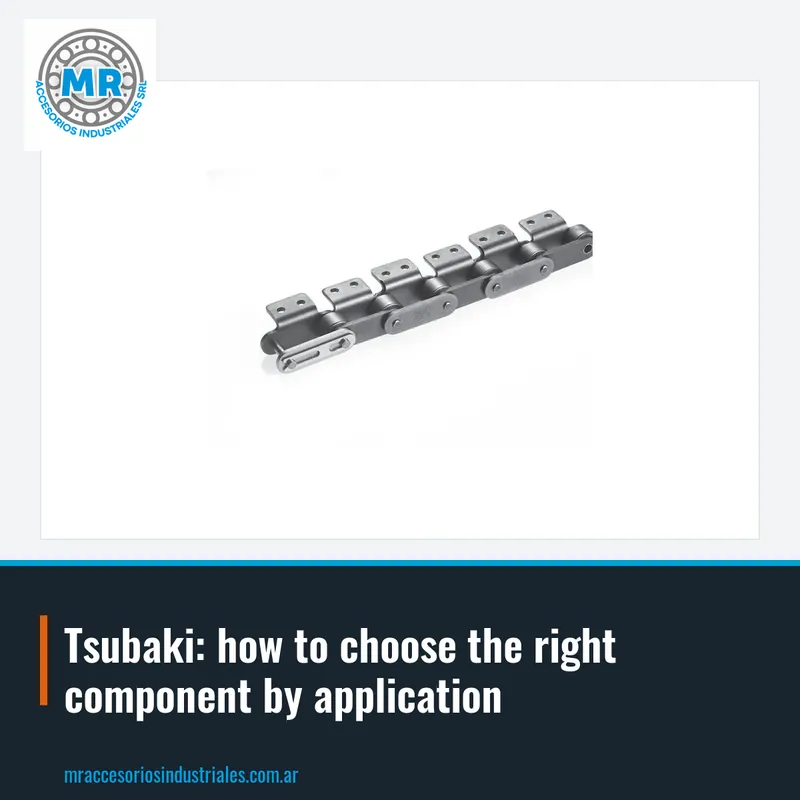
Tsubaki roller chains: selection by load and speed
Tsubaki roller chains transmit power between shafts in industrial equipment. The choice of pitch and series depends on the load to be transmitted and the rotation speed. A code like RS60 corresponds to a chain with a 3/4 inch pitch, widely used in medium transmissions. For light applications, such as small conveyors or agricultural machinery, you can opt for RS25, with a 1/4 inch pitch.
When selecting a roller chain, you must consider the torque and motor power. An undersized chain wears quickly or breaks, while an oversized one adds unnecessary weight and inertia. Speed also matters: at higher speeds, chains with better surface finish and adequate lubrication are recommended.
To get a quote, it's best to send the code stamped on the links or measure the pitch between pins. If the chain is very worn, you can measure the roller diameter and inner width. At MR we supply Tsubaki roller chains and help you confirm the correct reference. Send us a photo of the used chain or the equipment nameplate data.
Tsubaki freewheels: when to use them and how to identify them
Tsubaki freewheels allow rotation in one direction only and are used in applications such as motor starting, backstop systems or inclined conveyors. Model MZ17 is a compact-size freewheel, suitable for moderate loads. For higher demands, MZ35 offers greater torque capacity.
The choice of a freewheel depends on the torque to be transmitted, the maximum speed and the type of mounting. You must verify whether the shaft rotates freely in one direction and locks in the other, or if a freewheel with cams or rollers is needed. The environment also matters: in areas with dust or moisture, a sealed freewheel or one with additional protection is recommended.
To order a Tsubaki freewheel, send the code stamped on the outer race or hub. If it's not legible, measure the inner diameter, outer diameter and width. At MR we distribute Tsubaki freewheels and quote you the exact reference. Tell us what equipment you need it for and which rotation direction it should lock.
Tsubaki conveyor chains: design according to the material to be moved
Tsubaki conveyor chains are used in production lines, elevators and material handling systems. Codes like M 20, M 28 or M 56 correspond to M series conveyor chains; within the series, the higher number indicates a stronger chain, designed for heavier loads.
When choosing a conveyor chain, you must consider the weight of the material, the line speed and the type of guides. It also matters whether the chain works dry, with lubrication or in contact with food products. In corrosive environments or with frequent washing, stainless steel chains or chains with special treatments may be required.
To get a quote for a Tsubaki conveyor chain, indicate the chain code or measure the pitch between links. If the chain has attachments or plates, send photos and measurements. At MR we supply Tsubaki conveyor chains and help you find the correct configuration. Describe the conveyor and the material it moves.
Tsubaki leaf chains: lifting and traction applications
Tsubaki leaf chains are used in forklifts, hoists and traction systems where high tensile strength is required. Codes like BL 544, BL 823 or BL 466 correspond to BL series leaf chains, which cover different pitches and plate combinations depending on the load.
The selection of a leaf chain depends on the maximum working load, the required safety factor and the type of guide. You must verify the pitch between pins and the width of the links. The fastening method also matters: some chains have pin bolts, others use pins with keys or rivets.
To order a Tsubaki leaf chain, send the code stamped on the links or measure the pitch and width. If the chain is broken, send a photo of the section and the ends. At MR we distribute Tsubaki leaf chains and quote you the correct reference. Tell us what equipment you use it for and what load it lifts.
Tsubaki couplings: transmission between shafts with misalignment
Tsubaki couplings connect two shafts and transmit torque, compensating for angular, parallel or axial misalignments. Model CR4016 is a medium-size chain coupling, suitable for pumps and compressors. For larger shafts, CR5016 offers greater capacity. The CR series, such as CR5014, stands out for its simple mounting and reduced maintenance.
When choosing a coupling, you must consider the torque to be transmitted, the rotation speed and the expected misalignment. The shaft diameters and available space also matter. Tsubaki chain couplings allow some flexibility, but not as much as elastic couplings. In applications with shocks or vibrations, a coupling with a damping element may be required.
To get a quote for a Tsubaki coupling, indicate the coupling code or measure the outer diameter and total length. If you have the shaft diameters, that also works. At MR we supply Tsubaki couplings and help you select the right model. Send a photo of the used coupling or the equipment nameplate data.
Tsubaki torque limiters: protection against overloads
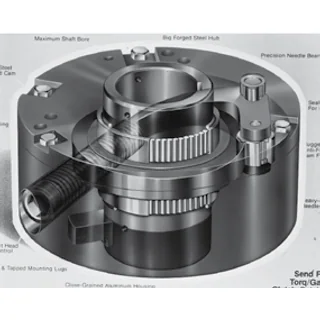
Tsubaki torque limiters protect the transmission against overloads, disengaging the shaft when a preset torque is exceeded. They are used in agricultural machinery, mixers and equipment where a jam can damage components. Unlike a mechanical fuse, the torque limiter can be reset after the overload.
The choice of a torque limiter depends on the trip torque, the speed and the type of mounting. You must define whether a friction, ball or roller limiter is needed. The frequency of trips also matters: in applications with frequent overloads, a quick-reset limiter is recommended.
To order a Tsubaki torque limiter, send the model code or describe the application and the working torque. If you don't know the torque, indicate the motor power and speed. At MR we distribute Tsubaki torque limiters and quote you the correct option. Tell us what equipment you want to protect and what type of overload it suffers.
How to order your Tsubaki component at MR Accesorios Industriales
To get a quote for any Tsubaki component, the most practical thing is to send the exact code that appears on the part or in the equipment manual. If you don't have the code, measure the main dimensions: pitch, width, inner and outer diameter, depending on the type of component. A clear photo of the used part also helps identify the reference.
At MR Accesorios Industriales, from Buenos Aires, Argentina, we sell and distribute Tsubaki components for industry. We work with roller chains, freewheels, conveyor chains, leaf chains, couplings and torque limiters. If you have a code from another brand, we can look for the Tsubaki equivalent.
Write to us via WhatsApp or email with the code, measurements or a photo of the part. We'll quote you the Tsubaki component you need and indicate the correct alternative for your application. Don't hesitate to ask us about any technical doubt regarding selection or mounting.
Frequently asked questions
How do I know which Tsubaki chain I need for my machine?
Check the code stamped on the links of the used chain or measure the pitch between pins. With that data, at MR we'll quote you the correct Tsubaki chain.
Which Tsubaki freewheel should I choose for an inclined conveyor?
It depends on the torque and speed. Models like MZ17 or MZ35 cover different capacities. Send the code or the housing measurements and we'll help you select.
Do Tsubaki couplings compensate for misalignment?
Yes, Tsubaki chain couplings like CR4016 or CR5016 allow some angular and parallel misalignment. For greater misalignments, ask us about other options.
Can I use a Tsubaki leaf chain in a forklift?
Yes, Tsubaki leaf chains like BL 544 or BL 823 are suitable for lifting. Verify the working load and the required safety factor.
How do I order a Tsubaki torque limiter if I don't know the torque?
Indicate the motor power and the output speed. With that data, at MR we'll quote you the appropriate Tsubaki torque limiter.
Products with photos in the catalogue
Keep reading
- Tsubaki industrial chains: quality, durability and performance for demanding applications
Discover the types of Tsubaki chains we supply: roller, conveyor, leaf, freewheels, couplings and torque limiters. We help you choose the right one for your application.
- How to Read Tsubaki Codes: Designation Structure, Prefixes, Suffixes, and Real Examples
Practical guide to interpreting the nomenclature of Tsubaki chains, freewheels, couplings, and other products. With real examples and tips for requesting quotes.
- Tsubaki by industry: where it is used, how to select it, assembly and maintenance to make it last
We review the most common Tsubaki applications in Argentine industry, selection criteria according to component type, and good assembly and maintenance practices to extend service life.
Continue here
Need a quote?
Send us the code, size or a photo of the part and we'll quote you shortly.