
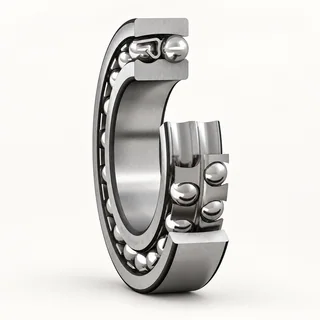
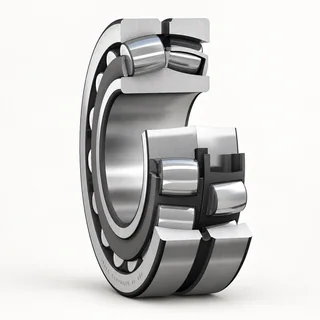
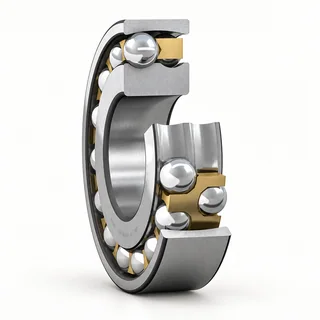
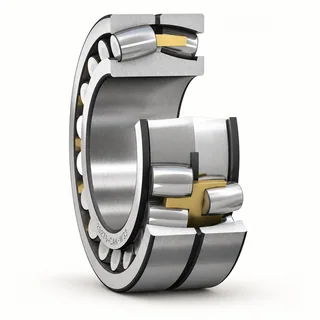
SKF deep groove ball bearings
The deep groove ball bearing is the most widely used bearing in industry: it takes radial load and some axial load in both directions, runs at high speed and its simple design makes it the most economical of the ball bearings.
The designation starts with the series number —60, 62 or 63 depending on width and load capacity— followed by the coded bore diameter, and ends with suffixes that describe the sealing and internal clearance: 2RS or 2RSH indicates two contact rubber seals, ZZ or 2Z indicates two non-contact metal shields, and the absence of a suffix indicates an open bearing, with no protection of its own. The C3 suffix (or another clearance number) indicates an internal clearance greater than normal, used when the shaft will run hot.
It is mounted in electric motors, pumps, fans, gearboxes, conveyor belts and in general any shaft that turns at medium or high speed with moderate load. It is the bearing that moves most in an Argentine industrial warehouse, precisely because it covers most of the standard motors and gearboxes on the market.
The choice comes down to shaft diameter, the load it will carry and the environment: a motor exposed to dust or moisture calls for 2RS sealing; a shaft turning at high speed with little contamination can use ZZ shielding, which generates less friction. Speed and working temperature also define the factory grease, which in sealed bearings cannot be relubricated.
It is one of the most standardized designs there is: the same inner, outer and width dimension is manufactured with equivalent numeric series by SKF, NSK, FAG, NTN, Timken and the rest of the brands on the market. If your equipment carries another brand's designation, send us the part number: most of the time there is an equivalent.
If you have the number on the bearing cap or the shaft diameter, write to us on WhatsApp with the part number and we will confirm the available sealing and the equivalent. We sell SKF deep groove ball bearings, from the 6000 series up to the largest diameters.