
Blog
SKF Laser Aligner for Shafts and Pulleys: How to Avoid Wear and Downtime
Misalignment in shafts and pulleys shortens the service life of bearings, seals and belts. Learn about SKF laser aligners and how to use them to correct it.
SKF bearings in Argentina: guide and quotes
Technical team at MR Accesorios Industriales · Updated on October 18, 2026

Why misalignment destroys bearings and belts
Misalignment between coupled shafts or between pulleys generates loads that were not foreseen in the design. These extra loads are transmitted to the bearings, which work under strain and wear out prematurely. Seals also suffer, losing their sealing capacity, and belts stretch or break. An SKF laser aligner allows you to detect and correct this problem before it causes a failure.
In industrial equipment such as pumps, compressors, fans or gearboxes, correct alignment is key to reliability. A small misalignment, invisible to the naked eye, already shortens the service life of a bearing. That is why predictive maintenance includes periodic alignment verification as a standard task. There is no need to wait for the equipment to vibrate or make noise before intervening.
When pulleys are misaligned, belts run twisted and wear unevenly. This causes loss of power transmission, overheating and premature breakage. In addition, the resulting vibration affects the shaft bearings. With a pulley aligner, the relative position of the pulleys is corrected so that the belts run in the correct plane.
SKF TKSA series shaft aligner: how it works
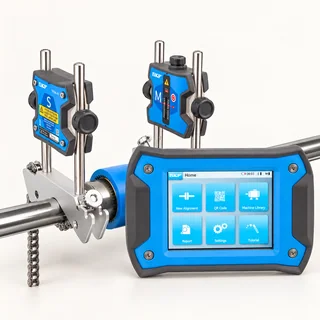
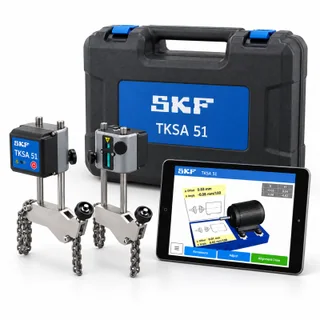
SKF TKSA series shaft aligners measure the relative position of two coupled shafts with two measuring units, one mounted on each shaft. The system calculates angular and parallel misalignment, and displays the necessary correction values. Models such as the TKSA 41 or the TKSA 51 are examples of this series.
The basic procedure consists of mounting the sensors on the shafts, rotating them to measurement positions and reading the results. The aligner indicates how much the machine must be moved vertically and horizontally, and whether shims must be added or removed. After correcting, the measurement is repeated to verify that the alignment is within tolerance. The result is recorded for the machine's maintenance history.
One advantage of laser aligners over traditional methods such as a ruler and feeler gauge is precision and speed. They also avoid human reading errors and allow measurement in tight spaces. To choose the right model, consider the shaft diameter, the distance between them and the working conditions. At MR we advise you on which aligner from the TKSA series is suitable for your application.
SKF TKBA series pulley aligner: for properly aligned belts
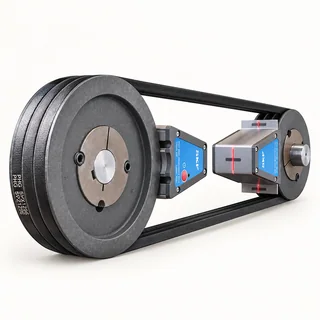
SKF TKBA series pulley aligners are designed to align grooved and flat pulleys. They are placed on the faces of the pulleys and use a laser to project a line that reveals misalignment. Models such as the TKBA 21 or the TKBA 31 are examples of this series. They are portable and easy-to-use tools, always with the machine stopped and locked out.
Pulley misalignment can be angular or parallel. The TKBA aligner detects both and corrects them by adjusting the position of one of the pulleys. The procedure consists of mounting the laser emitter on one pulley and the receiver on the other, and then observing the projected line. If the line does not match the reference, there is misalignment. It is corrected by moving the pulley until the line is aligned.
Using an SKF pulley aligner helps extend the service life of belts and shaft bearings. It also reduces energy consumption, because a properly aligned drive has fewer losses. It is a recommended tool for preventive maintenance in belt drive systems. At MR we supply the TKBA models and help you choose the right one.
Differences between aligning shafts and aligning pulleys
Aligning shafts and aligning pulleys are different tasks, although both aim to avoid premature wear. Shaft alignment applies to directly coupled machines, such as a motor and a pump. Pulley alignment applies to belt drives, where the pulleys must be in the same plane. Each task requires a specific type of aligner: TKSA series for shafts and TKBA series for pulleys.
In shaft alignment, angular and parallel deviations between the rotation axes are measured. In pulley alignment, the deviation between the pulley faces is measured. The measurement and correction procedures are different. Therefore, it is important to use the correct tool for each case. A shaft aligner does not work for pulleys and vice versa.
Both tasks are part of precision maintenance. Performing them periodically reduces unplanned downtime and spare parts costs. At MR we distribute both lines of SKF aligners and can guide you on which one you need according to your equipment. We also quote spare parts and accessories for these instruments.
How to choose the right SKF laser aligner
To choose an SKF laser aligner, first define whether you need to align shafts or pulleys. Then consider the size of the shafts or pulleys, the distance between them and the required precision. TKSA series models vary in features such as touchscreen, connectivity and measurement capacity. Therefore, it is advisable to compare models such as the TKSA 41 and the TKSA 51 before deciding.
The working environment must also be taken into account: if there is vibration, dust or humidity, a rugged unit is advisable. Ease of use is another factor: some models guide the operator step by step. The measurement history is useful for maintenance. At MR we help you compare the available models and choose the one that best suits your application.
You do not need to be an alignment expert to use this equipment, but basic training helps you get the most out of it. SKF publishes user manuals for its tools. If you have doubts about which model to choose, write to us with your machine data and we will advise you.
Alignment procedure with SKF laser aligner
The general alignment procedure with an SKF laser aligner begins with preparing the machine. You must verify that the machine is stopped and locked out, that the bases are firm and that there are no soft foot conditions. Then the sensors are mounted on the shafts or pulleys according to the type of aligner. The equipment guides the operator through the measurements.
After measuring, the aligner displays the necessary correction values in each plane. Vertical deviations are corrected first by adding or removing shims under the machine feet. Then horizontal deviations are corrected by moving the machine laterally. The measurement is repeated to verify that everything is within tolerance. Finally, the history is saved.
It is important to follow the manufacturer's instructions and use the appropriate accessories, such as mounting chains or magnetic brackets. A common bad practice is not verifying alignment after tightening the anchor bolts. Another is not compensating for thermal growth in machines that run hot. With an SKF aligner, these errors are minimized because the equipment displays the values in real time.
Where to buy SKF laser aligner in Argentina
At MR Accesorios Industriales, based in Buenos Aires, Argentina, we supply SKF laser aligners from the TKSA and TKBA series. We also carry other SKF mounting and maintenance tools. If you need an aligner for your plant, we will quote it promptly. We also distribute other SKF products such as bearings, housings and power transmission.
To get a quote, send us the model you are interested in, such as TKSA 11 or TKBA 21, or tell us what type of machine you want to align. If you do not know the exact model, send us a photo of the machine nameplate or the shaft measurements. With that we will indicate the right alternative.
You can contact us by WhatsApp or email. In your message, include the aligner code, the shaft or pulley measurement, or a photo of the part. We will reply promptly with the quote. This way you avoid buying equipment that does not suit your application.
Frequently asked questions
What is the difference between a shaft aligner and a pulley aligner?
The shaft aligner measures misalignment between two coupled shafts, such as a motor and a pump. The pulley aligner measures misalignment between pulleys of a belt drive. Each uses a different method and they are not interchangeable.
How do I know which SKF laser aligner model I need?
It depends on the type of alignment (shafts or pulleys), the size of the components and the required precision. You can consult us with your machine data and we will recommend the right model from the TKSA or TKBA series.
How often should shafts or pulleys be aligned?
It is recommended to verify alignment at every scheduled maintenance or when bearings, couplings or belts are replaced. Also after moving a machine or if abnormal vibrations appear.
Are SKF laser aligners easy to use?
Yes, they are designed to guide the operator step by step. You do not need to be an expert, but it is advisable to read the manual and practice. If you have doubts, write to us and we will guide you.
Products with photos in the catalogue



Keep reading
- SKF Chains: Reliable Power Transmission for Industrial Applications
SKF roller chains offer strength and precision for power transmission in industrial machinery. Learn about the PHC series, ASA and BS standards, and how to identify the correct chain for your equipment.
- SKF tools for industrial maintenance: pullers, heaters, aligners and calibrated shims
SKF tools simplify bearing mounting and dismounting, shaft alignment and instrument calibration. Discover TMMA and TMHP pullers, induction heaters, TKSA aligners and calibrated shims.
- How to Choose SKF Bearings by Application: Load, Speed, Environment, and Mounting
Choosing the right SKF bearing requires analyzing load, speed, environment, and mounting. We explain the main types and how to get a quote with the exact code.
Continue here
Need a quote?
Send us the code, size or a photo of the part and we'll quote you shortly.