
Blog
SKF in the cement industry: bearings for mills, rotary kilns, fans and conveyors
In a cement plant, bearings work with abrasive dust, heat and heavy loads. We tell you which SKF bearings are used in mills, rotary kilns, fans and conveyors, and how to order them.
SKF bearings in Argentina: guide and quotes
Technical team at MR Accesorios Industriales · Updated on October 21, 2026
Bearings in the cement industry: working conditions
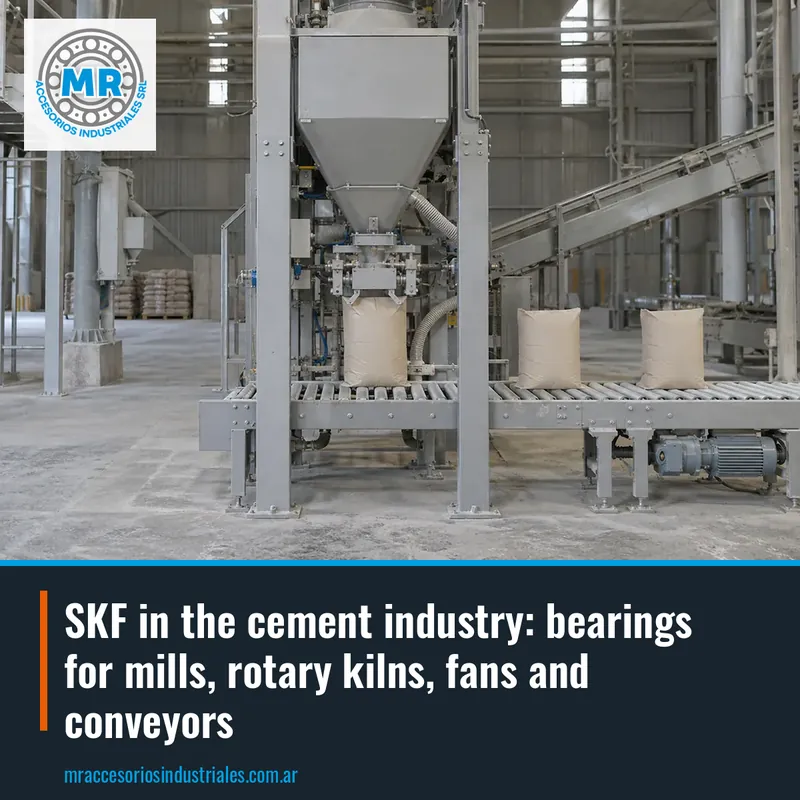
The cement industry subjects bearings to demanding conditions. Abrasive dust from clinker and limestone gets into the housings and wears the raceways. Temperatures near kilns and mills are high, and loads on the shafts are heavy and often involve impacts. Therefore, selecting the correct bearing is key to avoiding unscheduled downtime.
In ball and vertical mills, bearings support high radial loads and some shaft misalignment. In rotary kilns, the bearings of the support rollers work at low speed but with very high loads and process temperatures. Draft fans and conveyors also require bearings that tolerate dirt and vibration.
For these applications, spherical roller bearings and cylindrical roller bearings are the most used. The former absorb misalignments and combined loads; the latter support heavy radial loads and allow axial displacement. In addition, SNL split housings facilitate assembly and maintenance in hard-to-reach places.
SKF spherical roller bearings for mills and kilns
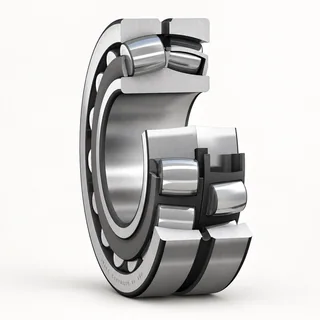
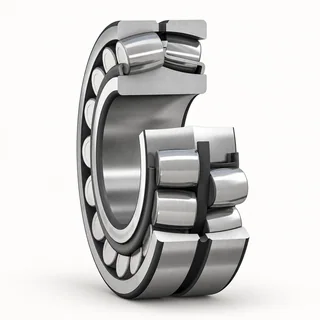
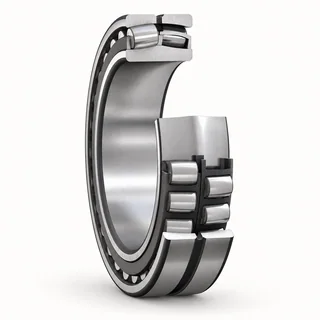
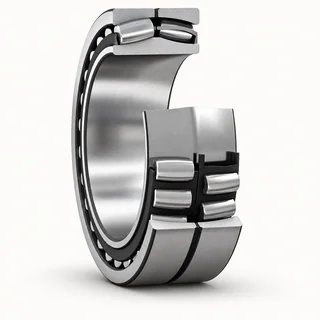
SKF spherical roller bearings are used in the trunnions of ball mills and in the support rollers of rotary kilns. Their design allows them to support very high radial loads and, at the same time, compensate for shaft misalignment or structure flexing. This is essential in large equipment, where perfect alignment is difficult to achieve and maintain.
In mills, these bearings are often mounted on adapter sleeves or directly on the shaft. In kilns, the support rollers work at low speed but with enormous static and dynamic loads. A well-lubricated spherical roller bearing protected from dust works better; if contamination enters, wear accelerates.
Some codes used in these applications are 23130, 22325, 22328 and 22336. To order them, it is advisable to have the complete bearing code, the shaft and housing dimensions, and to know whether it has a cylindrical or tapered bore. It is also useful to indicate the exact position in the equipment, because sometimes there are different configurations on the fixed side and on the free side.
SKF cylindrical roller bearings for heavy radial loads
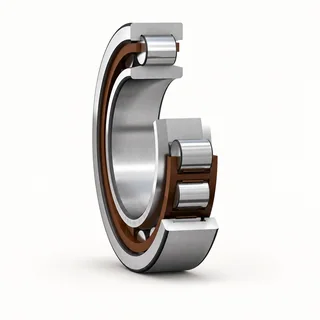
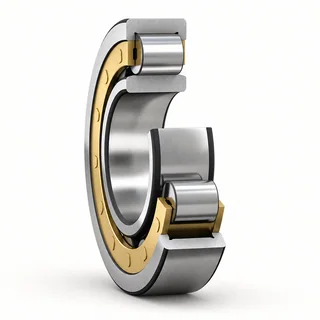
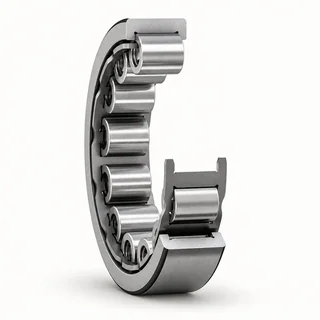
SKF cylindrical roller bearings are used in mill gearboxes, in draft fans and in some conveyors. They support very high radial loads and allow axial displacement of the shaft, making them ideal as floating bearings in configurations with a fixed bearing at the other end.
In vertical mills, cylindrical roller bearings may be in the grinding unit or in the main gearbox. In fans, they usually work at medium speeds and with vibrations, so an adequate internal clearance and lubrication that withstands temperature are needed. The sheet metal or solid cage depends on size and load conditions.
Codes such as NU 221 ECP, NU 224 ECM, NU 320 ECP and NU 326 ECJ appear in these equipments. When ordering a cylindrical roller bearing, it is important to clarify whether it is of type NU, N, NJ or NUP, because each has different axial retention characteristics. The radial clearance must also be indicated, especially if the bearing will operate at elevated temperature.
SNL split housings for assembly and maintenance
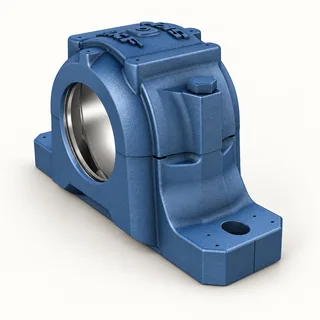
SKF SNL split housings are used in conveyors, bucket elevators and fans. Their main advantage is that they can be mounted and dismounted without removing the shaft, because the upper half is lifted. This reduces downtime and facilitates bearing inspection and relubrication in the field.
In environments with abrasive dust, SNL housings are equipped with effective seals, such as labyrinth or contact seals. Periodic relubrication is essential to purge the dust that enters and maintain a clean grease film.
Codes SNL 505, SNL 509, SNL 526 and SNL 528 correspond to different housing sizes. When ordering an SNL housing, you must indicate the complete code, the type of bearing inside, the fixing system (adapter sleeve, nut or direct) and the type of seal. It is also advisable to clarify whether the complete housing or only the upper cover is needed.
Lubrication and protection against dust
Lubrication is the most critical factor for bearing life in the cement industry. Abrasive dust acts as a polishing paste if mixed with grease. Therefore, bearings must be well sealed and receive new grease regularly to expel contamination through the seals.
In SNL housings, relubrication is done through the grease hole while the equipment is running, if safe. New grease pushes old grease and dust out. The frequency depends on temperature, speed and the amount of dust.
Some bearings come with built-in seals, such as those with the 2RS suffix, which have rubber seals on both sides. Others use metal shields, such as the 2Z suffix. For applications with heat, a larger internal clearance can be requested, such as the C3 suffix. And if mounted on a tapered adapter sleeve, the bearing has the K suffix.
How to identify and order an SKF bearing for a cement plant
To order an SKF bearing for a cement plant, the first step is to read the code engraved on the side face. That code includes the series, size and suffixes that indicate the type of seal, internal clearance or tapered bore. If the bearing is badly damaged and cannot be read, the inner diameter, outer diameter and width can be measured.
In addition to the code, it is advisable to send a photo of the bearing and of the place where it is mounted. That helps identify the type of cage, the seal and the housing configuration. If the bearing is from another brand, you can look for the equivalent SKF code.
We supply SKF bearings for the cement industry. If you have the code or the dimensions, we will quote you promptly. We also distribute SNL housings and fixing accessories. Send us a message via WhatsApp or email with the data and we will guide you for your equipment.
Common mistakes when mounting bearings in a cement plant
One of the most common mistakes is not cleaning the housing well before mounting the new bearing. If old dust remains inside, the new bearing is immediately contaminated. Another mistake is hitting the bearing directly with a hammer, which damages the raceways and cage. Always use appropriate tools or heat the bearing in a controlled manner.
In split housings, sometimes the upper cover is tightened too much, which deforms the housing and loads the bearing. It is also common not to respect the axial clearance of the floating bearing, which causes heating. In bearings with tapered bore, mounting with a poorly tightened adapter sleeve can leave insufficient radial clearance.
To avoid these problems, follow the manufacturer's instructions and use a clean and controlled mounting method. If you have doubts, consult us: we will guide you on the correct procedure for your application. A well-done mounting is the basis for the bearing to last in an environment as demanding as a cement plant.
Frequently asked questions
What SKF bearings are used in cement mills?
In ball mills, spherical roller bearings are used in the trunnions, such as codes 23130 or 22325. In vertical mills, cylindrical roller bearings are used in the gearbox or in the grinding unit. SNL housings are also used in auxiliary systems.
How do I protect bearings from dust in a cement plant?
Use bearings with 2RS seals or SNL housings with labyrinth seals. Perform periodic relubrication to expel dust through the seals. Keep housings clean and check seals frequently.
What does the C3 suffix mean in an SKF bearing?
C3 indicates that the bearing has a larger internal clearance than normal. It is used in applications with high temperatures or interference fits, such as in kilns and mills, to prevent the bearing from seizing due to thermal expansion.
Can I order an SKF bearing with only the dimensions?
Yes, with the inner diameter, outer diameter and width we can identify the bearing. But if you have the engraved code, it is more precise. Send us a photo of the bearing and of the mounting location to help you better.
Do SNL housings come complete with bearing?
SNL housings are sold separately from the bearing. We supply both. When ordering a housing, indicate the SNL code and the bearing inside, and we will quote the assembly.
Products with photos in the catalogue
Keep reading
- SKF Chains: Reliable Power Transmission for Industrial Applications
SKF roller chains offer strength and precision for power transmission in industrial machinery. Learn about the PHC series, ASA and BS standards, and how to identify the correct chain for your equipment.
- SKF tools for industrial maintenance: pullers, heaters, aligners and calibrated shims
SKF tools simplify bearing mounting and dismounting, shaft alignment and instrument calibration. Discover TMMA and TMHP pullers, induction heaters, TKSA aligners and calibrated shims.
- How to Choose SKF Bearings by Application: Load, Speed, Environment, and Mounting
Choosing the right SKF bearing requires analyzing load, speed, environment, and mounting. We explain the main types and how to get a quote with the exact code.
Continue here
Need a quote?
Send us the code, size or a photo of the part and we'll quote you shortly.