
Blog
SKF: Common Failures, How to Recognize Them in Time, and How to Prevent Them with Proper Mounting and Maintenance
We review the most common failures in SKF bearings, their causes, and best mounting and lubrication practices to avoid them.
SKF bearings in Argentina: guide and quotes
Technical team at MR Accesorios Industriales · Updated on October 5, 2026
Common Failures in SKF Deep Groove Ball Bearings
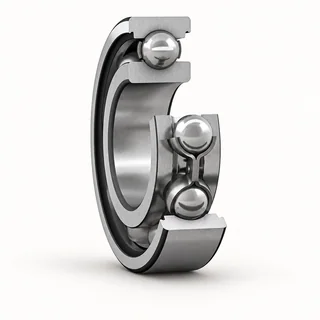
SKF deep groove ball bearings are among the most widely used in Argentine industry, and also among those that fail most often when mounting conditions are not respected. The most common failure is flaking on raceways or balls, which appears due to material fatigue, overload, or insufficient lubrication. Another typical failure is seizure, when the bearing locks up due to lack of internal clearance or excessive temperature. We also frequently see indentation marks on the raceways, caused by mounting with impacts or by contamination with hard particles.
To recognize these failures in time, it is advisable to pay attention to noise and vibration. A deep groove ball bearing in good condition rotates smoothly and quietly; if it starts to hum or rattle, something is happening. The increase in housing temperature is also an early indicator, especially when compared with other points on the machine. During scheduled inspections, the cage, balls, and raceways can be disassembled and visually inspected for pitting, discoloration, or incipient flaking.
To prevent these failures, mounting must be done without direct impacts on the ring that has a firm fit, using appropriate tools or controlled heating. Lubrication must be correct in type and quantity: neither too little, which generates metal-to-metal contact, nor too much, which produces churning heat. At MR we distribute SKF deep groove ball bearings such as 6010, 6008, or 6026, and we advise you on the most suitable internal clearance and seals for your application.
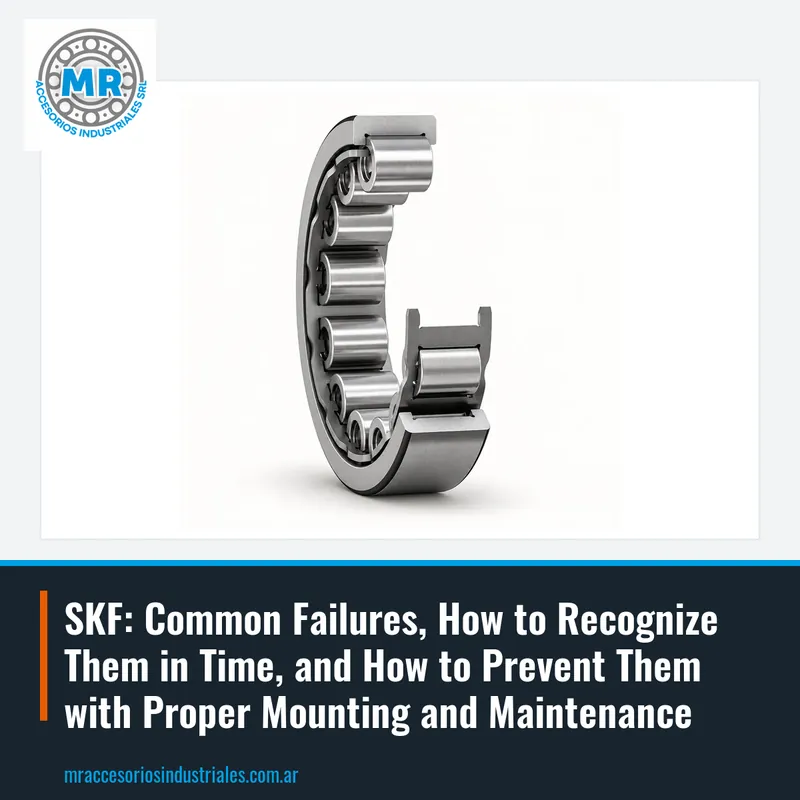
Typical Problems in SKF Cylindrical Roller Bearings
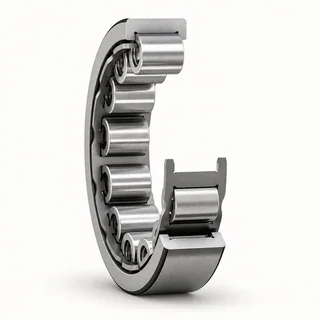
SKF cylindrical roller bearings withstand high radial loads and allow axial displacement in one direction, but they are sensitive to misalignment and lack of lubrication. A frequent failure is premature flaking on the rollers or raceways, often due to misalignment between shafts or excessive load. Roller scoring also appears when there are contaminant particles in the lubricant, and rib wear occurs if there is unforeseen axial load.
To detect these problems, it is key to monitor temperature and noise periodically. A cylindrical roller bearing with rib wear usually generates a characteristic metallic noise, different from the hum of a deep groove ball bearing. Vibration also increases when there is flaking, and it can be measured with simple instruments or by comparison with similar machines. During disassembly, the rollers, cage, and raceways of the inner and outer rings should be inspected for abnormal marks.
Prevention involves correct shaft alignment and clean, sufficient lubrication. In applications with axial loads, a design with adequate ribs must be chosen or combined with another bearing that absorbs that load. At MR we distribute SKF cylindrical roller bearings such as RNU 305 or RNU 306, and we help you define the most suitable variant for your equipment.
SKF Spherical Roller Bearings: Failures Due to Misalignment and Lubrication
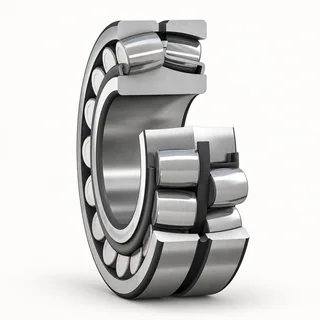
SKF spherical roller bearings are designed to withstand misalignment and combined loads, but they are not immune to failures. Flaking on raceways or rollers remains the most common failure, and it is usually due to insufficient lubrication or loads exceeding the permissible limits. Another typical failure is cage wear, which appears when there are strong vibrations or when the bearing rotates without sufficient load. Skidding marks are also seen on the rollers when acceleration is very abrupt or the lubricant is too viscous.
To recognize these failures, attention must be paid to abnormal noises and temperature increases, especially in applications such as fans, pumps, or conveyor belts. Visual inspection after disassembly is essential: the spherical raceways of the outer ring, the rollers, and the cage should be inspected for flaking, discoloration, or irregular wear. A spherical roller bearing with a damaged cage can lock up and cause catastrophic failure, so it should be replaced at the slightest doubt.
Prevention includes correct lubrication with quality grease or oil, and periodic monitoring of internal clearance and alignment. At MR we distribute SKF spherical roller bearings such as 22325, and we guide you in choosing the internal clearance and lubricant.
SKF Angular Contact Bearings: Failures Due to Axial Load and Fit
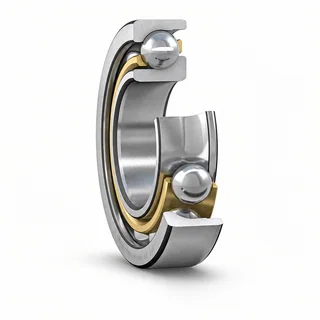
SKF angular contact bearings withstand combined radial and axial loads, and are usually mounted in pairs or assemblies. A frequent failure is flaking in the contact zone between the balls and raceways, caused by excessive axial load or incorrect fit. Wear of the contact surfaces also appears when there is sliding due to lack of preload or inadequate internal clearance. In high-speed applications, overheating due to friction is another common problem.
To detect these problems, it is advisable to measure the housing temperature and compare it with historical values. A sustained increase may indicate excessive preload or insufficient lubrication. Noise also changes: an angular contact bearing with flaking produces a rough, discontinuous sound. During disassembly, the condition of the balls, raceways, and cage should be inspected, paying attention to the load zone and possible sliding marks.
Prevention requires careful mounting, respecting the load direction and the preload indicated by the manufacturer. Lubrication must be suitable for the working speed and temperature, and the ring fit must be correct to avoid sliding. At MR we distribute SKF angular contact bearings such as 7417, and we advise you on the most suitable configuration.
SKF Y-Bearings (Inserts): Failures Due to Contamination and Misalignment
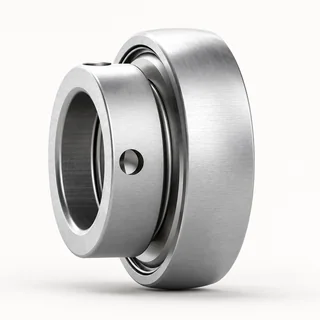
Y-bearings, also called inserts, are widely used in agricultural machinery, conveyors, and processing equipment. Their most common failure is the entry of contaminants through deficient sealing, which causes abrasive wear on balls and raceways. Another typical failure is the loosening of the locking ring on the shaft, which generates sliding and wear in the bore. Failures due to misalignment are also seen when the housing is not properly aligned with the shaft, forcing the bearing to work crooked.
To recognize these failures, the condition of the seals and the shaft fixation should be checked periodically. A Y-bearing with contamination usually presents rough noise and vibration, and the temperature may rise due to additional friction. During disassembly, the bore of the inner ring should be inspected for sliding marks, and the raceways and balls for pitting or flaking. It is also advisable to verify that the set screw or locking eccentric is in good condition.
Prevention includes the use of seals suitable for the work environment, correct shaft fixation, and housing alignment. In applications with a lot of dirt or moisture, it is recommended to use Y-bearings with reinforced seals and periodic relubrication. At MR we distribute SKF Y-bearings such as UC 216, UC 315, or UC 212, and we help you choose the correct housing and fixation.
SKF Tapered Roller Bearings: Failures Due to Fit and Preload
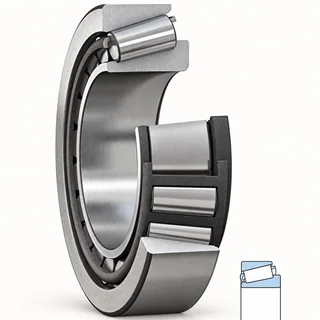
SKF tapered roller bearings are used in wheels, gearboxes, and applications with high combined loads. A frequent failure is flaking on the rollers or raceways, caused by excessive preload or incorrect fit. Wear on the roller ends also appears when there is misalignment or poorly distributed axial load. Another typical failure is overheating due to excessive friction, which can damage the lubricant and accelerate wear.
To detect these problems, it is important to monitor temperature and axial clearance during operation. A tapered roller bearing with excessive preload heats up more than normal and can generate metallic noise. During disassembly, the rollers, cage, and raceways should be inspected for flaking, discoloration, or sliding marks. It is also advisable to measure the internal clearance and compare it with the manufacturer's specifications.
Prevention requires careful mounting, adjusting the preload or axial clearance according to SKF's indications for each application. Lubrication must be correct in type and quantity, and the fit of the rings to the shaft and housing must be adequate to avoid sliding. At MR we distribute SKF tapered roller bearings and guide you on the most suitable fit and lubrication for your equipment.
SKF Rod Ends, Spherical Plain Bearings, and Needle Roller Bearings: Failures Due to Wear and Lack of Lubrication
SKF rod ends and spherical plain bearings are used in steering, suspension, and articulated mechanisms, and their most common failure is wear of the spherical surface due to lack of lubrication or impact loads. Excessive clearance also appears as wear advances, generating vibrations and noise. In SKF needle roller bearings, the typical failure is flaking on the needles or raceways, caused by overload, misalignment, or insufficient lubrication.
To recognize these failures, clearance and smoothness of movement in the articulations must be monitored. A spherical plain bearing with wear presents perceptible play and can lock up or make noise when moving. In needle roller bearings, temperature increase and rough noise are early indicators. During disassembly, the contact surfaces should be inspected for wear, pitting, or flaking, and the condition of the seals and lubrication should be verified.
Prevention includes periodic lubrication with suitable grease, monitoring of clearance and alignment, and replacement at the first signs of wear. At MR we distribute SKF rod ends, spherical plain bearings, and needle roller bearings, and we help you identify the correct part from the code or a photo.
Frequently asked questions
What are the most common failures in SKF bearings?
The most common failures are flaking due to fatigue or overload, wear due to contamination or insufficient lubrication, seizure due to lack of internal clearance, and indentation marks from mounting with impacts. Failures due to misalignment and incorrect fit are also seen.
How can I recognize a failure in an SKF bearing before it breaks?
Early signs are abnormal noise, temperature increase, excessive vibration, and, during inspections, visible marks on raceways, balls, or rollers. Periodic checks should be done and compared with historical values of the machine.
What can I do to prevent failures in SKF bearings?
Respect the mounting indications, use the correct lubrication in type and quantity, monitor alignment and fit, and keep the work environment clean. It is also important to choose the right bearing for each application.
Does MR distribute SKF bearings in Argentina?
Yes, at MR we distribute SKF bearings of different types, such as deep groove ball, cylindrical roller, spherical roller, angular contact, inserts, tapered, and needle roller. We also work with SKF rod ends and spherical plain bearings.
How do I get a quote for an SKF bearing at MR?
You can send us the bearing code, measurements, or a photo of the part via WhatsApp or email. We will quote you promptly and advise you on the most suitable bearing for your application.
Products with photos in the catalogue
Keep reading
- SKF Chains: Reliable Power Transmission for Industrial Applications
SKF roller chains offer strength and precision for power transmission in industrial machinery. Learn about the PHC series, ASA and BS standards, and how to identify the correct chain for your equipment.
- SKF tools for industrial maintenance: pullers, heaters, aligners and calibrated shims
SKF tools simplify bearing mounting and dismounting, shaft alignment and instrument calibration. Discover TMMA and TMHP pullers, induction heaters, TKSA aligners and calibrated shims.
- How to Choose SKF Bearings by Application: Load, Speed, Environment, and Mounting
Choosing the right SKF bearing requires analyzing load, speed, environment, and mounting. We explain the main types and how to get a quote with the exact code.
Continue here
Need a quote?
Send us the code, size or a photo of the part and we'll quote you shortly.