
Blog
SKF Bearings for Industrial Fans: Plummer Housings, Spherical Roller Bearings and Adapter Sleeves
How to select and order SKF bearings for industrial fans: SNL split housings, spherical roller bearings on adapter sleeves and fixed/free side configuration.
SKF bearings in Argentina: guide and quotes
Technical team at MR Accesorios Industriales · Updated on October 18, 2026
How to Choose Bearings for Industrial Fans
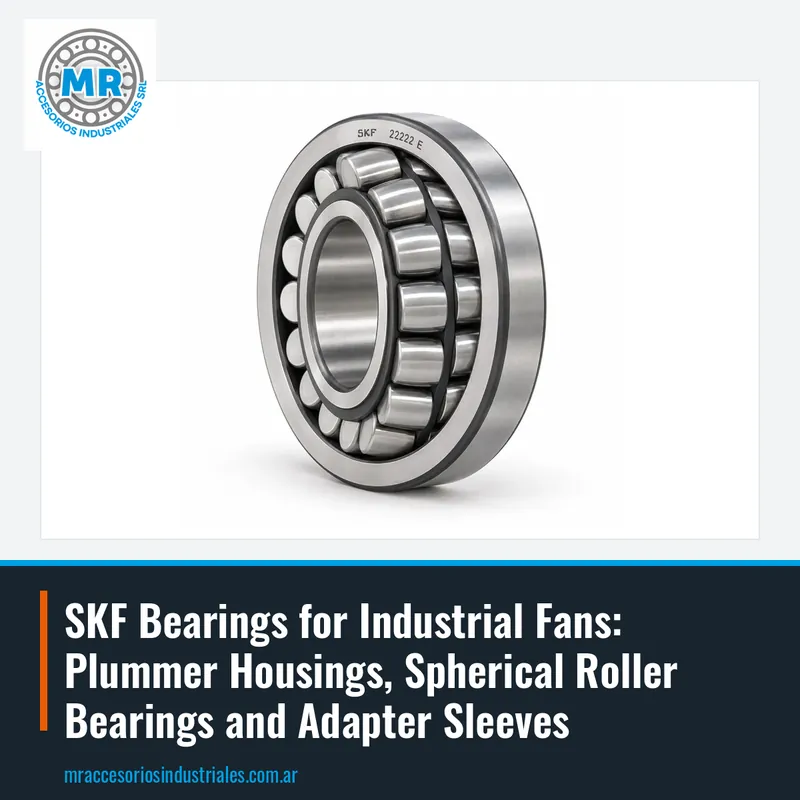
Industrial fans operate with long shafts, variable loads and temperatures that require bearings capable of absorbing misalignments and expansions. The most commonly used SKF bearings for industrial fans are spherical roller bearings, which self-align and support combined radial and axial loads. They are mounted on adapter sleeves in split plummer housings, a classic solution for large equipment.
When selecting the bearing, it is advisable to start from the shaft diameter and estimated loads, but also from the environment: dust, humidity and air temperature influence lubrication and seals. A common mistake is to order only the bearing without considering the housing or the sleeve, when in practice the complete assembly is replaced. That is why at MR we help you define the three components based on the equipment data.
To get a quote, send the fan brand and model, the shaft diameter and, if you have them, the codes engraved on the parts. With that information we will indicate the appropriate bearing, housing and sleeve. You can also send a photo of the current assembly, which always helps to identify the series.
SKF Spherical Roller Bearings for Fans
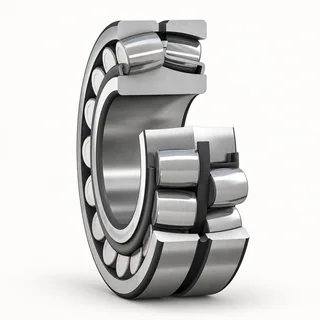
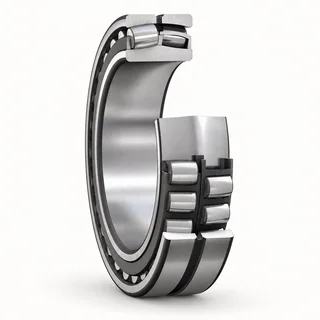
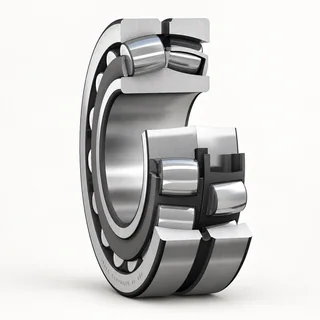
Spherical roller bearings are the most widespread option in industrial fans because they compensate for shaft misalignment and deflection under load. Their design with two rows of rollers on a spherical outer raceway gives them self-aligning capability, key in equipment with long shafts or separate supports. They work well with high radial loads and some axial load in both directions.
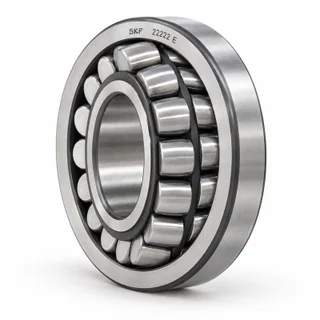
In this application, versions with tapered bore are used, mounted on adapter sleeves on plain shafts. For example, codes 22220 E, 22222 E and 22224 E correspond to spherical roller bearings of the 222 series, very common in medium and large fans. The K suffix indicates tapered bore, although in commercial codes it is sometimes omitted and taken for granted when ordered with a sleeve.
When ordering a spherical roller bearing for a fan, check the internal clearance: many equipment require C3 to absorb thermal expansions. It is also important to define whether the bearing is sealed or open; in relubricatable housings open bearings are used, while 2RS sealed bearings are reserved for maintenance-free applications. If in doubt, consult us with the current code.
SNL Split Housings for Fans
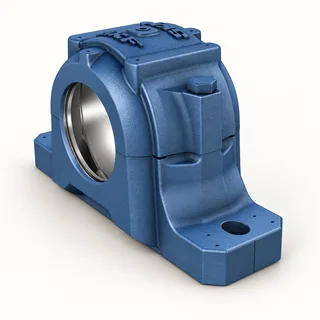
SNL split housings are the typical mounting base for industrial fan bearings. Their body split into two halves allows inspection and replacement of the bearing without dismantling the shaft or the fan. They are fixed to the base with bolts and house the spherical roller bearing with its sleeve, forming a rigid and easy-to-maintain assembly.
In fans, SNL housings are chosen according to shaft diameter and bearing size. For example, SNL 505, SNL 509, SNL 526 and SNL 528 are some of the series sizes. Each housing has a designated range of compatible bearings and sleeves, so it is advisable to order the complete assembly.
A frequent mistake is to reuse the old housing with a new bearing of a different series, which can cause premature wear or vibrations. When quoting, indicate the housing code if you know it, or the shaft diameter and bearing type. At MR we stock SNL housings and help you select the correct model.
SKF Adapter Sleeves for Tapered Mounting
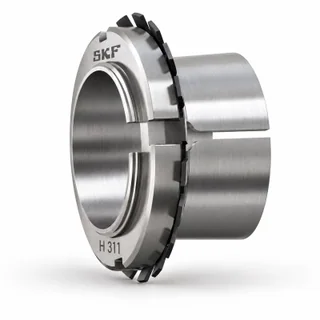
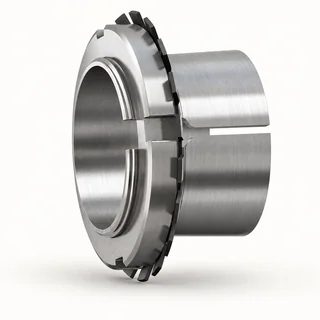
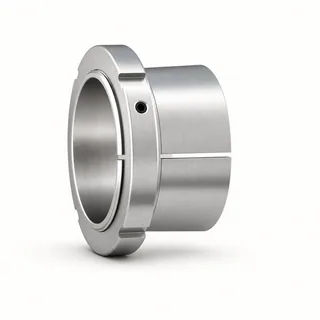
Adapter sleeves are slotted conical parts that slide onto the shaft and are tightened with a nut, expanding the tapered-bore bearing until it is firmly fixed. In industrial fans they allow mounting the bearing on plain shafts without the need for shoulders or complex adjustments. They also facilitate disassembly, since loosening the nut releases the bearing.
Each sleeve is designated with the letter H followed by a number corresponding to the bearing and shaft size. For example, H 311, H 312, H 313 and H 314. These sleeves are used with 222 series spherical roller bearings and corresponding SNL housings, forming a standard assembly.
When ordering a sleeve, verify that the shaft diameter exactly matches that of the sleeve and that the nut and lock washer are included. If you are unsure of the size, measure the shaft with a caliper and send us the measurement.
Fixed and Free Side Configuration in Fans
In an industrial fan, the shaft is usually supported in two housings: one fixed and one free. The fixed side prevents axial displacement of the shaft and absorbs axial loads, while the free side allows thermal expansion without generating stresses. This configuration is essential to avoid overloading the bearings and vibrations due to misalignment.
In practice, the fixed side is achieved by axially fixing the bearing in the housing, while the free side is left with axial clearance so that the bearing can slide slightly. Spherical roller bearings with sleeve allow this adjustment easily, since the position of the bearing on the sleeve defines the axial clearance. Incorrect mounting can block the shaft and damage the bearings.
When assembling the set, follow the fan manufacturer's instructions on which side is fixed and which is free. If you replace the bearings, maintain the same configuration and verify that the free housing does not become stuck. Any doubt about mounting, consult us before installing.
Vibration, Unbalance and Causes of Bearing Failure in Fans
Excessive vibration is the main cause of failure in industrial fan bearings. It can originate from rotor unbalance, coupling misalignment, loose housings or worn bearings. Sustained vibration generates dynamic loads that reduce bearing life and can damage the housing and shaft.
Rotor unbalance produces centrifugal forces that are transmitted to the bearings, causing premature wear and increased temperature. Therefore, it is essential to balance the rotor after any repair and verify alignment between motor and fan. The condition of the housings must also be checked: a loose or uneven base amplifies vibrations.
If you detect abnormal vibration, do not ignore it: check balancing, alignment and bearing condition. A bearing damaged by vibration usually shows pitting or spalling on the raceways. At MR we advise you on replacing the assembly and help you identify the root cause to avoid recurrence.
How to Order the Complete Assembly: Housing, Bearing and Sleeve
To ensure correct and durable mounting, it is advisable to order the complete assembly of housing, bearing and sleeve. Each component is designed to work with the other two, and mixing series or brands can cause incompatibilities. When quoting, indicate the three codes if you have them, or the shaft and fan data.
A typical assembly combines a 222 series bearing, an SNL housing and an H sleeve of the size corresponding to the shaft. If your fan uses another size, send us the shaft diameter and current reference, and we will propose the equivalent assembly. You can also send a photo of the housing and bearing so we can identify the series.
At MR we stock SKF bearings, housings and sleeves, and we help you select the right assembly for your industrial fan. Write to us via WhatsApp or email with your equipment data and we will quote you promptly.
Frequently asked questions
What bearing does an industrial fan use?
Most industrial fans use spherical roller bearings with tapered bore, mounted on adapter sleeves in split plummer housings. The exact series depends on shaft diameter and loads; we assemble the bearing, housing and sleeve set based on that data.
How is an SKF bearing mounted in an SNL housing?
The bearing is mounted on the adapter sleeve, which slides onto the shaft and is tightened with a nut. Then the assembly is placed in the split housing, which is fixed to the base. It is important to respect the fixed and free side configuration to allow thermal expansion.
Why is my industrial fan vibrating?
Vibration can be due to rotor unbalance, misalignment, loose housings or worn bearings. If the bearing is damaged, it must be replaced together with the housing and sleeve to avoid recurring failures.
Can I use a sealed bearing in an industrial fan?
In general, industrial fans use open bearings with relubrication through the housing. 2RS sealed bearings are used in maintenance-free or highly contaminated applications, but they are not common in SNL housings with grease nipple.
How do I order a fan bearing from MR?
Send via WhatsApp or email the shaft diameter, the current bearing or housing code, or a photo of the assembly. With that data we will quote the appropriate SKF bearing, housing and sleeve.
Products with photos in the catalogue
Keep reading
- SKF Chains: Reliable Power Transmission for Industrial Applications
SKF roller chains offer strength and precision for power transmission in industrial machinery. Learn about the PHC series, ASA and BS standards, and how to identify the correct chain for your equipment.
- SKF tools for industrial maintenance: pullers, heaters, aligners and calibrated shims
SKF tools simplify bearing mounting and dismounting, shaft alignment and instrument calibration. Discover TMMA and TMHP pullers, induction heaters, TKSA aligners and calibrated shims.
- How to Choose SKF Bearings by Application: Load, Speed, Environment, and Mounting
Choosing the right SKF bearing requires analyzing load, speed, environment, and mounting. We explain the main types and how to get a quote with the exact code.
Continue here
Need a quote?
Send us the code, size or a photo of the part and we'll quote you shortly.