
Blog
NTN bearing mounting and dismounting: tools, steps, and common mistakes that shorten service life
Practical guide to mounting and dismounting NTN bearings in Argentine industry: proper tools, correct procedure, and the mistakes that cause the most damage.
NTN bearings in Argentina: guide and quotes
Technical team at MR Accesorios Industriales · Updated on October 19, 2026
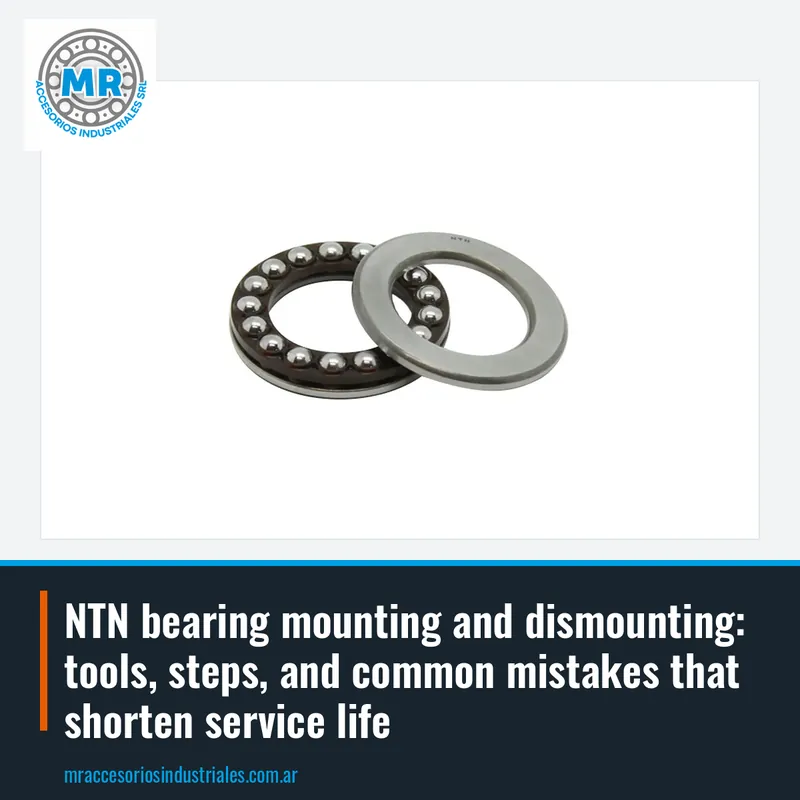
NTN bearing mounting and dismounting: why the procedure defines service life
Mounting and dismounting an NTN bearing is as important as the quality of the component. An incorrect procedure can damage raceways, rolling elements, or seals, and drastically reduce bearing service life. That is why it is advisable to know the proper tools and the steps to follow for each type of bearing. In this guide we review the key points for working with NTN bearings in industrial maintenance.
NTN bearings are manufactured with very tight tolerances, and any blow or improperly applied force can deform their components. During mounting, the goal is to transmit force only through the ring that is mounted with interference, never through the rolling elements. During dismounting, the priority is not to damage the shaft or the housing, and if the bearing is to be reused, neither its raceways.
In Argentine industry, NTN bearings are used in electric motors, gearboxes, pumps, fans, machine tools, and material handling equipment. Each application has its particularities, but the principles of mounting and dismounting are common. Well-executed maintenance starts with choosing the correct method and having the appropriate tools.
Tools for mounting and dismounting NTN bearings
To mount NTN bearings, tools that apply force uniformly and in a controlled manner are needed. Mounting kits with impact sleeves and rings of different diameters are widely used for small and medium bearings. For larger bearings, mounting plates and hydraulic presses are used. There are also induction heaters that expand the inner ring and facilitate mounting without effort.
During dismounting, two- or three-arm mechanical pullers are the basic tool for bearings mounted on shafts. For large or very tight bearings, hydraulic pullers are used, which generate greater force with less operator effort. In some cases, dismounting sleeves with hydraulic nuts are used for bearings with tapered bores. The choice depends on size and fit.
In addition to the main tools, it is advisable to have cleaning items, lint-free cloths, gloves, and a caliper to verify measurements on hand. An infrared thermometer is also useful for monitoring temperature when heating a bearing. At MR we advise you on which one is suitable for your specific application.
Mounting NTN tapered roller bearings
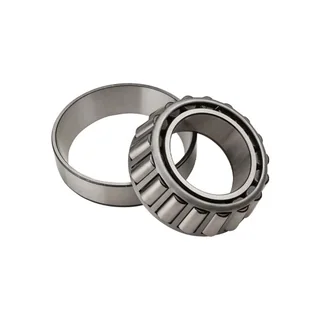
NTN tapered roller bearings, such as codes 32920, 32924, or 32926, are mounted separately: the cone with the rollers and the outer raceway are installed independently. The cone is heated or pressed onto the shaft until it seats against the shoulder. The outer raceway is placed in the housing with a sliding or interference fit, depending on the design. Then the axial clearance is adjusted using nuts or shims.
A common mistake when mounting tapered bearings is not controlling axial clearance or preload. If it is too tight, excessive heat is generated and premature failure occurs. If it is too loose, there is vibration and irregular wear. The manufacturer specifies the clearance or preload range for each application, and it must be measured with a dial indicator or feeler gauges. Another mistake is striking directly on the rollers or cage, which causes dents.
To mount the cone on the shaft, it is recommended to heat it in an oil bath or with an induction heater to the temperature specified by NTN. If a press is used, force must be applied only to the inner ring. Never strike the bearing directly with a hammer. After mounting, verify that the bearing rotates smoothly and that axial clearance is correct.
Mounting NTN angular contact and cylindrical roller bearings
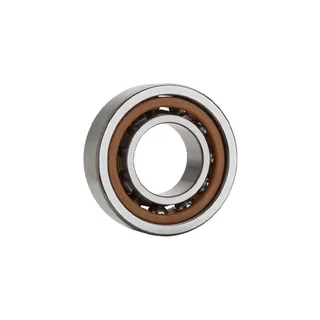
NTN angular contact bearings, such as 7010, 7011, or 7210, are generally mounted in pairs, in face-to-face or back-to-back arrangement. These bearings support combined loads and require controlled preload adjustment. They are mounted by heating the inner ring or pressing on it, and then the other ring is adjusted according to the chosen arrangement. Preload is achieved with precision nuts or springs, depending on the design.
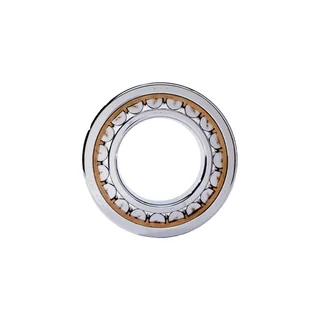
NTN cylindrical roller bearings, such as NU416, NU317, or NU218, have a separable inner and outer ring. This facilitates mounting: the inner ring with the rollers is mounted on the shaft, and the outer ring is placed in the housing. Then the assembly is slid into place to couple them. It is important not to damage the edges of the rollers or the raceways during handling.
In both types, heating the inner ring is the preferred method for interference fits. The heating temperature must not exceed the limit specified by NTN so as not to alter the steel properties. Localized overheating should be avoided, and thermal gloves should be used. After mounting, check that the bearing rotates freely and that there are no abnormal noises.
Mounting NTN Y-bearings (inserts) and needle roller bearings
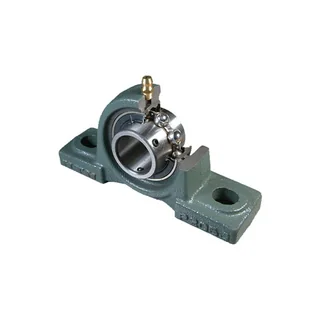
NTN Y-bearings (inserts) are mounted in housings with a spherical outer ring that allows alignment. They are fixed to the shaft by means of set screws, eccentric locking collar, or adapter sleeve. Mounting is simple: slide the bearing onto the shaft to the desired position and tighten the locking element. It is important that the shaft is clean and free of burrs to avoid damaging the seal.
NTN needle roller bearings are mounted carefully to avoid damaging the needles or the cage. They are used in applications with limited radial space and high loads. Mounting is done by pressing on the outer or inner ring, as applicable, with a sleeve that supports the entire circumference. Force should never be applied to the cage or needles.
In both cases, cleanliness is essential. Any foreign particle inside the bearing can cause premature wear. Before mounting, verify that the shaft and housing are within the tolerances recommended by NTN. An incorrect fit can cause slippage on the shaft or in the housing, with consequent damage. If you have doubts about the fit, consult our technical team.
Dismounting NTN bearings: techniques and precautions
Dismounting an NTN bearing must be done with tools that do not damage the shaft or housing. For bearings mounted on shafts, mechanical or hydraulic pullers are used that pull on the inner ring. If the bearing is very tight, the inner ring can be slightly heated with an induction heater to expand it and facilitate extraction. Never strike the bearing directly with a hammer.
For bearings with tapered bores, such as those mounted on adapter sleeves, dismounting is done by loosening the nut and pushing the sleeve outward with a dismounting nut. For large bearings, hydraulic pumps are used that inject oil between the shaft and the sleeve, reducing friction. This method is very effective and prevents damage to the shaft.
If the bearing is to be reused, it must be extracted carefully so as not to damage the raceways or rolling elements. After dismounting, clean and visually inspect it. If it is to be discarded, it is still advisable to extract it without damaging the shaft or housing, so as not to compromise the mounting of the new bearing. At MR we advise you on the appropriate tool for each case.
Common mistakes in mounting and dismounting NTN bearings
One of the most frequent mistakes is striking directly on the bearing with a hammer and without protection. This produces dents on the raceways and rolling elements, which then generate noise and vibration. Another mistake is applying force through the rolling elements, for example, pressing on the outer ring when the fit is on the inner ring. This irreparably damages the bearing.
Lack of cleanliness is another serious mistake. Working in a dirty environment or with contaminated tools introduces particles inside the bearing. It is also a mistake not to verify shaft and housing tolerances before mounting. An excessive fit can cause overheating and seizure; an insufficient fit, slippage and wear. Both cases shorten service life.
During dismounting, a common mistake is using poorly supported pullers that deform the cage or seals. Another mistake is heating the bearing with a direct-flame torch, which alters the steel properties and can damage the seals. It is always preferable to use induction heaters or a controlled oil bath. If you have doubts about the procedure, consult our specialists.
Frequently asked questions
What tools do I need to mount an NTN bearing?
It depends on the size and fit. For small and medium bearings, mounting kits with impact sleeves and rings are used. For large bearings, hydraulic presses or induction heaters. Gloves, caliper, and infrared thermometer are also useful.
Can I hit the bearing with a hammer to mount it?
It is not recommended to strike directly on the bearing. If unavoidable, use a mounting sleeve that supports only the ring with interference and strike gently. Ideally, use a press or heat the bearing.
How do I dismount an NTN bearing without damaging the shaft?
Use a mechanical or hydraulic puller that pulls on the inner ring. If it is very tight, you can heat the inner ring with an induction heater. For bearings with tapered bores, loosen the nut and use a dismounting nut or oil injection.
What mistakes shorten the service life of an NTN bearing?
Striking directly on the bearing, applying force through the rolling elements, working dirty, not verifying tolerances, overheating with a direct flame, and not controlling clearance or preload in tapered or angular contact bearings.
Where can I get tools for mounting and dismounting NTN bearings?
Contact us via WhatsApp or email with the code, size, or a photo of the bearing and we will advise you on the appropriate tool for your application. We will respond promptly.
Products with photos in the catalogue
Keep reading
- How to Read NTN Codes: Structure, Prefixes, and Suffixes
Understanding the designation of an NTN bearing allows you to identify its features and order the correct replacement. We explain the basic nomenclature and the most common suffixes.
- How to Choose NTN Bearings by Application: Load, Speed, Environment and Mounting
Choosing the right NTN bearing involves analyzing load, speed, environment and mounting. We show you what to consider and real catalog codes for each case.
- Common NTN Bearing Failures: How to Recognize and Prevent Them
NTN bearing failures usually have identifiable causes: poor lubrication, incorrect mounting, or contamination. We explain how to detect them early and avoid them.
Continue here
Need a quote?
Send us the code, size or a photo of the part and we'll quote you shortly.