
Blog
Common NTN Bearing Failures: How to Recognize and Prevent Them
NTN bearing failures usually have identifiable causes: poor lubrication, incorrect mounting, or contamination. We explain how to detect them early and avoid them.
NTN bearings in Argentina: guide and quotes
Technical team at MR Accesorios Industriales · Updated on October 13, 2026
Introduction to NTN Bearing Failures
NTN bearings are precision components that, with proper use, achieve a long service life. However, in Argentine industry, premature failures are common and could be avoided with correct diagnosis. Recognizing symptoms early is key to preventing plant downtime and unnecessary costs.
The most frequent failures usually do not originate from manufacturing defects, but from inadequate operating conditions. Poor lubrication, forced mounting, or contaminant ingress are the main causes. Therefore, understanding how these problems manifest allows action before damage becomes irreversible.
In this guide, we review the most common types of failures in NTN bearings according to their design: tapered, angular contact, inserts, cylindrical, spherical, cam, and needle. For each case, we explain what to observe and how to prevent it with good maintenance practices.
Typical Failures in NTN Tapered Roller Bearings
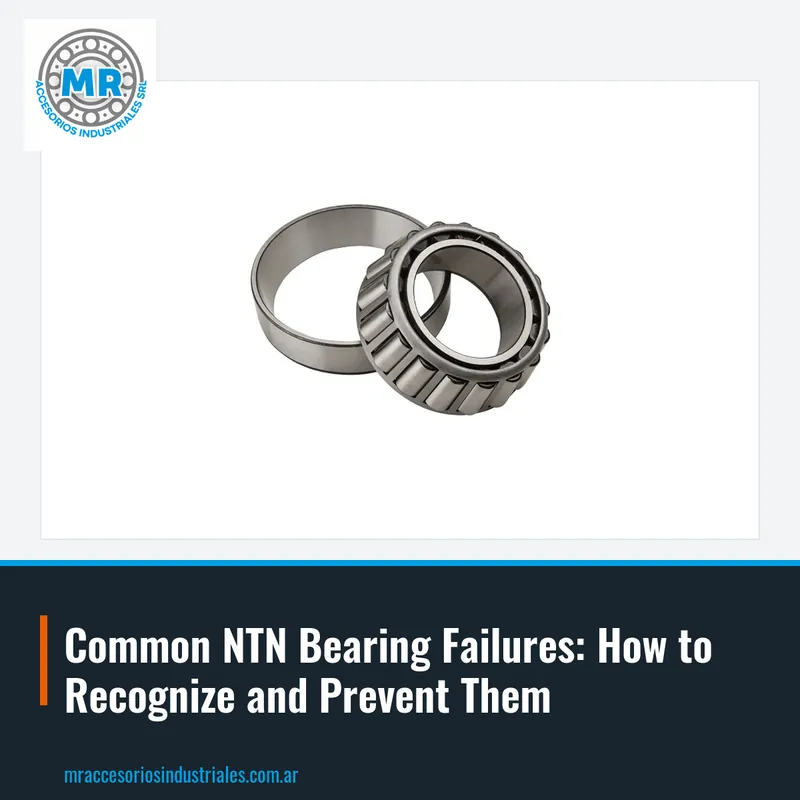
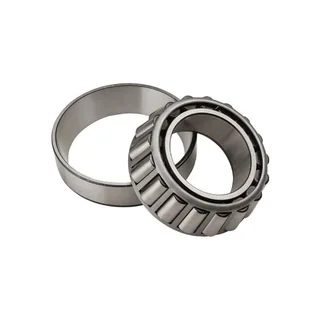
NTN tapered roller bearings, such as models 32924 or 32910, support combined radial and axial loads. A frequent failure is flaking on raceways or rollers, which appears as small metal scales. This is usually due to improperly adjusted internal clearance or excessive preload during mounting.
Another common symptom is overheating, which is felt by touch on the housing. It may indicate lack of lubricant or incorrect tightening of the lock nut. If detected early, it is enough to correct the adjustment and renew the grease; if ignored, damage progresses to cage breakage.
To prevent these failures, it is essential to follow the mounting procedure indicated by the manufacturer. Always measure axial clearance after installation and verify that the outer raceway is properly seated. If in doubt, consult a specialist before starting the equipment.
Problems in NTN Angular Contact Bearings
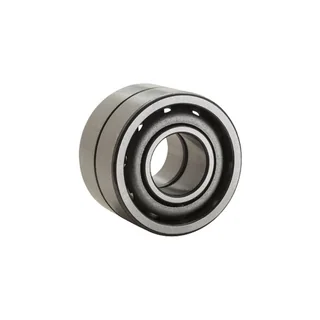
NTN angular contact bearings, such as 7911 or 7317, are often mounted in pairs to support axial loads in both directions. A common failure is indentation by foreign particles, seen as small marks on the raceways. This occurs when the lubricant is contaminated or seals are damaged.
Vibration wear is another frequent problem in machines that remain stopped with oscillating loads. It manifests as bright polishing in the contact areas of the rolling elements. To avoid it, it is recommended to rotate the shaft periodically and isolate the stopped machine from environmental vibrations.
Mounting these bearings requires precision: they must be installed with the appropriate preload, which depends on the application. A common mistake is over-tightening the nut, which generates heat and reduces service life. Always follow catalog instructions and use appropriate mounting tools.
Failures in NTN Y-Bearings (Inserts)
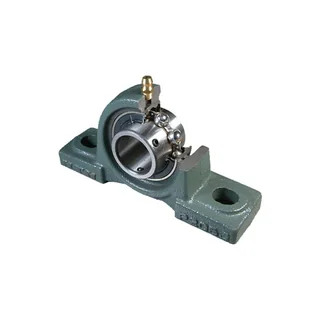
NTN Y-bearings, such as AR202 or AS208, are mounted in pillow block or flange housings and are widely used in agricultural machinery and conveyors. The most common failure is loosening of the inner ring on the shaft, causing slippage and wear. This is usually due to inadequate fit or lack of locking.
Another typical failure is corrosion on external surfaces, especially in humid environments or with frequent washdowns. Corrosion can penetrate to the raceways and cause pitting that leads to noise and vibration. To prevent it, use bearings with efficient seals and apply water-compatible grease.
When mounting these bearings, it is key to verify that the set screw is properly tightened on the shaft groove. The housing must also be correctly aligned to avoid eccentric loads. Careless mounting shortens service life and can damage the housing.
Failures in NTN Cylindrical Roller Bearings
NTN cylindrical roller bearings, such as NU413 or NU215, are used in gearboxes and electric motors. A recurring failure is scratching of the raceways by hard particles, seen as fine lines in the rolling direction. This indicates lubricant contamination or wear of other components.
Misalignment between shaft and housing produces a diagonal wear pattern on the rollers. It is detected by increased temperature and characteristic noise. To correct it, realign the supports and verify housing concentricity.
Prevention includes using clean lubricants and periodic filter changes. It is also important not to overload the bearing beyond its dynamic capacity. At the slightest sign of abnormal noise, inspect the bearing and replace it if it shows signs of fatigue.
Failures in NTN Spherical Roller Bearings
NTN spherical roller bearings, such as 21314 or 21318, tolerate misalignment and heavy loads. A typical failure is cage wear due to lack of lubrication, which manifests with metal particles in the grease. A damaged cage can jam the rollers and cause sudden seizure.
Surface fatigue on the raceways is another common failure in applications with fluctuating loads. It is observed as flaking in localized areas. To delay this phenomenon, use a lubricant with extreme pressure additives and respect regreasing intervals.
Mounting these bearings requires special attention to the seating of the outer spherical raceway. A frequent mistake is forcing the bearing with blows, which damages the rollers. For medium and large sizes, heat it uniformly with an induction heater and use an appropriate mounting device.
Failures in NTN Cam Followers, Support Rollers, and Needle Roller Bearings
NTN cam followers and support rollers, which run on cams and guides, often fail due to fatigue on the outer surface. This is due to high point loads and lack of lubrication at the contact with the cam. It manifests as flaking or cracks on the outer ring.
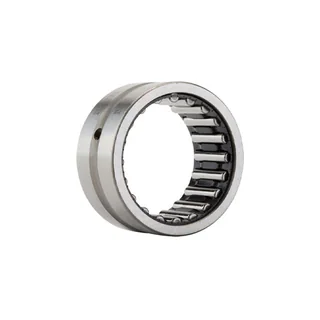
In NTN needle roller bearings, the most common failure is wear of the needles due to lack of lubricant film. This occurs in frequent starts or with very high loads at low speed. Damage is detected by increased radial clearance and metallic noise.
To prevent these failures, it is essential to use the correct lubricant and keep it clean. Also verify that the cam follower rotates freely and that the shaft is well aligned. In critical applications, monitor temperature and vibration to anticipate replacement.
Frequently asked questions
What are the most common failures in NTN bearings?
The most common failures are flaking, scratching, particle indentation, corrosion, and wear due to lack of lubrication. Most are caused by poor mounting, contamination, or inadequate lubrication.
How can I tell if an NTN bearing is failing?
Typical symptoms are abnormal noise, vibration, increased temperature, and presence of metal particles in the grease. If you detect any, inspect the bearing as soon as possible.
What causes flaking in an NTN bearing?
Flaking is usually caused by material fatigue due to excessive loads, inadequate internal clearance, or incorrect mounting. It can also be due to poor lubrication.
How are NTN bearing failures prevented?
They are prevented with careful mounting, using appropriate tools, lubricating with the correct product and in the right amount, and keeping the environment clean. Respecting maintenance intervals is also key.
Where can I get genuine NTN bearings in Argentina?
At MR Accesorios Industriales, official NTN distributor in Buenos Aires, Argentina. You can quote your bearing via WhatsApp or email indicating the code, dimensions, or sending a photo of the part, and we will respond promptly.
Products with photos in the catalogue
Keep reading
- How to Read NTN Codes: Structure, Prefixes, and Suffixes
Understanding the designation of an NTN bearing allows you to identify its features and order the correct replacement. We explain the basic nomenclature and the most common suffixes.
- How to Choose NTN Bearings by Application: Load, Speed, Environment and Mounting
Choosing the right NTN bearing involves analyzing load, speed, environment and mounting. We show you what to consider and real catalog codes for each case.
- GUMMI Couplings: Vibration Absorption and Reliable Power Transmission for Industry
GUMMI elastic couplings absorb vibrations and misalignments, protect machinery, and ensure reliable power transmission. Learn about their configurations and how to choose the right model.
Continue here
Need a quote?
Send us the code, size or a photo of the part and we'll quote you shortly.