
Blog
How to Read SKF Codes: Designation Structure, Prefixes, Suffixes and Real Examples
SKF codes follow a logic of series and suffixes that allows identifying dimensions, type and characteristics. We explain how to read them and what data to send for a quote.
SKF bearings in Argentina: guide and quotes
Technical team at MR Accesorios Industriales · Updated on October 8, 2026
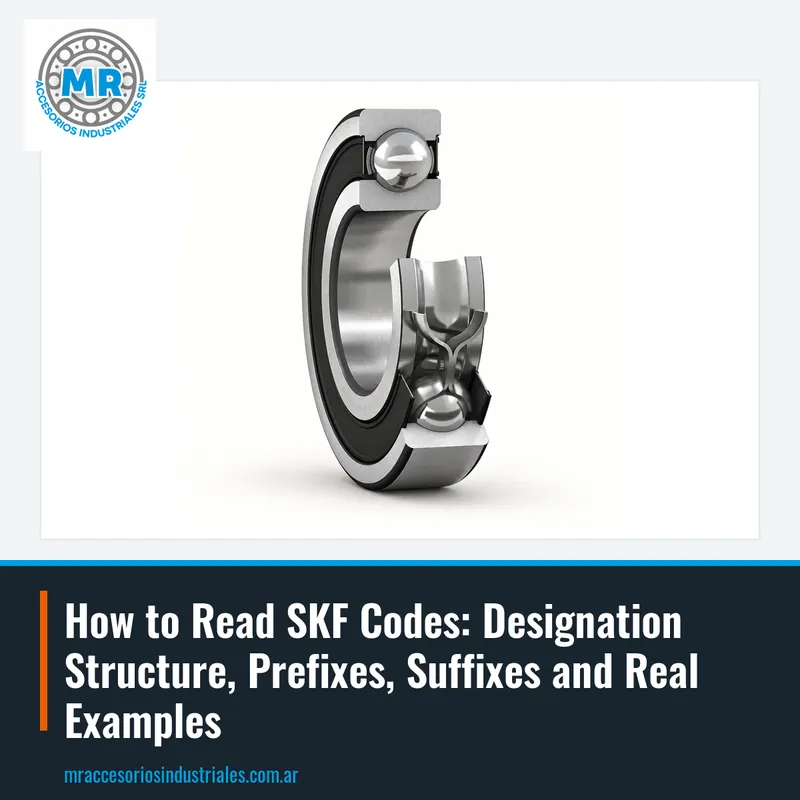
Basic Structure of an SKF Code
An SKF code consists of a basic designation and, often, prefixes and suffixes. The basic designation identifies the bearing type and its dimension series. For example, a deep groove ball bearing of the 60 series with a 50 mm bore is designated 6010. Prefixes and suffixes add information about materials, seals or internal clearance.
In the basic designation, the first digits or letters indicate the bearing type. A 6 at the beginning corresponds to a single row deep groove ball bearing, and a 7 to a single row angular contact bearing. Letters like N, NU or NJ at the beginning identify cylindrical roller bearings.
The last two digits of the basic designation usually indicate the bore diameter multiplied by 5. Thus, 6010 has a 50 mm bore, and 6008 has a 40 mm bore. For very small or very large bores, other rules apply. It is always advisable to verify the actual size in the technical catalog.
Deep Groove Ball Bearings: 60 and 62 Series
Deep groove ball bearings are the most common in industry. They are identified with codes starting with 6, such as 6010, 6008 or 6026. The 60 series has a lighter section than the 62 series, which is more robust. The number following the series indicates the bore size.
In equipment such as electric motors, pumps or fans, these bearings support moderate radial and axial loads. Their simple designation facilitates replacement: if the part is engraved with 6008, that exact code is requested. Suffixes like 2RS or 2Z indicate the type of seal or shield.
When quoting a deep groove ball bearing, it is advisable to send the complete code and a photo of the part. If the bearing has a rubber seal on both sides, 2RS is added. If it has metal shields, 2Z is used. Internal clearance greater than normal is indicated with C3. These suffixes are key to not receiving a bearing different from the one needed.
Cylindrical Roller Bearings: Common Designations
Cylindrical roller bearings are designated with letters such as N, NU or NJ at the beginning, which indicate on which ring the flanges are located. For example, N3055 is a cylindrical roller bearing with a basic designation starting with N. Codes such as RNU 305 or RNU 306 also appear in the catalog.
These bearings support high radial loads. They are used in gearboxes, large electric motors and heavy machinery. The designation includes the series number and bore size, similar to deep groove ball bearings.
When ordering a cylindrical roller bearing, it is essential to indicate the complete designation. An N and a NU are not interchangeable: the NU has flanges on the outer ring and the N on the inner ring. If the part is engraved with RNU 305, that exact code must be requested to ensure correct fit.
Spherical Roller Bearings: 223 Series
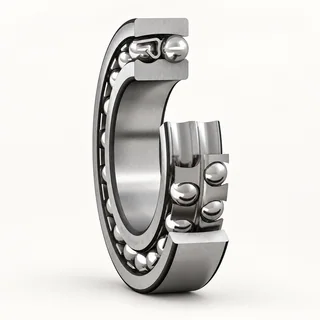
Spherical roller bearings are identified with codes starting with 2, such as 22325, 22361 or 23666. The 223 series is common in applications with heavy loads and misalignments. The digits following the series are the bore code.
These bearings have two rows of rollers and a spherical outer ring, which allows them to absorb shaft misalignments. They are used in industrial fans, mills, conveyors and mining equipment. Their designation does not include letters in the basic part, only numbers.
When quoting a spherical roller bearing, it is advisable to send the complete code and, if available, the dimensions. Some may have a tapered bore, indicated with the suffix K. For example, a 22325 K has a tapered bore for mounting with an adapter sleeve. It should always be verified whether the application requires a cylindrical or tapered bore.
Angular Contact Bearings: Codes Starting with 7
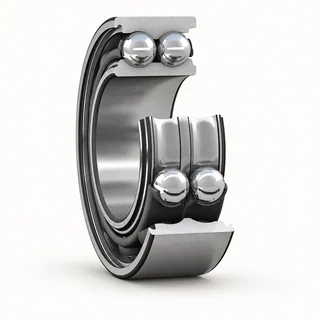
Single row angular contact bearings are identified with codes starting with 7, such as 7417, 7453 or 7829. The basic designation indicates the series and size, and other characteristics are added with suffixes.
These bearings support combined radial and axial loads in one direction. They are used in pumps, compressors, machine tool spindles and gearboxes. They are often mounted in pairs, face-to-face or in tandem, to support axial loads in both directions.
When ordering an angular contact bearing, it is key to indicate the complete code, with all suffixes that appear on the part, because they change the bearing characteristics. If you have trouble reading it, send us a photo of the engraving and we will quote it with the exact designation.
Y-Bearings (Inserts)
Y-bearings, also called inserts, are mounted in pillow block or flange housings. Codes such as UC 216, UC 315 or UC 212 appear in the catalog. When ordering them, the safest is to copy the exact code that appears on the part.
Y-bearings have a spherical outer ring that allows alignment within the housing. They are used in agricultural machinery, conveyors, fans and processing equipment. Their designation is simple and direct, which facilitates ordering. If the engraving is worn, a photo of the insert and the mounted housing helps us identify it.
When quoting a Y-bearing, it is advisable to send the complete insert code and, if you also need the housing, its code or a photo. With that data we will quote the assembly.
Common Suffixes: 2RS, 2Z, C3 and K
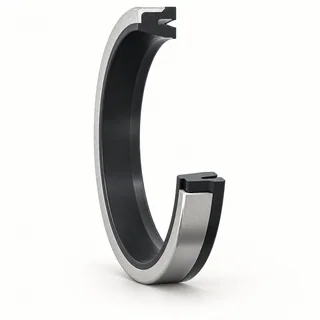
Suffixes in SKF codes indicate specific characteristics. The suffix 2RS means the bearing has rubber seals on both sides. The suffix 2Z indicates metal shields on both sides. These seals protect against contamination and retain grease.
The suffix C3 indicates internal clearance greater than normal. It is used in applications with high temperatures or forced fits. The suffix K indicates a tapered bore, which is mounted on an adapter sleeve or directly on a tapered shaft. These suffixes are added at the end of the basic designation.
When reading a complete code, first identify the basic designation and then the suffixes. For example, a 6010 2RS C3 is a deep groove ball bearing with rubber seals and C3 clearance. It is always advisable to copy the exact code from the part or manual to avoid errors when ordering the spare part. At MR we market SKF bearings from Buenos Aires, Argentina: send us the code, measurement or a photo via WhatsApp or email and we will respond promptly.
Frequently asked questions
What does the suffix 2RS mean on an SKF bearing?
The suffix 2RS indicates that the bearing has rubber seals on both sides. These seals protect against contamination and retain internal grease.
How do I know the bore diameter of an SKF bearing?
In most bearings with a bore of 20 mm or more, the last two digits of the basic designation multiplied by 5 give the diameter in mm. For example, 6010 has a 50 mm bore.
What is the difference between 2RS and 2Z?
2RS means rubber seals on both sides, which offer better sealing against moisture and dust. 2Z means metal shields on both sides, which protect against particles but do not seal as tightly.
What is C3 clearance in a bearing?
C3 clearance is an internal clearance greater than normal. It is used in applications with high temperatures or forced fits, where the bearing needs more internal clearance to function correctly.
Can I order an SKF bearing with just a photo?
Yes, you can send a photo of the part where the engraved code is visible. With that data we will quote the exact bearing. If the code is not visible, you can also send the main dimensions.
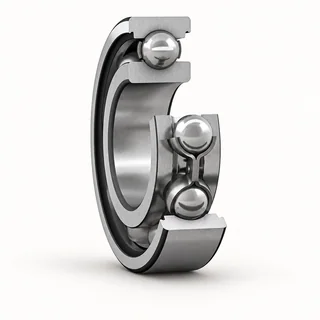
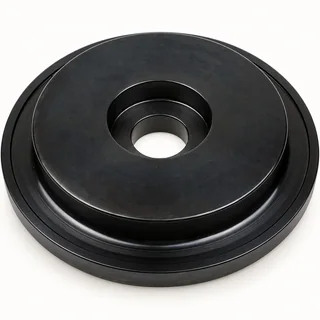
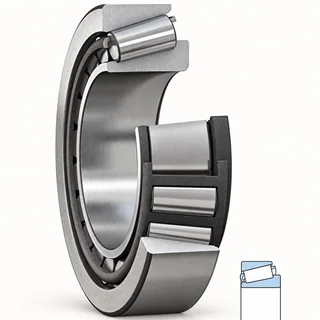
Products with photos in the catalogue
Keep reading
- SKF Chains: Reliable Power Transmission for Industrial Applications
SKF roller chains offer strength and precision for power transmission in industrial machinery. Learn about the PHC series, ASA and BS standards, and how to identify the correct chain for your equipment.
- SKF tools for industrial maintenance: pullers, heaters, aligners and calibrated shims
SKF tools simplify bearing mounting and dismounting, shaft alignment and instrument calibration. Discover TMMA and TMHP pullers, induction heaters, TKSA aligners and calibrated shims.
- How to Choose SKF Bearings by Application: Load, Speed, Environment, and Mounting
Choosing the right SKF bearing requires analyzing load, speed, environment, and mounting. We explain the main types and how to get a quote with the exact code.
Continue here
Need a quote?
Send us the code, size or a photo of the part and we'll quote you shortly.