
Blog
HMV hydraulic nut mounting: how to fit a tapered bore bearing onto an adapter sleeve
Step-by-step guide to mounting a tapered bore bearing onto an adapter sleeve using an HMV hydraulic nut. Which parts go together and how to control the fit.
SKF bearings in Argentina: guide and quotes
Technical team at MR Accesorios Industriales · Updated on October 18, 2026
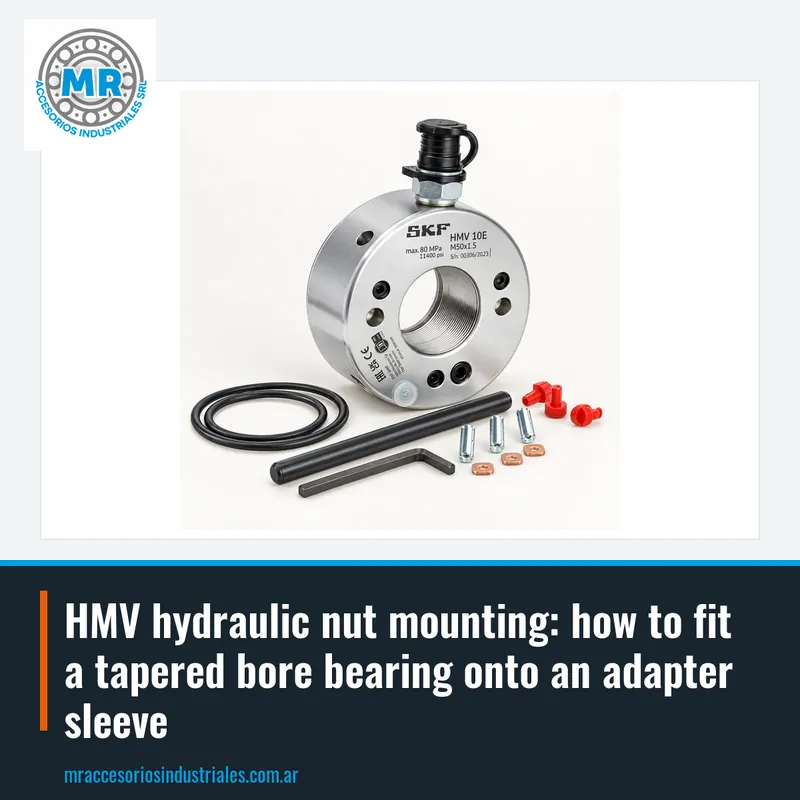
What is an HMV hydraulic nut and what is it for
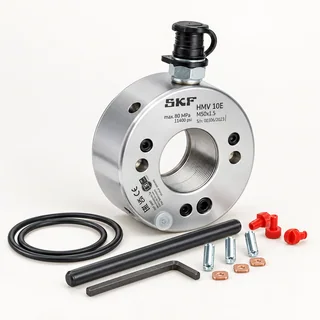
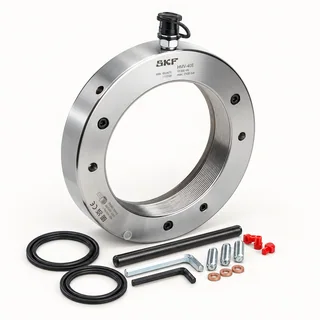
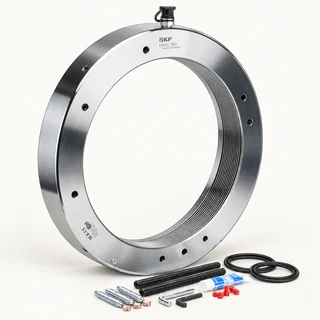
The HMV hydraulic nut is a mounting tool that allows tapered bore bearings to be fitted onto adapter sleeves or directly onto tapered shafts. Unlike a mechanical nut, which is tightened with a wrench, the HMV uses oil pressure to generate a controlled axial thrust. This facilitates the displacement of the bearing along the taper without impacts or excessive heating. In industrial maintenance it is used when space is limited or when precision in the fit is required.
The principle is simple: the nut is screwed onto the threaded end of the sleeve or shaft, and a hand pump injects oil behind an annular piston. That piston pushes against the bearing or against an intermediate washer, moving it axially. Since the bore is tapered, each millimetre of advance reduces the internal clearance of the bearing. That is why mounting with an HMV hydraulic nut is the recommended method for medium and large bearings, where the interference fit is important.
In the SKF catalogue, hydraulic nuts of the HMV series are identified with codes such as HMV 10E or HMV 19E. To choose the correct nut, you need to know the thread of the sleeve or shaft. At MR we supply these nuts and help you select the one that corresponds to your application.
The adapter sleeve: the basis of the mounting
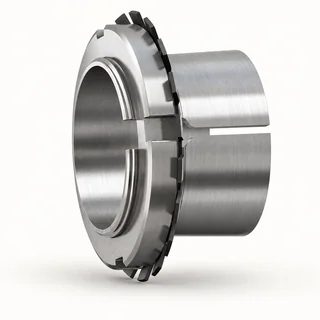
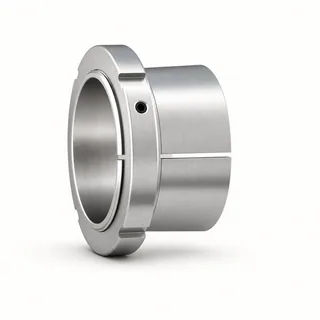
The adapter sleeve is a steel sleeve with a cylindrical bore and a tapered outer surface. It slides onto the shaft and serves as a seat for tapered bore bearings, identified with the K suffix. As the bearing advances on the taper, the sleeve is compressed against the shaft and becomes fixed by interference. Sleeves of the H series, such as H 207 or H 306, are used on transmission shafts, fans and pumps.
Each sleeve has a thread on its larger end to accommodate a lock nut or a hydraulic nut. It also has a slot for the tab of the lock washer. Before mounting, check that the shaft diameter is within the specified tolerance and that the surface is clean and free of burrs. A scratched or rusty shaft can prevent the correct seating of the sleeve.
To choose the correct sleeve, you need the shaft diameter and the bearing code. At MR we distribute SKF adapter sleeves and quote the complete assembly: sleeve, lock nut and hydraulic nut if you need it.
KM lock nut: the final lock
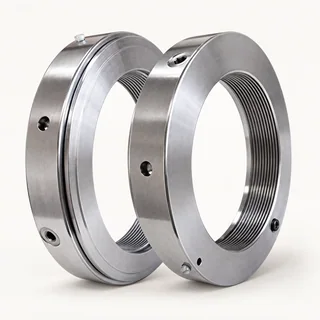
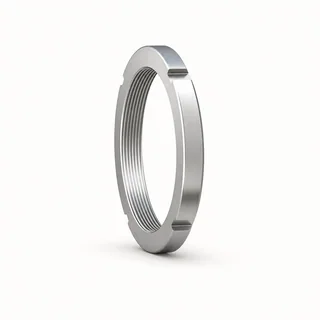
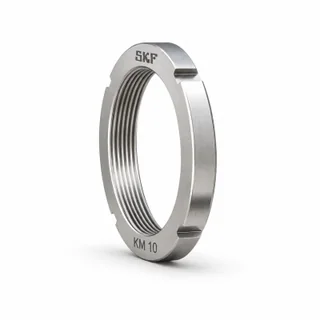
Once the bearing has reached the desired position on the sleeve, it must be fixed axially so that it does not loosen during operation. For this, a KM series lock nut is used, such as KM 9 or KM 5. These nuts have a fine thread and are tightened against the bearing or against a lock washer. Their function is to maintain the preload or internal clearance achieved during fitting.
The KM nut is installed after removing the hydraulic nut. It is screwed on by hand until it bottoms out and then tightened with a hook or impact wrench, depending on size. To prevent it from loosening, a tab of the lock washer is bent into a slot of the nut. It is important not to replace the washer with an ordinary washer, because the tab is what locks the assembly.
When ordering a lock nut, it is advisable to indicate the sleeve code or the thread diameter. At MR we supply SKF lock nuts and help you confirm compatibility with your sleeve.
Preparation before mounting with an HMV hydraulic nut
Before starting, gather all the parts: the tapered bore bearing, the adapter sleeve, the HMV hydraulic nut, the hand pump with pressure gauge and the recommended clean oil. You also need the KM lock nut with its lock washer for the final closure. The shaft must be clean, dry and free of surface damage. It is recommended to measure the shaft diameter at several points to ensure it is within tolerance.
The sleeve is slid onto the shaft to the approximate working position. Then the bearing is placed on the taper, pushing it by hand until it makes contact. The HMV hydraulic nut is screwed onto the threaded end of the sleeve until the piston touches the bearing or an intermediate washer. It is key that the nut is well aligned and that the piston is fully retracted before starting to pump.
A common mistake is not purging the air from the hydraulic circuit. If air remains inside the nut, the advance will be irregular and the pressure gauge will give false readings. Therefore, pump slowly until oil comes out without bubbles from the bleed screw. At MR we quote the HMV hydraulic nut you need.
Step-by-step fitting with an HMV hydraulic nut
With the HMV nut in position and the circuit purged, start pumping oil slowly. The piston advances and pushes the bearing onto the sleeve taper. As the bearing moves, the sleeve is compressed against the shaft and the internal clearance of the bearing decreases. The operator must monitor the pressure gauge and, if possible, measure the radial clearance with feeler gauges before, during and after mounting.
The advance must be uniform and without pressure spikes. If the pressure rises sharply without the bearing moving, stop and check: there may be dirt on the taper, lack of lubrication on the thread or a mispositioned sleeve. Never force with impacts or heat the bearing if using a hydraulic nut, because control of the fit is lost. The HMV nut allows cold, clean and repeatable mounting.
The final fitting point is determined by the residual internal clearance or by the clearance reduction specified by the bearing manufacturer. There is no universal pressure: it depends on the bearing size, the fit and the condition of the shaft. Therefore, it is essential to record the mounting pressure and axial displacement for future maintenance. Each nut, such as HMV 10E or HMV 19E, corresponds to a specific thread, so it must match that of the sleeve or shaft.
Final fixing with KM nut and lock washer
When the bearing has reached the correct position, release the pressure from the hydraulic nut and unscrew it carefully. In its place, fit the lock washer and the corresponding KM lock nut. The nut is tightened firmly against the bearing or against the washer, depending on the design. Then a tab of the washer is bent into a slot of the nut to prevent it from loosening.
It is important not to reuse old lock washers if the tabs are fatigued or broken. A damaged washer can allow the nut to loosen and the bearing to lose its fit. At MR we supply SKF lock nuts and compatible lock washers, so that the mounting is secure. We also quote the complete assembly: sleeve, hydraulic nut and lock nut.
After fixing the nut, it is recommended to turn the shaft by hand to verify that the bearing rotates smoothly and without hard spots. If irregular resistance is felt, there may be an alignment or dirt problem. In that case, it is advisable to disassemble and check before putting the equipment into operation. A job done well with an HMV hydraulic nut prolongs bearing life and prevents premature failures.
Common mistakes and how to order the correct parts
One of the most frequent mistakes is using a hydraulic nut with the wrong thread. If the thread does not match that of the sleeve, both the nut and the sleeve can be damaged. Therefore, check the sleeve code and thread before ordering the HMV. Another mistake is not lubricating the thread and piston before mounting, which increases friction and distorts the pressure indicated by the gauge.
It is also common to confuse the hydraulic nut with the lock nut. The HMV is a mounting tool that is removed after fitting; the KM is the one that remains fixed on the equipment. The HMV should not be left mounted in service, because it is not designed to withstand continuous axial loads. When ordering spare parts, it is advisable to send a photo of the sleeve and bearing, or indicate the codes engraved on the parts.
At MR we work with SKF HMV hydraulic nuts, H adapter sleeves and KM lock nuts. If you have doubts about compatibility, we will indicate the correct combination for your shaft and bearing. You can write to us via WhatsApp or email with the bearing code, shaft diameter and a photo of the assembly. We will quote the parts promptly.
Frequently asked questions
Which HMV hydraulic nut do I need for my sleeve?
The HMV hydraulic nut must have the same thread as the adapter sleeve. To confirm, tell us the sleeve code or measure the thread and we will help you choose.
Can I leave the HMV hydraulic nut mounted on the equipment?
No, the hydraulic nut is a mounting tool. After fitting the bearing, it is removed and replaced by a KM lock nut with its lock washer. The HMV is not designed to withstand axial loads in service.
How do I know when to stop pumping during mounting with a hydraulic nut?
The final point is determined by the residual internal clearance of the bearing or by the clearance reduction indicated by the manufacturer. It is controlled with feeler gauges or by measuring axial displacement. There is no universal pressure; it depends on size and fit.
What is the difference between an HMV hydraulic nut and a KM lock nut?
The HMV uses oil pressure to push the bearing onto the taper during mounting. The KM is a mechanical nut that is tightened with a wrench and remains fixed on the equipment to maintain the bearing position. They are complementary parts, not interchangeable.
Can I mount a tapered bore bearing without a hydraulic nut?
Yes, you can use a KM lock nut with an impact wrench, but control of the fit is less precise and there is a greater risk of damaging the bearing. The HMV hydraulic nut is the recommended method for medium and large bearings.
Products with photos in the catalogue
Keep reading
- SKF Chains: Reliable Power Transmission for Industrial Applications
SKF roller chains offer strength and precision for power transmission in industrial machinery. Learn about the PHC series, ASA and BS standards, and how to identify the correct chain for your equipment.
- SKF tools for industrial maintenance: pullers, heaters, aligners and calibrated shims
SKF tools simplify bearing mounting and dismounting, shaft alignment and instrument calibration. Discover TMMA and TMHP pullers, induction heaters, TKSA aligners and calibrated shims.
- How to Choose SKF Bearings by Application: Load, Speed, Environment, and Mounting
Choosing the right SKF bearing requires analyzing load, speed, environment, and mounting. We explain the main types and how to get a quote with the exact code.
Continue here
Need a quote?
Send us the code, size or a photo of the part and we'll quote you shortly.