
Blog
DIAMOND in agriculture: components for combine harvesters, seeders, norias and storage plants, and how to quote them
Guide to choosing and quoting DIAMOND roller and conveyor chains in agricultural applications. Includes example codes and common mistakes to avoid.
DIAMOND catalog by part number
Technical team at MR Accesorios Industriales · Updated on November 14, 2026
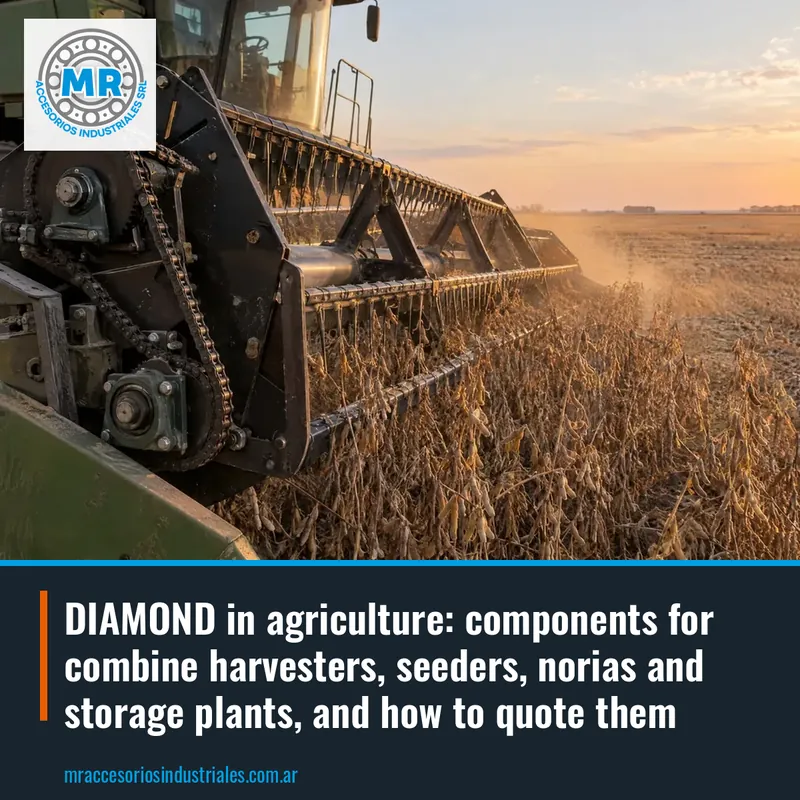
Why DIAMOND is an option for Argentine agriculture
In agriculture, equipment works many hours under demanding conditions: dust, harvest residues, humidity and variable loads. DIAMOND roller and conveyor chains are used in combine harvesters, seeders, norias and storage plants at different points on the machine. We market these chains so you can replace wear parts with the same reference you already have on your machine.
DIAMOND chains transmit motion in traction, lifting and grain transport systems. In a combine harvester, for example, they drive augers, elevators and cleaning mechanisms. In a noria, conveyor chains lift the grain from the hopper to the top. Choosing the correct chain avoids unexpected downtime and reduces wear on other components.
When you need to replace a chain, the most practical thing is to identify the code engraved on the links or on the original box. If you can't find it, you can measure the pitch between pins and the inner width. With that data we quote the DIAMOND chain that corresponds to your equipment.
DIAMOND roller chains for power transmission
DIAMOND roller chains are used to transmit power between shafts in agricultural equipment. They are the ones you see in the drives of combine harvester headers, in seeding systems and in grain conveyors. They are identified by pitch, which in standard American series is expressed in eighths of an inch. For example, a 40 chain has a half-inch pitch and a 60 has a three-quarter-inch pitch.
Within roller chains there are different series and versions. Some DIAMOND reference codes are 40LG, 60LG and 200H. If you have one of these codes on your chain, that's enough for us to quote it.
To order a DIAMOND roller chain, you need to know the pitch, the number of rows and the total length. If you have the old chain, count the links and measure the pitch between pins. A photo of the chain and the sprocket where it works also helps. With that data we indicate the exact reference and send you the quote shortly.
DIAMOND conveyor chains for norias and elevators
DIAMOND conveyor chains are designed to move bulk material, such as grains, seeds or fertilizers. They are used in norias, bucket elevators and chain conveyors in storage plants and silos. Unlike roller chains, these have wider links and reinforced side plates to withstand the load of the transported material.
In norias, the conveyor chain holds the buckets that lift the grain. Some DIAMOND reference codes in this line are S81X, 43SB and 63SB. The choice depends on the size of the noria, the working speed and the type of grain. A poorly sized chain stretches prematurely or breaks a link during harvest.
When you order a DIAMOND conveyor chain, indicate the code if you have it, or measure the pitch and inner width of the links. It is also useful to know how many buckets the noria has and the center distance. If you are not sure, send us a photo of the chain and the complete system. We quote the correct chain for your elevator.
How to identify a DIAMOND chain on your equipment
Most DIAMOND chains have the code engraved on the links or on a plate. That code combines numbers and letters that indicate the pitch, link type and series. If the code is blurry, you can measure the pitch between pins and compare it with standard tables.
On conveyor chains, the code is usually on the sides of the links. If you can't find the code, measure the distance between centers of consecutive pins and the inner width of the link.
In addition to the code, it is advisable to check the condition of the sprockets and buckets. A new chain on a worn sprocket wears out quickly. So when you order a chain, tell us what equipment it works on and how long it has been since the sprockets were changed. We advise you so the replacement lasts longer.
Common mistakes when choosing or mounting agricultural chains
One of the most frequent mistakes is ordering a chain only by length, without verifying the pitch. Two chains can have the same number of links but different pitches, and they will not work on the same sprocket. Always confirm the pitch by measuring the distance between pins. Another mistake is using a standard roller chain where a reinforced conveyor chain goes.
During mounting, respect the tension recommended by the equipment manufacturer. A chain that is too tight works under stress and stretches; a loose chain jumps teeth and hits the sides. In norias, tension is adjusted by moving the lower or upper shaft. After the first hours of work, it is advisable to check the tension because new chains settle in.
It is also a mistake not to lubricate the chain in applications where required. Agricultural roller chains need periodic lubrication to reduce friction between pins and bushings. In dusty environments, it is recommended to clean the chain before lubricating. If the chain works outdoors, choose one with anti-corrosion treatment.
Where DIAMOND chains are used in agriculture
In combine harvesters, DIAMOND roller chains are in the header drives, the unloading auger and the clean grain elevators. They are also used in the transmission systems of the platforms. In seeders, chains drive the seed and fertilizer meters, and the transmission systems of the drive wheels.
In storage plants, DIAMOND conveyor chains are mounted on grain norias, chain conveyors and bucket elevators. These are chains that work many hours per day during harvest, so reinforced models are chosen. In silos and dryers, there are also roller chains in the extractors and augers.
In forage equipment, such as round balers and mixers, DIAMOND chains transmit power to the rotors and augers. In all these cases, the chain is a wear component that is replaced periodically. Therefore, it is advisable to have the exact reference identified to replace it quickly when needed.
How to quote DIAMOND chains for your equipment
To quote a DIAMOND chain, the best thing is to send us the exact code if you have it. For example, 40LG or S81X. If you don't have the code, measure the pitch between pins and the inner width of the link, and count the number of links. A photo of the old chain and the place where it works also helps.
If you are replacing a chain on imported equipment, you can tell us the brand and model of the machine. With that data we look for the equivalent DIAMOND chain. If you have a sample of the old chain, you can bring it to our store in Buenos Aires, Argentina, so we can identify it.
Once we have the data, we send you the quote shortly by WhatsApp or email. We also tell you if it is advisable to change the sprockets along with the chain. We help you choose the correct reference.
Frequently asked questions
How do I know which DIAMOND chain my combine harvester uses?
Look for the code engraved on the links of the old chain. If it is not there, measure the pitch between pins and the inner width. With that data we indicate the correct DIAMOND chain.
What is the difference between a roller chain and a conveyor chain?
The roller chain transmits power between shafts, as in the drives of a header. The conveyor chain moves bulk material, such as grains in a noria, and has wider, reinforced links.
Can I use a DIAMOND chain in a storage noria?
DIAMOND conveyor chains are used in norias and grain elevators. Send us the pitch, inner width and center distance of your equipment and we will quote the corresponding one.
What data do I need to quote a DIAMOND chain?
Send us the chain code if you have it, or the measurements of pitch, inner width and number of links. A photo of the old chain also helps to identify it.
Is it advisable to change the sprockets along with the chain?
Yes, if the sprockets are worn, a new chain wears out faster. We recommend checking the condition of the sprockets and changing them if necessary.
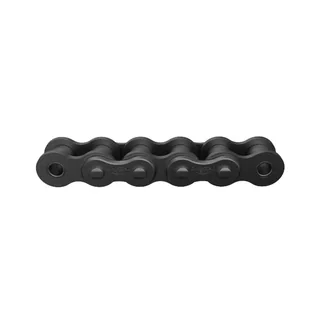
Products with photos in the catalogue
Keep reading
- How to identify a DIAMOND chain by its code and choose the right one
Learn about the DIAMOND chain lines we supply in Argentina: roller chains and conveyor chains. We explain what each one is for and how to quote them by code.
- How to read DIAMOND chain codes: structure, examples and what data to send
What a DIAMOND chain code says, how it relates to pitch in roller chains, how conveyor chains differ and what data to send for a quote.
- Where DIAMOND chain is used and how to choose it for your equipment
We review typical applications of DIAMOND chains in Argentine industry, how to identify the correct model and what care extends their useful life.
Continue here
Need a DIAMOND quote?
Send us the DIAMOND part number, the size or a photo of the part and we will get back to you with a quote.