
Blog
BGL dimensions: how to identify the code from the part and what data to send for a quote
We explain how to measure BGL sleeves, nuts and washers to identify the correct code, and what information to send us for an accurate quote.
Technical team at MR Accesorios Industriales · Updated on November 11, 2026
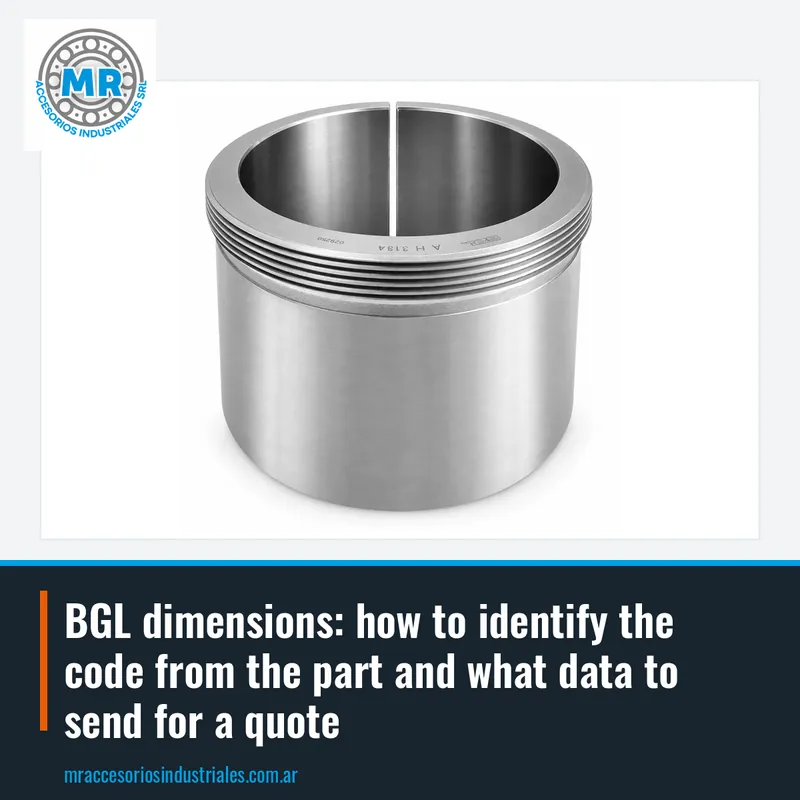
Adapter sleeves: how to measure them and identify the code
BGL adapter sleeves are used to mount bearings with a tapered bore on cylindrical shafts. They are parts with a longitudinal slot and a nut that, when tightened, pushes the sleeve against the shaft and secures the bearing. They are identified with codes such as H210, H211 or H310, which correspond to adapter sleeve series.
To identify the code from the part, measure the sleeve's bore diameter with a caliper. That measurement, in millimeters, is the first data point to locate the code within the series. You can also check if the code is engraved on the outer surface or on the nut. If the part is very worn, a photo with a ruler next to it helps confirm the measurement.
When requesting a quote, send us the shaft diameter, the sleeve's total width and, if you have it, the code of the bearing it will mount. Avoid confusing the bore diameter with the outer diameter. If you have doubts, take a photo of the sleeve next to a ruler and send it to us via WhatsApp or email.
Hydraulic sleeves: identification by dimensions and series
BGL hydraulic sleeves are used to mount large bearings where mechanical interference is not enough. They are mounted with oil under pressure, which expands the sleeve to slide it onto the shaft. Typical codes are AOH248, AOH234 or AOH252, which correspond to hydraulic sleeves.
To identify a hydraulic sleeve, measure the bore diameter and the total width. Also observe if it has a thread at the end for the hydraulic nut and if it has an oil hole. Compare those measurements with the BGL catalog tables, but if you don't have the catalog, send us the measurements and we'll tell you the corresponding code. Many times the code is engraved on the front face of the sleeve.
When requesting a quote, include the shaft diameter, the sleeve width and the thread type if you can measure it. If the sleeve comes with its hydraulic nut, mention the nut code if you see it. Avoid forcing identification only by the outer diameter, because two sleeves with the same bore diameter can have different widths and belong to different series.
Withdrawal sleeves: how to recognize and measure them
BGL withdrawal sleeves are used to dismount bearings with a tapered bore. They have a thread at the end, where a nut is placed for dismounting. Common codes are AH210, AH211 or AH310, which correspond to withdrawal sleeves.
To identify a withdrawal sleeve, measure the bore diameter and the total width. Also check if it has a thread at the end and if the nut is part of the assembly. Sometimes the code is engraved on the outer surface, but if it's not visible, the measurements are enough to determine it. Compare with the reference tables.
When requesting a quote, send us the shaft diameter, the sleeve width and a photo of the part. It is important to clarify if you need only the sleeve or also the withdrawal nut. Avoid confusing it with an adapter sleeve: if you have doubts, send us a photo and we'll verify it.
Lock nuts: dimensions and designation
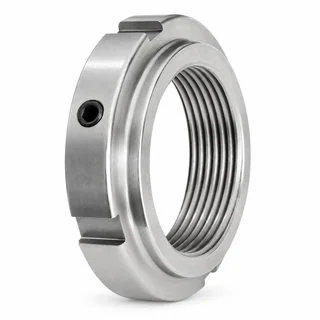
BGL lock nuts are used to secure adapter sleeves and bearings on shafts. They have an internal thread and slots on the outer face for tightening with a special wrench. Typical codes are KMP1, KM20 or KMP2, which correspond to lock nuts. For example, a KM20 nut has an M100x2 thread.
To identify a lock nut, measure the thread's bore diameter with a caliper and, if you can, the thread pitch with a thread gauge. Those two measurements give you the thread designation, which is what defines the code. Also observe if it has a radial hole for a locking screw or if it is self-locking. Many nuts have the code engraved on the front face.
When requesting a quote, indicate the nominal thread diameter and pitch, or directly the code if you see it. If the nut comes with a lock washer, mention if you need it too. Avoid measuring only the outer diameter, because it does not determine the code: what matters is the internal thread.
Hydraulic nuts: identification by thread and application
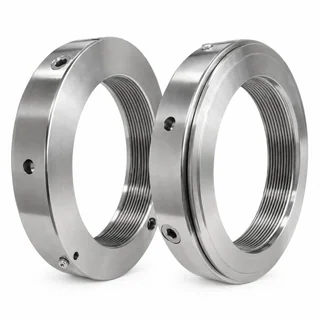
BGL hydraulic nuts are used together with hydraulic sleeves to mount large bearings. They have an internal piston that, when oil is injected, pushes the sleeve against the bearing. Codes such as HMV18E, HMV36E or HMV54E indicate the thread diameter in millimeters: HMV18E corresponds to a 90 mm thread, HMV36E to 180 mm and HMV54E to 270 mm.
To identify a hydraulic nut, measure the thread's bore diameter and pitch. Also check if it has a hole for the hydraulic pump coupling and a pressure gauge. The code is usually engraved on the outer face, but if it's not visible, you can deduce it from the thread measurement. Compare with the reference table: each HMV number corresponds to a specific thread diameter.
When requesting a quote, send us the thread diameter, the pitch and a photo of the nut. If you use it with a hydraulic sleeve, indicate the sleeve code to verify compatibility. Avoid confusing the hydraulic nut with a common lock nut: the hydraulic one is more robust and has an oil connection.
Lock washers: how to measure them and order them
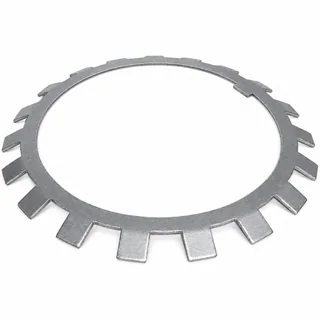
BGL lock washers are placed between the lock nut and the bearing to prevent the nut from loosening. They have an internal tab that fits into the sleeve's slot and external tabs that are bent over the nut. They are designated with codes from the MB series, whose number matches that of the nut.
To identify a lock washer, measure the bore diameter and the tab width. Also observe if it has an internal or external tab, because that defines the type. Many washers have the code engraved, but if not, with the measurements and the nut code you can determine it. For example, a washer for a KM20 nut is designated MB20.
When requesting a quote, indicate the bore diameter, the tab type and, if you have it, the code of the nut it is used with. Avoid ordering only by the outer diameter, because there are washers with the same outer diameter but different bore. A photo with a ruler helps confirm the measurement.
Inch sleeves and mounting tools
BGL also has inch adapter sleeves, for shafts with imperial dimensions. The measurement logic is the same as for metric ones, but with the shaft diameter in inches.
To identify an inch sleeve, measure the bore diameter with a caliper and convert to inches (1 inch = 25.4 mm). If the bore diameter is 25.4 mm, it corresponds to a 1-inch shaft. Also check if the code is engraved or if the nut has markings. Compare with the conversion tables to confirm.
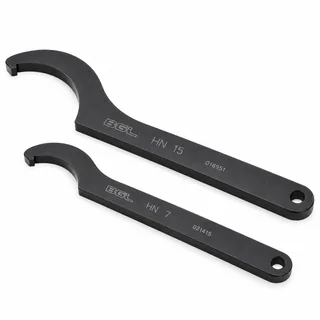
We also handle BGL mounting and maintenance tools. To request a quote, indicate the tool type and the code of the part it is used on, or send a photo of the nut or sleeve and we'll guide you.
Frequently asked questions
How do I identify the code of a BGL sleeve if it has no engraving?
Measure the bore diameter with a caliper and the total width. With those measurements, compare with the reference tables or send them to us via WhatsApp and we'll tell you the corresponding code.
What measurements do I need to quote a BGL lock nut?
We need the thread's bore diameter and pitch. If you can't measure the pitch, send a photo of the nut with a ruler and we'll help you identify it.
Are BGL inch sleeves measured the same as metric ones?
Yes, the bore diameter is measured with a caliper and converted to inches by dividing by 25.4. For example, 25.4 mm corresponds to 1 inch.
Can I use a BGL hydraulic nut with a common adapter sleeve?
No, hydraulic nuts are designed for hydraulic sleeves with a thread and oil hole. Using one with a common adapter sleeve is not compatible.
What do I do if I can't find the code on the lock washer?
Measure the bore diameter and the tab width, and if you have the nut it is used with, indicate its code. With that data we can identify the correct washer.
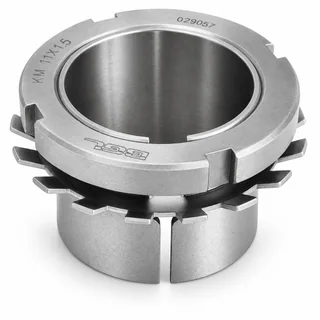
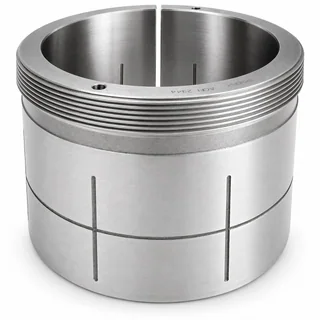
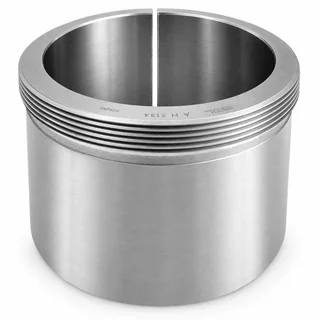
Products with photos in the catalogue
Keep reading
- BGL in Argentina: product guide, uses and quoting by code
Discover BGL product lines for bearing mounting and locking: adapter sleeves, locknuts, lock washers and tools. We explain how to identify and order them.
- How to Read BGL Codes: Designation Structure, Prefixes, Suffixes, and Real Examples
BGL codes follow a clear logic: letters indicate the part type and numbers define the size. We explain how to interpret them so you order the correct replacement.
- How to choose and maintain BGL sleeves and nuts
Practical guide to choose and assemble adapter, hydraulic sleeves and BGL nuts in industrial equipment. Learn the key codes and dimensions.
Continue here
Need a BGL quote?
Send us the BGL part number, the size or a photo of the part and we will get back to you with a quote.