
Product page
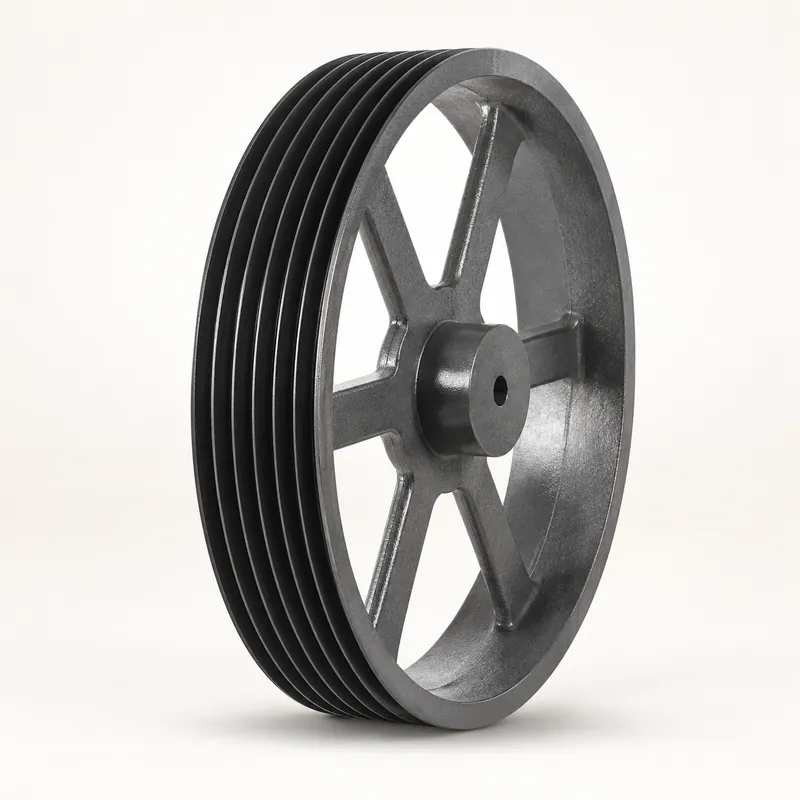
Industrial pulley 160 mm, 4 grooves, section C
- Manufacturer Part Number
- POLEA 160 4C
- Brand
- EMMARIn-house manufacturing
- Category
- Power transmission
- Subcategory
- Pulleys
- Series
- Sección C
 In-house manufacturing
We respond promptly.
Request your quote via WhatsApp or email, with the quantity and time frame you need.
Can't find the exact model? Write to us with the part number or model you're looking for: we'll find it and quote it, even if it's not listed in the catalog.
Description
EMMAR POLEA 160 4C is a pulleys reference, within Power transmission. Request a quote for POLEA 160 4C via WhatsApp or email with the quantity you need; we respond promptly with lead time and equivalents.
The POLEA 160 4C pulley is a V-belt transmission pulley with section C, 160 mm diameter and 4 grooves. It is used to drive shafts from a motor, distributing power among several belts in parallel. It is in-house manufactured, EMMAR brand, designed for equipment where torque must be transmitted with a good speed ratio and some tolerance to misalignment. It is mounted on shafts with a keyway and secured with a set screw or bushing as applicable.
This item is a pulley with a 160 mm diameter, 4 grooves and section C. The designation POLEA 160 4C summarizes those three data points: the reference pitch diameter, the number of grooves and the belt profile it accepts. Section C corresponds to wide-profile V-belts, which are used when medium and high power must be transmitted with few grooves. The four grooves allow the load to be distributed among four belts, which extends the service life of the assembly and reduces the demand on each belt.
It is used in industrial machine transmissions: compressors, fans, centrifugal pumps, conveyor belts, mixers and milling equipment. It also appears in the field, in agricultural machines and in implements that take motion from the power take-off. In all those cases the pulley is mounted on the shaft of the driven equipment or the motor, and works together with a smaller-diameter pulley to increase or reduce RPM as required by the machine.
To choose it correctly, take into account the shaft diameter, the type of fastening (keyway, set screw or taper bushing), the center distance and the transmission ratio you are looking for. Verify that the belt section matches that of the pulley and that the number of grooves is the same on both pulleys. During assembly, align the pulleys with a straightedge or laser, tension the belts according to the belt manufacturer's manual and check the parallelism of the grooves.
If you need another size, another number of grooves or another section, an equivalent pulley or a nearby size within the same line can be requested. Send the code, the shaft diameter and the belt section you use, and we will confirm which option fits. We can also see whether a pulley with more grooves for the same diameter or a different diameter is better to adjust the final speed of the equipment.
MR Accesorios Industriales manufactures this pulley and sells it together with the rest of the power transmission line. If you want to request a quote or inquire about a variant, send the code POLEA 160 4C via WhatsApp and we will reply with the technical information you need.
Dimensions
- Size
- 160mm
- Grooves
- 4
- Section
- C
Frequently Asked Questions
- What does section C mean on a pulley?
- Section C is the V-belt profile that the pulley accepts. It defines the width and depth of the groove, and determines which belt fits. Do not mix sections: a belt of another letter does not seat properly and wears out quickly.
- How do I know if I need 4 grooves or fewer?
- It depends on the power to be transmitted and the pulley diameter. More grooves distribute the load better, but require more width. If you already have the drive pulley, the simplest thing is to match the number of grooves on both.
- Can I request a pulley with a different shaft diameter?
- Yes. The pulley is manufactured with the bore and fastening you need. Send the shaft diameter, the type of keyway and the belt section, and we will quote the corresponding variant.