
Blog
Which SKF grease to use: the lubrication point data that define the grease
Choosing the right SKF grease starts by surveying the lubrication point: bearing type and size, speed, load, temperature and environmental conditions. We tell you which data to look at, how to verify compatibility when changing grease and how to read the package code.
SKF bearings in Argentina: guide and quotes
Technical team at MR Accesorios Industriales · Updated on October 14, 2026
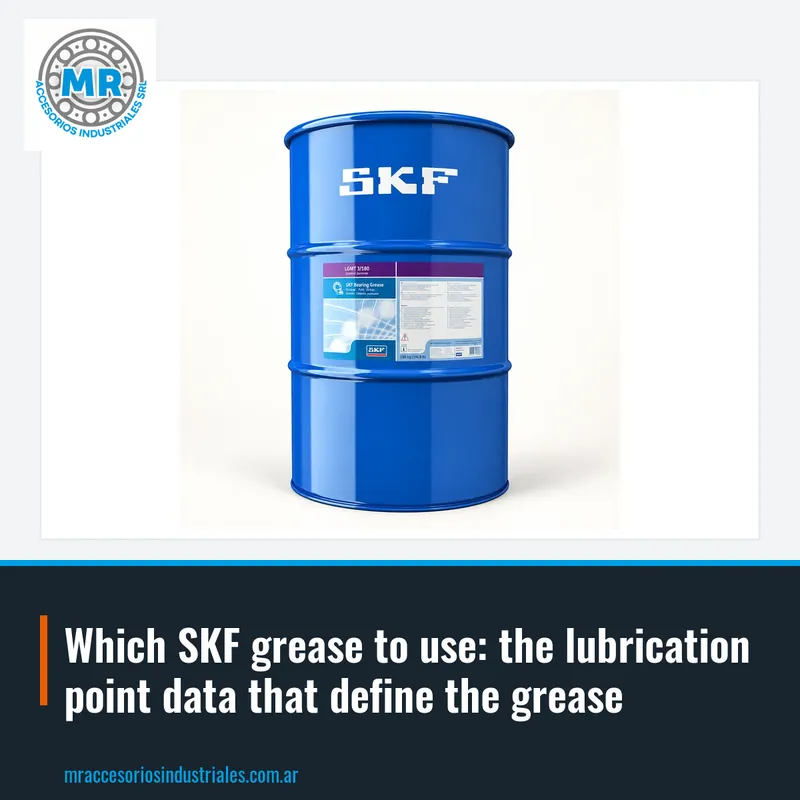
Which lubrication point data define the grease
Before choosing which SKF grease to use, survey the lubrication point. The bearing type and size, rotation speed, load it supports and working temperature are the data that most influence the selection. A grease for a small, fast bearing is not the same as for a large, heavily loaded one. Therefore, the first step is to identify the exact bearing: you can read the code engraved on the raceway or measure its main dimensions.
Environmental conditions also matter: presence of water, dust, vibration or contact with food change the requirement. For example, in humid environments a grease with good washout resistance is advisable, while in food equipment a formulation suitable for that use is needed. Vibration requires a grease that does not displace from the contact point, and dust calls for one that seals well and prevents particle entry.
When you ask for an SKF grease, describe those conditions. At MR we distribute the LGMT, LGEP, LGWA, LGHP, LGEM and LGFG lines, and we help you define which one fits. Send us the bearing code, approximate speed and working temperature to guide you. With that data we indicate the most suitable option and quote it for you.
Speed and load: how they condition the grease
Bearing speed defines grease consistency. For high speeds, softer grades are used, offering lower resistance to movement. For low speeds with heavy load, harder grades that maintain the lubricating film are preferred. The consistency grade is measured with the NLGI scale, which goes from 000 to 6: low numbers are more fluid greases and high numbers are thicker.
Load also influences additives. Heavy or impact loads usually require greases with extreme pressure additives, while moderate loads allow general-purpose greases. If the bearing supports combined loads or moments, a grease with good adhesion and slip resistance is advisable.
If you have doubts about the speed-load combination, consult us. We distribute SKF greases in different consistency grades, and we indicate which is most suitable for your application. Send us the lubrication point data and we quote the right option. For example, for an electric motor bearing with medium speed and light load, a grade 2 grease is usually the right choice.
Working temperature and water resistance
Working temperature is a critical data point. SKF greases are formulated for different ranges: some withstand high temperatures without degrading, while others are designed for cold starts or moderate conditions. A grease exposed to excessive heat oxidizes and loses its properties, and one that does not resist cold hardens and makes starting difficult.
The presence of water or moisture requires a grease with good washout resistance and anti-corrosion protection. In wash bays, process plants or outdoor equipment, an inadequate grease emulsifies and loses lubrication capacity. Water can enter the bearing and cause corrosion, pitting and premature failure, so the grease must repel or absorb it without losing consistency.
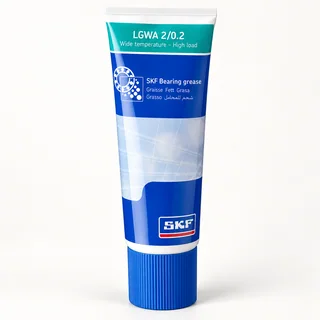
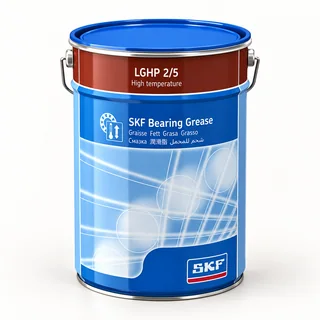
When asking which SKF grease to use, indicate the maximum and minimum temperature of the point and whether there is contact with water. At MR we help you choose among the lines we distribute, such as LGWA 2/5 or LGHP 2/5, and we quote the right package. You can also mention if there are hot water or steam wash cycles, because that changes the requirement.
Compatibility when changing grease
Changing grease without verifying compatibility can cause softening, hardening or separation of components. Greases with incompatible thickeners must not be mixed: the structure is lost and the bearing is left unprotected. Thickeners are the soap that retains the oil, and if two types react with each other, the grease becomes liquid or breaks down.
If you are going to switch from another brand's grease to an SKF one, or between two SKF greases, it is advisable to purge the bearing well. In cases of incompatibility, it must be disassembled, cleaned and refilled with the new grease to avoid problems. Purging consists of removing as much old grease as possible, rotating the bearing and purging again until clean grease comes out.
At MR we distribute SKF greases and advise you on compatibility. Send us the grease you are using and the one you want to use, and we indicate whether you can make the direct change or whether prior cleaning is advisable. We also help you plan the change to minimize equipment downtime.
Quantity and relubrication: how much and when
The amount of grease in a bearing is key. Too much grease generates heat and increases friction; too little leaves areas unlubricated. The correct amount depends on bearing size and speed. In high-speed bearings, less grease is used to avoid churning heat.
Relubrication frequency depends on speed, temperature and contamination. In severe conditions, relubrication is more frequent; in clean, low-speed equipment, intervals are longer. It is always advisable to record consumption to adjust the plan. A good starting point is to follow the equipment manufacturer's recommendation and then adapt it according to lubricant condition.
If you need to define a lubrication plan, consult us. We distribute SKF greases in different packages, such as LGMT 3/1 or LGEP 2/5, and we help you calculate the right quantity and frequency for your equipment. We also advise you on the application method: grease gun, manual pump or centralized system.
How to read the SKF grease package code
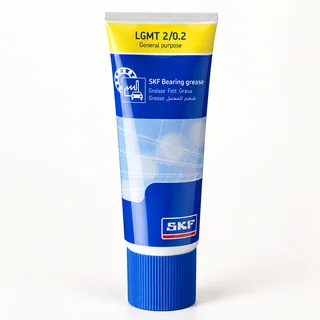
An SKF grease code has useful information. For example, LGMT 3/1 indicates the LGMT line, consistency grade 3 and the 1 kg package. LGEP 2/5 is the LGEP line, grade 2 and 5 kg package. Knowing this structure allows you to order exactly what you need without confusion.
The consistency grade goes from 000 to 6: low numbers are softer greases, high numbers are harder. In the examples, the number after the slash indicates the package in kilograms: 1 for 1 kg, 5 for 5 kg.
If you have an SKF grease code and want to replenish it, send it to us. At MR we quote the same code or indicate the equivalent alternative within the lines we distribute, such as LGEM 2/5 or LGFG 2/1. If you do not remember the code, send us a photo of the package or describe the application and we help you identify it.
Common mistakes when choosing or applying grease
A frequent mistake is choosing grease only by color or brand, without looking at the point conditions. Another is mixing incompatible greases, which ruins lubrication and damages the bearing. Over-greasing is also common, causing heating and energy loss. These mistakes translate into premature failures and unplanned stoppages.
Not surveying the actual working temperature leads to using a grease that runs off or carbonizes. Ignoring the presence of water or dust shortens bearing life. And not recording the package code complicates replenishment, because later you do not know what to buy. Another oversight is not purging old grease when changing type, which generates unwanted mixtures.
To avoid these problems, rely on the lubrication point data. At MR we help you define which SKF grease to use and we quote the right product. Send us a photo of the current package or the bearing data and we will reply shortly. With a simple inquiry you save headaches and keep your equipment running.
Frequently asked questions
Which SKF grease do I use for a high-speed bearing?
For high speed, a softer consistency grease is advisable, generating low resistance to rotation. You must also always verify temperature and load; send us that data and we indicate the option and quote it for you.
Can I mix two different SKF greases?
Not always. Thickener compatibility must be verified. If they are incompatible, the mixture loses consistency and does not lubricate. When in doubt, it is advisable to clean the bearing before changing grease.
What does the number in the SKF grease code mean?
The number after the abbreviation indicates the NLGI consistency grade, from 000 to 6. For example, in LGMT 3/1, the 3 is the grade. The last number is the package size in kg.
How often should I relubricate a bearing with SKF grease?
It depends on speed, temperature and contamination. In severe conditions, relubrication is more frequent; in clean, slow equipment, less. It is advisable to record consumption and adjust the interval.
Where to buy SKF grease in Argentina?
At MR Accesorios Industriales, in Buenos Aires, Argentina, we sell and distribute SKF greases. You can get a quote via WhatsApp or email with the package code or the lubrication point data.
Products with photos in the catalogue
Keep reading
- SKF Chains: Reliable Power Transmission for Industrial Applications
SKF roller chains offer strength and precision for power transmission in industrial machinery. Learn about the PHC series, ASA and BS standards, and how to identify the correct chain for your equipment.
- SKF tools for industrial maintenance: pullers, heaters, aligners and calibrated shims
SKF tools simplify bearing mounting and dismounting, shaft alignment and instrument calibration. Discover TMMA and TMHP pullers, induction heaters, TKSA aligners and calibrated shims.
- How to Choose SKF Bearings by Application: Load, Speed, Environment, and Mounting
Choosing the right SKF bearing requires analyzing load, speed, environment, and mounting. We explain the main types and how to get a quote with the exact code.
Continue here
Need a quote?
Send us the code, size or a photo of the part and we'll quote you shortly.