
Blog
How to Choose and Use an SKF Induction Bearing Heater
Induction heating is the safe way to mount bearings without impacts or a torch. We explain how to choose the right SKF equipment and use it step by step.
SKF bearings in Argentina: guide and quotes
Technical team at MR Accesorios Industriales · Updated on October 13, 2026
Why heat a bearing before mounting it
Mounting a bearing cold, with impacts or with a torch, is one of the most common causes of premature failure. The SKF induction bearing heater heats the part evenly and in a controlled manner, so that the bore expands just enough and fits onto the shaft without effort. This prevents damage to raceways, cages or seals during mounting. It is a standard practice in industrial maintenance when working with interference fits.
The induction method uses a magnetic field to heat only the bearing, not the shaft or the environment. Unlike the oil bath or the torch, it does not make a mess, does not generate an open flame and allows precise temperature control. This is key to not exceeding the bearing's thermal limit, which can alter the heat treatment of the steel. In addition, uniform heating reduces the risk of the part getting stuck halfway.
In process plants, mining, paper, sugar or steel industries, where medium and large bearings are changed frequently, an induction heater speeds up the task and makes it safer. The operator does not have to handle hot parts with uncomfortable gloves or wait for long heating times. With the right equipment, the bearing heats up in minutes and is mounted immediately. That is why it is a widely used tool during scheduled shutdowns.
How an SKF induction heater works
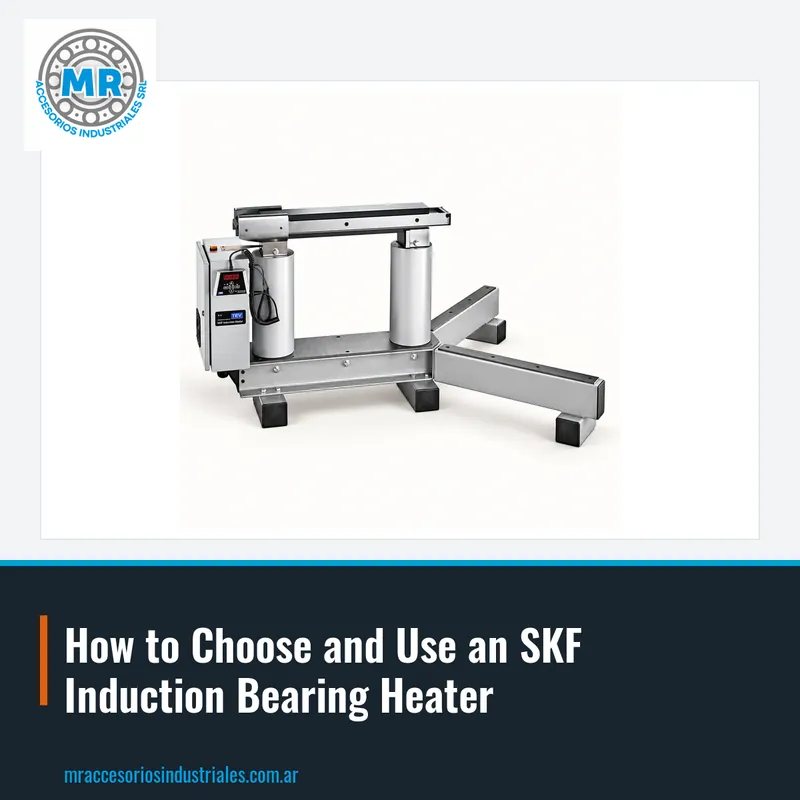
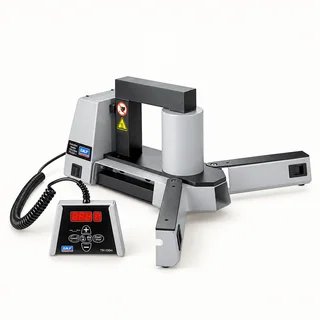
The SKF induction heater generates an alternating magnetic field that induces currents in the metallic mass of the bearing. These currents, called eddy currents, heat the part from the inside out, homogeneously. The equipment has a magnetic core that is inserted through the bearing bore, and the part rests on an insulated surface. There is no direct contact with heating elements or flames.
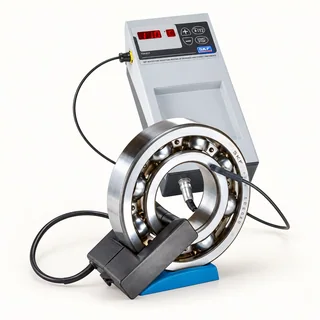
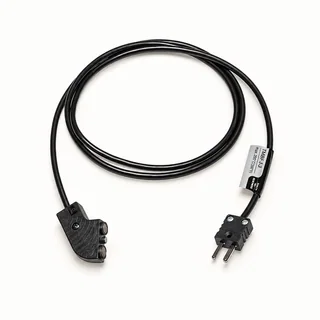
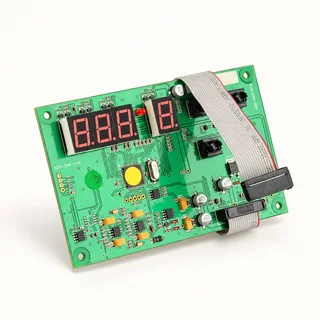
The TIH series, with codes such as the TIH T1, the TIH P20 or the TIH CB16A, groups heaters with electronic control. In general, a target temperature or a time can be programmed, and the equipment shuts off automatically when reached. Many work with a magnetic probe to measure the actual temperature of the inner ring, which is the data that matters. Each model has its working range, which should be checked in the datasheet before choosing.
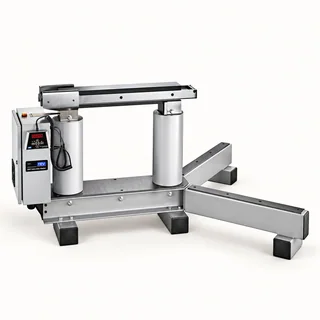
The TMBH series, with codes such as the TMBH 1, the TMBH 1-5 or the TMBH 40, is the other family of SKF induction heaters we supply. The choice between one series and another, and between the models of each, depends on the weight and bore diameter of the largest bearing to be heated, and on how many mountings are done. If you have doubts, send us the bearing code and we will guide you.
How to choose the heater according to the bearing
To choose an SKF induction bearing heater, two data points must be considered: the bore diameter and the weight of the largest bearing to be mounted. Each model has a working range that the manufacturer indicates in its datasheet. It is not advisable to buy a very small unit that runs at its limit, because heating will be slow and the cycle may cut out due to thermal protection. Nor one that is oversized if only light parts are handled.
Within the TIH and TMBH series there are units for different part sizes. If pump, electric motor or gearbox bearings are changed in the plant, a mid-range unit is enough. If rolling mill or large fan bearings are handled, a more robust model is advisable.
A common mistake is choosing the heater only by bore diameter and forgetting the weight. A bearing with large mass needs more energy to reach mounting temperature in a reasonable time. Therefore, when requesting a quote, it is advisable to have the bearing code and its approximate weight on hand. At MR we help you select the correct model according to the part you are going to heat.
Step-by-step mounting with an induction heater
Before heating, clean the bearing and the shaft seat well. Remove the bearing from its packaging and place it on the heater core, centered. Place the magnetic probe in contact with the inner ring, which is the part that must expand. Program the recommended temperature for that bearing according to the fit, and never exceed the limit indicated by the manufacturer.
When the equipment cuts off by temperature, remove the bearing with thermal gloves or an insulated handle. Take it quickly to the shaft and slide it until it rests against the shoulder or the locking nut. Do not force or strike it: if it does not fit, it is because the temperature was not sufficient or the fit is greater than expected. Let the bearing cool naturally, without cooling it abruptly.
After mounting, verify that the bearing turns freely and that it has not become tilted. Some SKF heaters include an automatic demagnetization function, which eliminates residual magnetism that can attract metal particles. If the equipment does not have it, demagnetization must be done with a separate accessory. A magnetized bearing is a serious problem in precision machines.
Temperature control and demagnetization
Temperature control is the key to safe mounting. If you overheat, you can modify the hardness of the steel and ruin the bearing. If you underheat, the bore does not expand enough and mounting gets stuck. SKF heaters with a magnetic probe measure the actual temperature of the inner ring, not that of the air or the core. This allows the process to be repeated exactly on each mounting.
Demagnetization is another point that many overlook. After induction heating, the bearing may retain residual magnetism. This magnetism attracts filings and steel particles that then act as abrasives inside the bearing. Therefore, SKF units include a demagnetization cycle that is activated automatically or manually. It is a mandatory step before lubricating and closing the machine.
To verify temperature without a probe, an infrared pyrometer can be used, but it is less accurate. The magnetic probe is the recommended method because it measures at the exact point. If the heater does not include a probe, it is advisable to buy it as an accessory. At MR we advise you on the accessories compatible with each SKF heater model.
Common mistakes when heating bearings
The most serious mistake is heating with a torch. The direct flame generates hot spots, deforms the part and can burn the seal or the cage. In addition, it is impossible to control the temperature precisely. Another frequent mistake is striking the bearing cold to make it fit onto the shaft, which marks the raceways and causes premature vibrations. None of these practices is acceptable in professional maintenance.
Overheating is also a serious problem. If the bearing exceeds the thermal limit, the steel loses hardness and its service life is drastically reduced. Therefore, SKF induction heaters cut off automatically when reaching the programmed temperature. This protection must not be bypassed nor higher temperatures programmed to speed up the process. Patience during mounting prevents costly failures.
Another mistake is not demagnetizing after heating. Residual magnetism is invisible, but it attracts particles that contaminate the lubrication. It is also a mistake not to clean the shaft seat before mounting: a burr or a mark can prevent the bearing from seating properly. With an SKF induction heater and an orderly procedure, these problems are eliminated at the root.
How to request a quote for your SKF induction bearing heater
To request a quote for an SKF induction bearing heater, the most practical thing is to tell us the code of the largest bearing you are going to heat. With that data we recommend the appropriate model from the TIH or TMBH series. You can also send us a photo of the part and the bore and outer diameter measurements. This way we avoid selection errors.
If you already have a model in mind, such as the TIH T1 or the TMBH 1, send us that code and we will quote it promptly. We supply SKF mounting and maintenance tools, including accessories such as temperature probes and magnetic cores. We advise you on the choice.
You can write to us via WhatsApp or email with your inquiry. At MR, in Buenos Aires, Argentina, we distribute SKF induction heaters for different industries. Tell us which bearing you need to mount, with code, measurement or photo, and we will reply promptly.
Frequently asked questions
Which SKF heater do I need for my bearing?
It depends on the bore diameter, the bearing weight and the frequency of use. Send us the bearing code and its approximate weight and we will recommend the corresponding model from the TIH or TMBH series.
Can a bearing be heated with a torch?
It is not recommended. The torch generates hot spots, deforms the part and does not allow temperature control. The SKF induction heater heats uniformly and safely, preventing damage to the bearing.
Do SKF heaters demagnetize the bearing?
Yes, most models include an automatic or manual demagnetization cycle. It is important to use it to eliminate residual magnetism that attracts metal particles and contaminates the lubrication.
What temperature is used to mount a bearing?
It depends on the fit and the type of bearing; the reference is the one indicated by the manufacturer and its limit must never be exceeded. SKF heaters allow programming the exact temperature and cut off automatically.
Can I heat bearings with plastic seals or cages?
Yes, but with caution. Induction heaters heat quickly and evenly, but the maximum temperature that the seals or cage can withstand must be respected. Consult the bearing datasheet before programming the equipment.
Products with photos in the catalogue
Keep reading
- SKF Chains: Reliable Power Transmission for Industrial Applications
SKF roller chains offer strength and precision for power transmission in industrial machinery. Learn about the PHC series, ASA and BS standards, and how to identify the correct chain for your equipment.
- SKF tools for industrial maintenance: pullers, heaters, aligners and calibrated shims
SKF tools simplify bearing mounting and dismounting, shaft alignment and instrument calibration. Discover TMMA and TMHP pullers, induction heaters, TKSA aligners and calibrated shims.
- How to Choose SKF Bearings by Application: Load, Speed, Environment, and Mounting
Choosing the right SKF bearing requires analyzing load, speed, environment, and mounting. We explain the main types and how to get a quote with the exact code.
Continue here
Need a quote?
Send us the code, size or a photo of the part and we'll quote you shortly.