
Blog
How to detect a bearing failure before the machine stops
The SKF electronic stethoscope lets you listen to the condition of bearings while running and anticipate unexpected downtime. Learn how to use it together with thermometers and tachometers for effective predictive maintenance.
SKF bearings in Argentina: guide and quotes
Technical team at MR Accesorios Industriales · Updated on October 16, 2026

What an SKF electronic stethoscope is and what it is used for
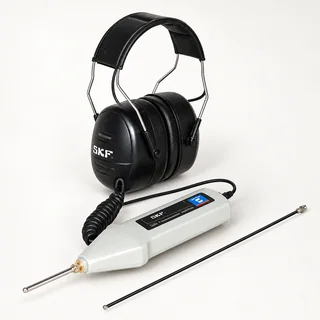
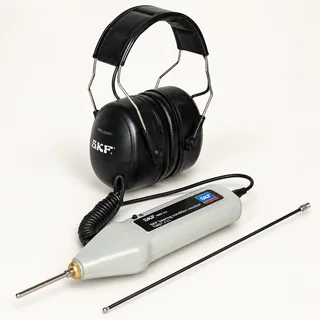
The SKF electronic stethoscope is an instrument that amplifies the sounds of a running machine so you can clearly hear what is happening inside a bearing. Unlike a mechanical stethoscope, this device converts acoustic vibrations into electronic signals, allowing you to perceive friction, knocking, or incipient wear noises that go unnoticed to the naked eye. It is a key tool for predictive maintenance, because it helps you identify problems before they become a catastrophic failure.
In practice, it is used to inspect bearings, gears, pumps, electric motors, and any rotating component where an abnormal noise indicates wear or lack of lubrication. The operator places the probe tip on the machine housing and listens through headphones, adjusting the volume as needed. This way, they can distinguish between the normal sound of a healthy bearing and the irregular pattern of a damaged one.
Within the SKF line, the TMST series corresponds to electronic stethoscopes. One model in the series is the TMST 2, designed for industrial equipment maintenance. When requesting this equipment, it is advisable to indicate the type of machines you will monitor and the frequency of inspections, so we can advise you on the most suitable model. You can also send us a photo of the work area if you have doubts about the probe length or the ergonomics of the device.
SKF digital and infrared thermometers for measuring temperature
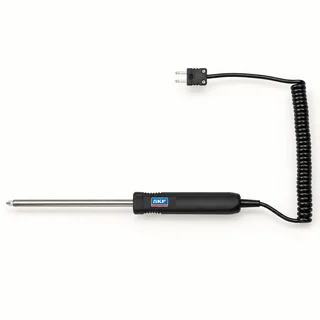
Temperature is one of the earliest indicators of a bearing failure. An abnormal increase can be due to lack of lubrication, overload, misalignment, or internal wear. Therefore, having an SKF digital thermometer or an SKF infrared thermometer allows you to record precise values and compare them with previous measurements to detect trends.
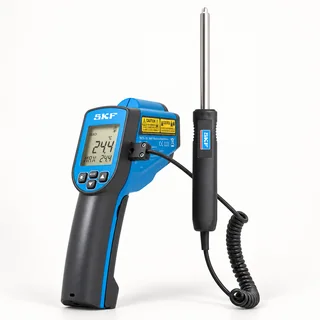
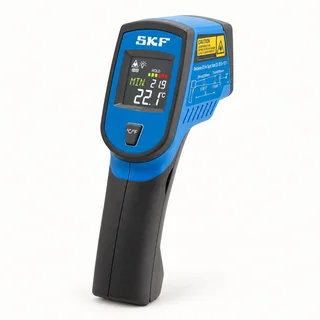
The TMDT series groups the digital contact thermometers, ideal for measuring the surface temperature of housings, shafts, and bearings. An example is the TMDT 2-1. On the other hand, the TKTL series corresponds to infrared thermometers, which measure temperature at a distance without touching the part. The TKTL 20 is an example from that series.
When using these instruments, it is important to always measure at the same point on the machine and under similar load conditions so that comparisons are valid. If you detect a notable difference between similar bearings or a progressive increase over time, it is a sign that something is changing. In that case, it is advisable to deepen the inspection with a stethoscope or vibration analysis. To get a quote, tell us the temperature range you need to measure and whether you prefer a contact or infrared device.
SKF tachometers for controlling rotation speed
The SKF tachometer measures the rotation speed of a shaft or pulley, a fundamental data point to verify that the machine is operating within design parameters. An incorrect speed can generate excessive loads on bearings, vibrations, and premature wear. With a tachometer you can confirm whether the motor, gearbox, or fan are rotating at the expected RPM.
The TKRT series includes SKF tachometers. The TKRT 10 is an example from that series, used to measure rotation speed in RPM.
In an inspection round, the tachometer complements the stethoscope and thermometer: if you hear a strange noise and notice an elevated temperature, verifying the speed helps you rule out or confirm a transmission problem. For example, a slipping belt can make a fan rotate at fewer RPM than expected. When ordering a tachometer, specify the speed range you handle and whether you need contact or non-contact measurement.
SKF endoscopes for internal inspection without disassembly
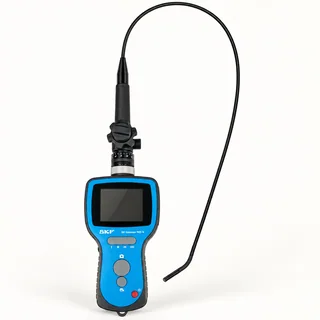
When you cannot see the inside of a machine without disassembling it, an SKF endoscope allows you to insert a flexible probe with camera and light to observe the condition of gears, bearings, pipes, or cavities. This tool is very useful in gearboxes, encapsulated motors, or hard-to-reach areas where direct visual inspection is impossible.
The TKES series includes SKF endoscopes, such as the TKES 1S. They are instruments designed to look into dark and hard-to-reach spaces.
Using the endoscope reduces downtime and avoids unnecessary disassembly. For example, if you suspect a gearbox, you can insert the probe through an existing opening and observe the interior without opening the box. When quoting an endoscope, tell us the probe diameter and length you need, as well as the type of environment where you will use it.
SKF thermal imaging cameras to see heat distribution
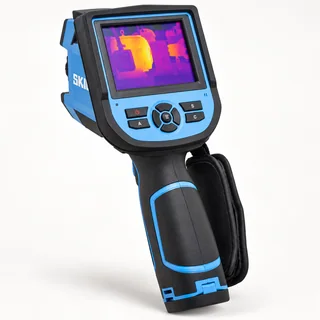
An SKF thermal imaging camera goes a step beyond the spot thermometer: it shows a thermal image of the entire machine, where each color represents a different temperature. This allows you to quickly identify abnormal hot spots, such as an overloaded bearing, a loose electrical connection, or friction on a pulley. It is a powerful tool for quick and complete inspections.
The TKTI series corresponds to SKF thermal imaging cameras. The TKTI 31 model is an example from that series. With a thermal imaging camera you can scan an electrical panel, a motor, or an entire production line in a few minutes and detect anomalies that would otherwise go unnoticed.
As with thermometers, it is important to take measurements under stable conditions and compare images of the same machine over time. A hot spot that grows week by week is a clear sign of deterioration. If you are building a predictive maintenance program, the thermal imaging camera is a very useful complement to anticipate unexpected downtime. To get a quote, tell us what type of equipment you will inspect and whether you need advanced analysis functions.
How to set up an inspection round with these instruments
An effective inspection round combines several instruments: listening with the stethoscope, measuring temperature with the thermometer, verifying speed with the tachometer, observing internally with the endoscope, and visualizing heat with the thermal imaging camera. The recommended order is to start by listening, because an abnormal noise tells you where to focus the other measurements. Then measure temperature at that point and at neighboring bearings for comparison.
Record all readings in a spreadsheet, indicating date, time, machine, measurement point, and value obtained. Over time, that database will allow you to establish a baseline for each equipment and detect deviations. For example, if a bearing normally operates at a certain temperature and suddenly rises several degrees, it is an early alert. The same if a new noise appears on the stethoscope or if the RPM drop without explanation.
When something changes, do not wait for the failure to manifest. Deepen the inspection with the endoscope to see the internal condition and, if necessary, schedule a stop for repair. If you have doubts about which instrument to use or how to interpret a reading, you can consult us: we guide you on best practices and quote the equipment you need. Send your data via WhatsApp or email and we will respond shortly.
What data to send to quote an SKF instrument
To quote an SKF electronic stethoscope, a thermometer, a tachometer, or any other instrument in the line, it is advisable to send us as much information as possible. Indicate the type of machine you will monitor, the work environment (ambient temperature, presence of dust or humidity), and the frequency of use. If you already have a reference code, such as TMST 2 or TKRT 10, include it in your inquiry.
It is also useful to tell us what problem you are trying to solve: strange noises in a bearing? elevated temperatures in a motor? do you need to inspect the inside of a box without disassembling it? With that information we can suggest the most suitable instrument and, if necessary, combine it with other maintenance tools. If you have a photo of the part or the work area, even better.
Do not forget to indicate if you need additional accessories, such as spare probes, headphones, or carrying cases. Write to us via WhatsApp or email with your inquiry and we will respond shortly with the proposal.
Frequently asked questions
What is the difference between an electronic and a mechanical stethoscope?
The electronic stethoscope electronically amplifies sounds and allows volume adjustment, making it easier to hear low-intensity noises in noisy environments. The mechanical one transmits sound through a metal rod without amplification, so it is less sensitive. For detecting incipient bearing failures, the electronic one is more effective.
How do I know if a bearing is failing with an SKF electronic stethoscope?
A healthy bearing produces a smooth, uniform sound. If you hear knocking, squealing, humming, or a rough, irregular noise, there is likely wear, lack of lubrication, or damage to the raceways. Compare the sound with that of other similar bearings on the same machine to confirm the anomaly.
Can I use an SKF infrared thermometer to measure the temperature of a bearing?
Yes, the infrared thermometer measures surface temperature at a distance, which is practical for bearings in motion or hard to reach. However, keep in mind that the measurement can be affected by the material's emissivity and distance. For greater precision at critical points, you can complement with a contact thermometer.
Which SKF tachometer should I get to measure RPM on a motor?
Tell us the RPM range, whether you can touch the shaft end, and the access conditions, and we will quote the corresponding model from the TKRT series.
Does the SKF endoscope work to see inside a bearing without disassembling it?
It allows you to look inside boxes, housings, and hard-to-reach areas without disassembling the machine, as long as there is an opening to pass the probe through. It is useful for inspecting the general condition and detecting leaks, corrosion, or contamination.
Products with photos in the catalogue

Keep reading
- SKF Chains: Reliable Power Transmission for Industrial Applications
SKF roller chains offer strength and precision for power transmission in industrial machinery. Learn about the PHC series, ASA and BS standards, and how to identify the correct chain for your equipment.
- SKF tools for industrial maintenance: pullers, heaters, aligners and calibrated shims
SKF tools simplify bearing mounting and dismounting, shaft alignment and instrument calibration. Discover TMMA and TMHP pullers, induction heaters, TKSA aligners and calibrated shims.
- How to Choose SKF Bearings by Application: Load, Speed, Environment, and Mounting
Choosing the right SKF bearing requires analyzing load, speed, environment, and mounting. We explain the main types and how to get a quote with the exact code.
Continue here
Need a quote?
Send us the code, size or a photo of the part and we'll quote you shortly.