
Blog
How to choose SKF bearings for gearboxes, shaft by shaft
Which SKF bearing goes on each shaft of a gearbox, how tapered bearings are mounted in pairs and what data to send to quote the complete set.
SKF bearings in Argentina: guide and quotes
Technical team at MR Accesorios Industriales · Updated on October 19, 2026
How to identify the correct bearing in a gearbox
In a gearbox, each shaft has different requirements: the input shaft usually rotates faster, the intermediate shafts combine load and speed, and the output shaft supports the highest torque. That's why it's not enough to ask for “a bearing for a gearbox”: it's better to identify the position, dimensions and type of bearing on each one. SKF bearings for gearboxes are chosen according to the radial load, axial load and speed of each shaft.
The first thing is to look at the mounted bearing: the complete code is usually engraved on the side ring, for example 30304 or NU 209 ECJ. If the code is blurry, you can measure the inner diameter, outer diameter and width, and compare with dimension tables. It also helps to know if the bearing is tapered, cylindrical or spherical, because each type serves a different function within the gearbox.
A common mistake is to replace a bearing with another with the same dimensions but a different type or internal clearance. In gearboxes, clearance and fit are critical: a bearing with standard clearance can be too tight or too loose if the original design called for C3. That's why, when you send us the code or dimensions, we quote the exact bearing and tell you if you need to consider the internal clearance or cage type.
Tapered roller bearings in pairs: the standard for shafts with combined load
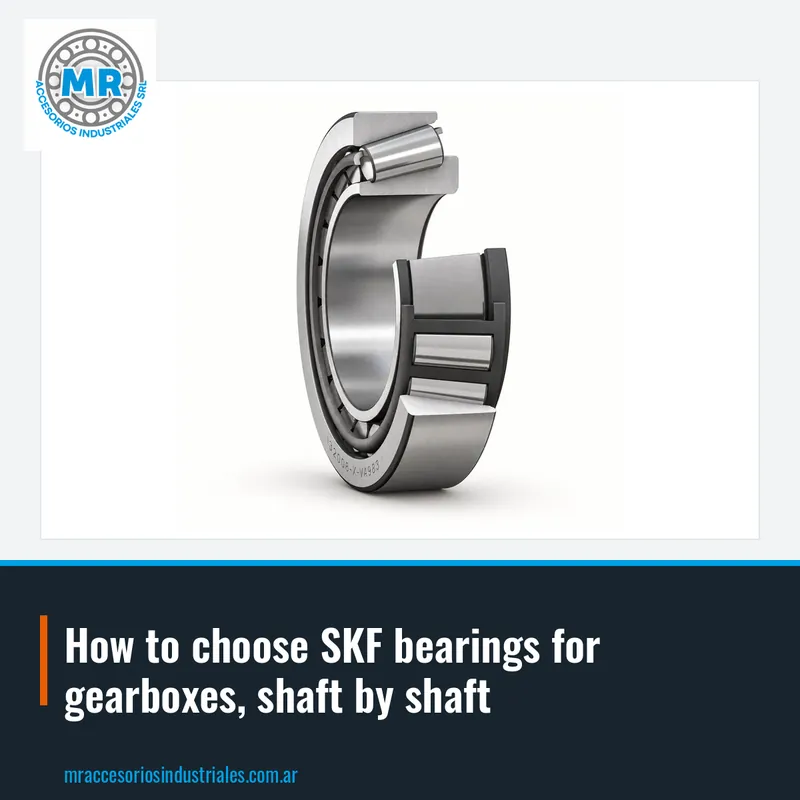
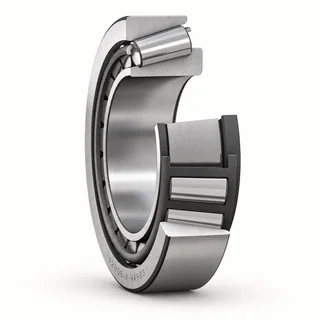
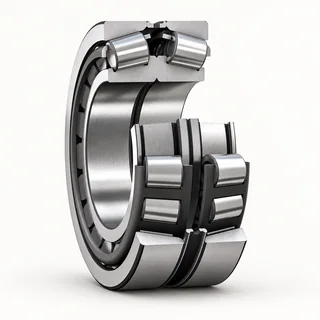
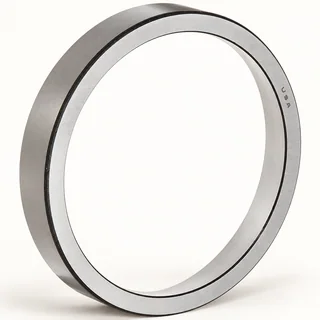
Tapered roller bearings are the most used in gearboxes because they support radial and axial loads at the same time. In a gearbox, they are usually mounted in facing pairs or in tandem, so that each bearing takes the axial load in one direction. That pair mounting allows adjusting the shaft clearance and maintaining the gear position.
To order a tapered bearing, the complete code is the safest reference. For example, 30206 and 30306 are tapered bearing codes. Although they look similar, the complete code defines the exact bearing. If you have a tapered bearing without a code, measure the inner diameter, outer diameter and total width, and with that we look for the equivalent.
When changing tapered bearings in a gearbox, it's advisable to replace both on the same shaft at the same time, even if one seems in good condition. Wear is even and a new bearing with a used one can leave the load poorly distributed. You must also respect the axial clearance adjustment indicated by the gearbox manufacturer: a poorly adjusted clearance overheats the bearing and shortens its life.
Cylindrical rollers: for shafts with high radial load
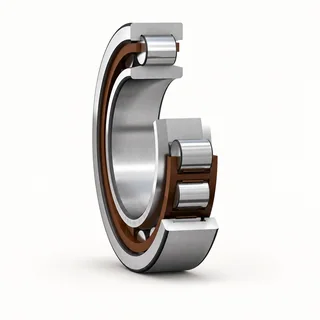
Cylindrical roller bearings are used in gearbox shafts where radial load predominates and there is little axial load. They support high loads and allow the inner or outer ring to be removed separately, which facilitates mounting in split housings. In gearboxes, they are usually on the output shaft or on intermediate shafts with helical gears.
An SKF cylindrical bearing is identified by the complete code engraved on the ring, such as NU 207 ECM or NU 208 ECM: the final letters also count, so it's best to copy them entirely. If you have a cylindrical bearing with the inner ring separated, keep both parts together to avoid confusing the reference.
When ordering a cylindrical bearing for a gearbox, it's advisable to indicate whether the bearing works with the inner ring fitted to the shaft or sliding. In some designs, the inner ring is mounted with interference and the outer is free in the housing. That doesn't change the bearing code, but it does change the fit and mounting procedure. We quote the exact bearing and guide you on mounting according to the gearbox design.
Spherical rollers: when the gearbox has misalignments or heavy loads
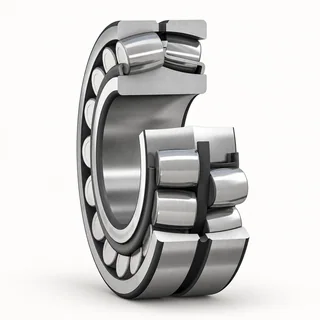
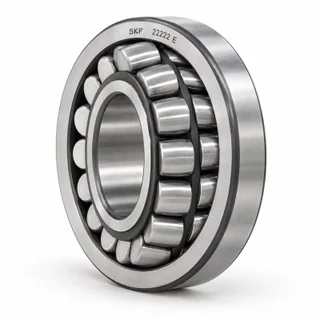
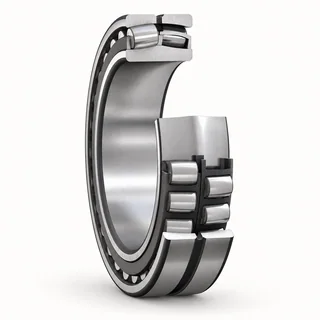
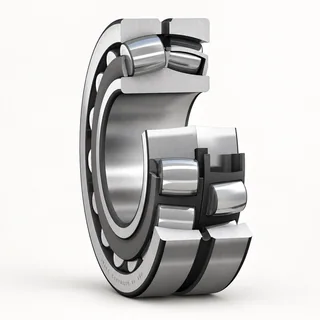
Spherical roller bearings are chosen when the shaft can misalign or when loads are very high and combined. In large gearboxes, or in gearboxes working under severe conditions, these bearings absorb small misalignments without overloading the roller edges. They also support axial loads in both directions.
SKF spherical bearings are ordered by the complete code, such as 22220 E or 22222 E. There's no need to interpret each letter: the complete code identifies the bearing. If the bearing has a tapered bore, it carries the K suffix, and is mounted on an adapter sleeve or directly on a tapered shaft.
In gearboxes, spherical bearings are usually on output shafts of large machines or in mill and crusher gearboxes. When ordering them, it's good to know if the bearing has a cylindrical or tapered bore, because that changes the mounting and accessories. It's also important to check the condition of the housing: a spherical bearing does not correct severe misalignments, it only absorbs small mounting variations.
Lubrication with the gearbox oil: what to consider
Most bearings in gearboxes are lubricated with the same oil as the gears. That oil bathes or splashes the bearings and keeps them lubricated, but it also carries gear wear particles. Therefore, the gearbox oil must be filtered or changed according to the maintenance plan, so that particles do not damage the bearing races.
When changing bearings in a gearbox, it's advisable to check the condition of the oil and seals. A damaged seal lets oil out and contamination in, and that shortens the life of the new bearings. If the gearbox works in a dusty or humid environment, the seals and covers must be in good condition before mounting the bearings.
Some bearings for gearboxes are ordered with C3 internal clearance, which is greater than normal. That clearance is used when the bearing works at high temperature or with tight fits, to prevent it from tightening when hot. If the original bearing had C3, it's advisable to respect that specification. With the complete code, we quote the bearing with the corresponding clearance.
What data to send to quote gearbox bearings
To quote SKF bearings for gearboxes, the fastest way is to send the complete code engraved on the bearing ring. For example, 30305 or NU 206 ECP are codes that identify the exact bearing without measuring. If the code is blurry, measure the inner diameter, outer diameter and width, and with that we look for the reference.
It also helps to know where the bearing goes in the gearbox: input, intermediate or output shaft. That information serves to confirm that the bearing type is correct for that position. If the gearbox is from a known brand, the gearbox model can also help to find the original bearing.
If you have a photo of the bearing or the gearbox, send it via WhatsApp along with the dimensions or code. With that we quote the exact bearing and tell you if it's advisable to change both bearings on the same shaft. You don't need to interpret the letters in the code: with the complete reference or dimensions, we take care of the search.
Common mistakes when ordering or mounting bearings in gearboxes
One of the most common mistakes is ordering the bearing only by dimensions, without verifying the type. For example, a tapered and a cylindrical bearing can have the same inner and outer diameter, but they are not interchangeable. In a gearbox, mounting the wrong type can misalign the gears and damage the bearing in a short time.
Another mistake is not changing both bearings on the same shaft. On a shaft with two tapered bearings, if one failed, the other surely has even wear. Changing only the damaged one leaves the shaft with one new bearing and one worn, and the axial clearance is poorly distributed. The same happens with cylindrical or spherical bearings: it's advisable to replace the complete pair.
Mistakes are also made with internal clearance. If the original bearing had C3 and one with normal clearance is installed, the bearing can overheat and seize. Therefore, when quoting, it's advisable to send the complete code that includes the clearance suffix. With the exact code, we quote the correct bearing and you avoid surprises during mounting.
Frequently asked questions
What bearing does a gearbox have?
It depends on the shaft and the gearbox design. Input shafts usually have tapered or rigid ball bearings, intermediate shafts have tapered or cylindrical, and output shafts have tapered, cylindrical or spherical depending on the load. The safest is to look at the code engraved on the original bearing or measure its dimensions.
Are tapered bearings changed in pairs?
Yes, on the same shaft it's advisable to change both tapered bearings together, even if one seems in good condition. Wear is even and a new bearing with a used one leaves the load and axial clearance poorly distributed.
What does the C3 suffix mean in a bearing for a gearbox?
C3 indicates that the bearing has greater internal clearance than normal. It is used in gearboxes when the bearing works at high temperature or with tight fits, to prevent it from tightening when hot. If the original bearing had C3, it's advisable to respect that specification.
How do I order an SKF bearing if the code is not legible?
Measure the inner diameter, outer diameter and width of the bearing, and send us those dimensions via WhatsApp. A photo of the bearing and knowing where it goes in the gearbox also helps. With that we quote the exact bearing.
Are gearbox bearings lubricated with the gear oil?
Yes, in most gearboxes the bearings are lubricated with the same oil as the gears, by bath or splash. That's why it's important to keep the oil clean and the seals in good condition, so that wear particles do not damage the bearings.
Products with photos in the catalogue
Keep reading
- SKF Chains: Reliable Power Transmission for Industrial Applications
SKF roller chains offer strength and precision for power transmission in industrial machinery. Learn about the PHC series, ASA and BS standards, and how to identify the correct chain for your equipment.
- SKF tools for industrial maintenance: pullers, heaters, aligners and calibrated shims
SKF tools simplify bearing mounting and dismounting, shaft alignment and instrument calibration. Discover TMMA and TMHP pullers, induction heaters, TKSA aligners and calibrated shims.
- How to Choose SKF Bearings by Application: Load, Speed, Environment, and Mounting
Choosing the right SKF bearing requires analyzing load, speed, environment, and mounting. We explain the main types and how to get a quote with the exact code.
Continue here
Need a SKF quote?
Send us the SKF part number, the size or a photo of the part and we will get back to you with a quote.