
Blog
SKF Bearings for Centrifugal Pumps: Selection and Mounting Guide
Choosing the right bearing for a centrifugal pump prevents unexpected downtime. We explain which types of SKF bearings are used in each position, how to handle axial thrust, and what data to send for a quote.
SKF bearings in Argentina: guide and quotes
Technical team at MR Accesorios Industriales · Updated on October 17, 2026
How to choose the bearing for a centrifugal pump
In a centrifugal pump, bearings support the shaft and allow the impeller to rotate smoothly. The choice depends on radial load, axial thrust, and rotational speed. SKF bearings for centrifugal pumps are designed to work under demanding conditions, with vibrations and variable temperatures. A poorly selected bearing can fail in a short time and damage the mechanical seal or the impeller.
The impeller side usually receives the axial thrust generated by the liquid pressure. Therefore, in that position, bearings that support combined load are used, such as deep groove ball bearings or angular contact bearings. The coupling side, on the other hand, mainly supports radial load and can carry a bearing that allows some axial freedom, such as a cylindrical roller bearing. This configuration prevents the shaft from seizing due to thermal expansion.
To identify the correct bearing, look at the code engraved on the ring and the shaft and housing dimensions. If the bearing is badly damaged, you can measure the inner diameter, outer diameter, and width. With that data, at MR we quote the equivalent SKF bearing or the same code. It is also advisable to check the pump manual, which usually indicates the exact type and designation.
SKF deep groove ball bearings for pumps
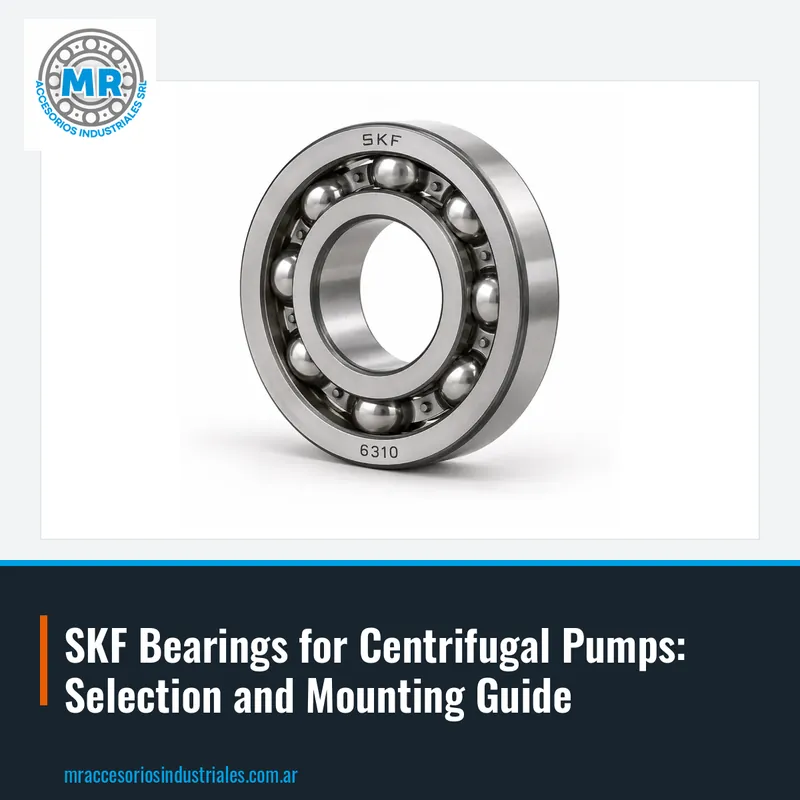
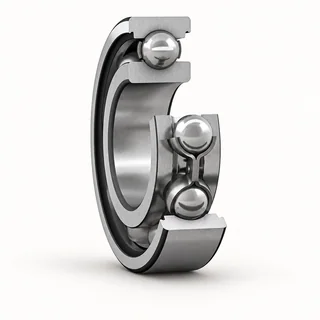
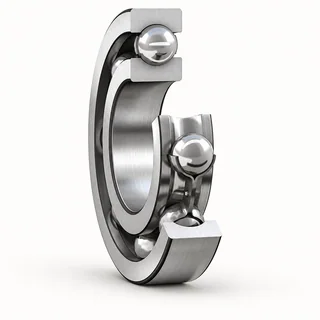
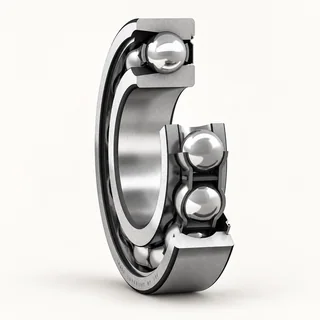
Deep groove ball bearings are the most common in medium-sized centrifugal pumps. They support moderate radial and axial loads in both directions, making them versatile for the impeller side and the coupling side. Their simple design facilitates mounting and reduces maintenance cost. In small pumps, a single deep groove ball bearing at each end of the shaft is usually sufficient.
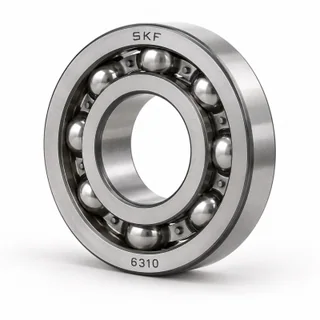
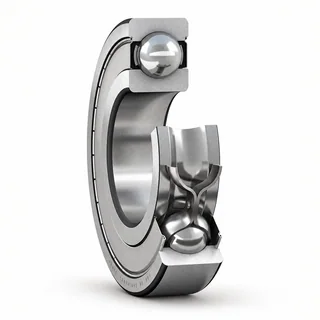
A typical example is the 6211 bearing, used in pumps with a 55 mm shaft. For larger pumps, the 6310 or 6311 offer greater load capacity. These bearings can have seals or shields depending on lubrication: the 2RS variant has rubber seals on both sides, ideal for retaining grease and preventing water ingress. The 2Z variant uses metal shields, suitable when there is a risk of splashes.
When ordering a deep groove ball bearing for a pump, indicate the full code and whether you need special internal clearance. The C3 suffix, for example, indicates greater internal clearance than normal, useful when the shaft operates at high temperature. It is also key to know whether the bearing goes on the impeller or coupling side, because the axial load may require a more robust design. At MR we distribute the SKF line of deep groove ball bearings and help you confirm the reference.
SKF angular contact bearings for impeller thrust
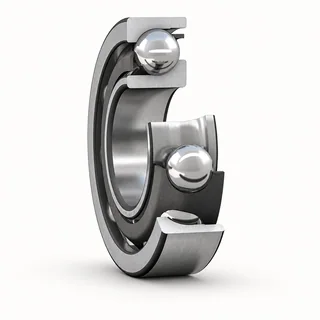
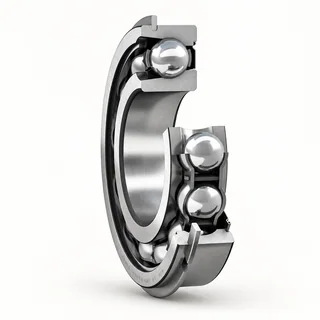
When the axial thrust of the impeller is high, angular contact bearings are the best option. These bearings have offset raceways, which allow them to support axial loads in one direction and combined radial loads. In centrifugal pumps, they are generally mounted in pairs, face-to-face or in tandem, to absorb thrust in both directions. The impeller side is the typical position for this type of bearing.
A code frequently consulted for pumps is the 7210 BEP. For larger shafts, the 7312 BEM or 7310 BEP are larger references. The important thing is to respect the exact code that appears in the pump catalog. If the bearing is illegible, measure the shaft and housing diameters and consult us: we will indicate the corresponding SKF angular contact bearing.
Mounting an angular contact bearing requires care with the load direction. If installed backwards, the bearing is destroyed in a short time. Therefore, when requesting a quote, send a photo of the old bearing or the assembly, and clarify to our MR team if it goes on the impeller side. It is also important to verify the preload or axial adjustment recommended by the pump manufacturer, since excessive clearance generates vibration and excessive adjustment overheats the bearing.
SKF cylindrical roller bearings for high radial loads
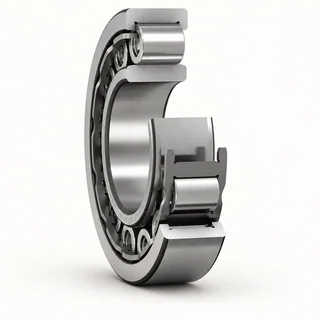
In centrifugal pumps with high flow or heavy impellers, the radial load can be very high. That is where cylindrical roller bearings come in, as they support much higher radial loads than deep groove ball bearings of the same size. Their design with rollers and flanges allows the inner or outer ring to be removed, facilitating mounting on long shafts. They do not support axial load, except for special designs.
An example is the NU 308 ECJ, a cylindrical roller bearing from the NU series. For larger shafts there is the NU 309 ECJ, and for smaller shafts the NU 306 ECM or NU 307 ECM. The NU series has two flanges on the outer ring and none on the inner, allowing axial displacement of the shaft. This is ideal for the coupling side, where the shaft can expand without generating stresses on the bearing.
When ordering a cylindrical roller bearing, verify if you need the inner ring with flanges (NJ series) or without flanges (NU series). It is also key to know whether the bearing goes on the impeller or coupling side, because the configuration changes. At MR we distribute SKF cylindrical roller bearings for pumps and advise you on the correct designation. Send us the code or measurements and we will quote you promptly.
Lubrication and sealing in centrifugal pump bearings
Lubrication is critical in centrifugal pumps because the bearing works close to the pumped liquid. If water or product enters, the grease becomes contaminated and the bearing fails. Therefore, many pump bearings have built-in seals, such as 2RS, which retain grease and block moisture. In oil-lubricated pumps, open bearings with a constant level system are used.
The pump's mechanical seal is the first barrier against liquid ingress into the bearing. If the seal leaks, water reaches the bearing and damages it. Therefore, when changing a bearing, always check the condition of the seal and gaskets. A bearing with C3 clearance can better tolerate heat generated by friction, but it does not compensate for a water leak.
When quoting a bearing for a pump, indicate whether lubrication is by grease or oil. If by grease, tell us if the bearing should be sealed (2RS) or shielded (2Z). If by oil, the bearing is usually open and requires a circulation or bath system. At MR we guide you on the correct variant according to the pump type and the fluid handled.
Mounting and dismounting bearings in centrifugal pumps
Mounting a bearing in a centrifugal pump requires cleanliness and precision. The shaft and housing must be free of burrs and corrosion. It is recommended to heat the bearing in an oil bath or with an induction heater to expand it and slide it on without impacts. Never strike directly on the rollers or balls: the force must be applied to the ring that is fitted.
Dismounting also requires appropriate tools, such as jaw or hydraulic pullers. If the bearing is stuck due to corrosion, apply a penetrant and let it act. In pumps with cylindrical roller bearings, the inner ring can be removed separately if the design allows. Always protect the shaft seating areas to avoid scratching them.
A common mistake is not respecting the fit between the ring and the shaft or housing. If the fit is too loose, the ring rotates and wears the seat. If it is too tight, the internal clearance is eliminated and the bearing overheats. When installing a new bearing, check the radial clearance with a gauge and compare it with the catalog value. At MR we advise you on the correct fit for your pump.
What data to send to quote SKF bearings for pumps
To quote quickly and without errors, send the full bearing code if you have it. For example, 6212 or NU 307 ECM. If the code is erased, measure the inner diameter, outer diameter, and width with a caliper. A photo of the old bearing and the mounting location also helps. With that data, at MR we identify the correct SKF bearing.
In addition to the code, indicate the pump brand and model, if you know it. Many centrifugal pumps use specific bearings according to the manufacturer, and that data speeds up the search. Also clarify to our team whether the bearing goes on the impeller or coupling side, because the axial load changes the selection. If the pump works with hot water or chemicals, mention the temperature and fluid.
At MR we distribute SKF bearings for centrifugal pumps. You can write to us via WhatsApp or email with the code, measurements, or a photo of the part. We will respond promptly with the quote. Don't leave your pump down: contact us today.
Frequently asked questions
What bearing does a centrifugal pump have on the impeller side?
It depends on the axial thrust. In small pumps, a deep groove ball bearing such as 6211 or 6310 is usually sufficient. In pumps with high thrust, a pair of angular contact bearings such as 7210 BEP is used, or a cylindrical roller bearing with flanges if the radial load is dominant.
Can I use a 2RS sealed bearing in a centrifugal pump?
Yes, if the pump is grease-lubricated and the bearing is not exposed to very high temperatures. The 2RS seal retains grease and prevents water or dust ingress. If the pump is oil-lubricated, the bearing must be open.
What does the C3 suffix mean in a pump bearing?
C3 indicates greater internal clearance than normal. It is useful when the shaft operates at high temperature or when there is misalignment. In centrifugal pumps, it is often used to compensate for thermal expansion of the shaft.
How do I know if my pump bearing is angular contact or deep groove ball?
Look at the engraved code. Deep groove ball bearings have designations like 62, 63, 60. Angular contact bearings use series 72, 73, 70. If it is not legible, send us a photo or the measurements and we will confirm.
What do I do if my pump bearing is damaged and has no code?
Measure the inner diameter, outer diameter, and width with a caliper. Take photos of the bearing and the mounting location. Send that data via WhatsApp or email and at MR we will identify the equivalent SKF bearing.
Products with photos in the catalogue
Keep reading
- SKF Chains: Reliable Power Transmission for Industrial Applications
SKF roller chains offer strength and precision for power transmission in industrial machinery. Learn about the PHC series, ASA and BS standards, and how to identify the correct chain for your equipment.
- SKF tools for industrial maintenance: pullers, heaters, aligners and calibrated shims
SKF tools simplify bearing mounting and dismounting, shaft alignment and instrument calibration. Discover TMMA and TMHP pullers, induction heaters, TKSA aligners and calibrated shims.
- How to Choose SKF Bearings by Application: Load, Speed, Environment, and Mounting
Choosing the right SKF bearing requires analyzing load, speed, environment, and mounting. We explain the main types and how to get a quote with the exact code.
Continue here
Need a quote?
Send us the code, size or a photo of the part and we'll quote you shortly.