
Blog
SKF Bearing Puller: How to Choose the Right Model and Use It Without Damaging the Shaft
Choosing the right SKF bearing puller depends on the part, available space and required force. We explain the TMMA, TMHP, TMMR and TMMP series, and how to avoid mistakes that mark the shaft or break the bearing.
SKF bearings in Argentina: guide and quotes
Technical team at MR Accesorios Industriales · Updated on October 13, 2026
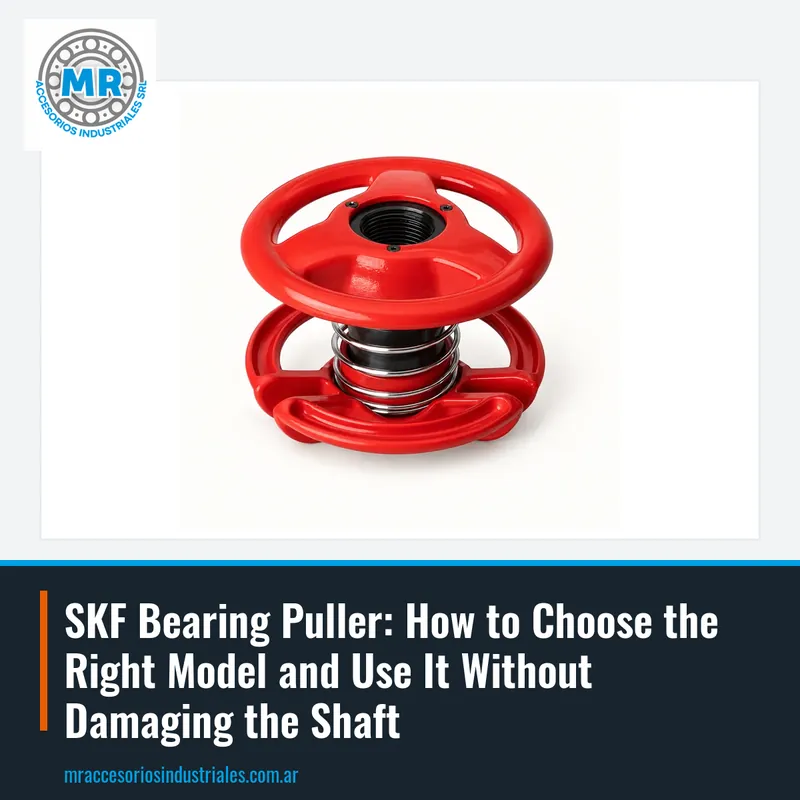
What is an SKF bearing puller and what is it used for?
An SKF bearing puller is a maintenance tool that allows removing bearings, pulleys, gears and other parts fitted on a shaft without damaging them. It is used when the part is mounted with interference or has been in service for a long time and cannot be removed by hand. The SKF line includes mechanical, hydraulic, reversible and jaw pullers, each designed for a specific type of work.
In Argentine industry, SKF pullers are used in maintenance of electric motors, gearboxes, pumps, conveyor belts and mining or agro-industrial equipment. They are tools used in the workshop or in the field, when the entire assembly cannot be disassembled. Choosing the correct model prevents damage to the shaft, bearing or part to be reused.
To identify the right puller, it is advisable to look at the space behind the bearing, the shaft diameter and the force that may be needed. Example codes such as TMMA 3 or TMHP 8 correspond to different series, and each has characteristics worth knowing before ordering. At MR we market and distribute SKF pullers, and we help you choose the model according to your application.
SKF Mechanical Pullers TMMA Series: Manual Force and Simplicity
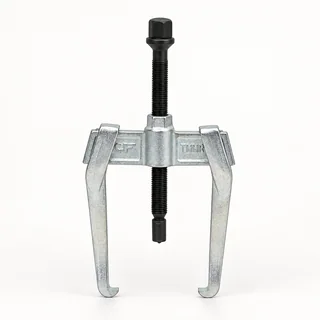
SKF mechanical pullers of the TMMA series are the most common option for workshop jobs where there is enough space to maneuver and the required force is moderate. They are operated with a wrench or a central screw that pushes against the shaft while the jaws pull the bearing. They are lightweight, easy to transport and do not need a pump or hoses.
A code such as TMMA 3 or TMMA 8 corresponds to a model in the series, which is chosen according to the outer diameter of the bearing or part to be extracted. It is important that the jaws open enough to grip the part by the outer ring or by a flange, without forcing the working angle. If the jaws are too open or poorly supported, they can slip and mark the shaft.
When using a mechanical puller, it is advisable to clean the support area and apply a little penetrating oil if there is rust. The screw should be turned evenly and the jaws should be checked to be well engaged before applying force. If the screw jams or the part does not yield, it is better to switch to a hydraulic puller before forcing the tool.
SKF Hydraulic Pullers TMHP Series: Controlled Force for Large Parts
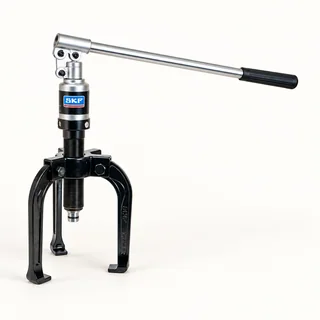
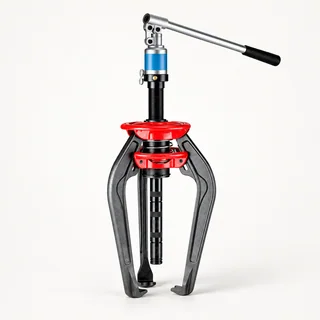
SKF hydraulic pullers of the TMHP series use a hydraulic cylinder to generate the extraction force, which allows removing large or very tight bearings with less physical effort. They are ideal for large diameter shafts, roller bearings or parts that have been mounted for a long time. The operator pumps and the cylinder pushes against the shaft in a controlled manner.
A code such as TMHP 8 or TMHP-5 corresponds to a model in the series. Before choosing, measure the space behind the bearing and the shaft diameter, because the puller must fit without hitting other parts.
When using a hydraulic puller, it is key to verify that there are no oil leaks. The cylinder should be centered with the shaft and pressure applied gradually, observing that the part comes out straight. If the bearing jams or comes out crooked, the shaft seat can be damaged. At MR we quote the SKF hydraulic puller you need, with the code or the measurements of your part.
SKF Reversible Pullers TMMR Series: Versatility for Tight Spaces
SKF reversible pullers of the TMMR series have jaws that can be inverted to work as an internal or external puller. This makes them very useful when there is little space behind the part or when a bearing needs to be extracted from inside a housing. They are a versatile tool for maintenance of gearboxes, motors and pumps.
A code such as TMMR 80F corresponds to a model in this series. To choose, check the jaw opening range and reach depth, because in tight spaces every millimeter counts.
When using a reversible puller, it is important to mount the jaws in the correct position and lock them well before applying force. If the jaws are inverted, make sure the support angle is adequate to prevent slipping. At MR we distribute SKF reversible pullers and advise you on which one is best according to the available space.
SKF Jaw Pullers TMMP Series: For Parts with Flange or Edge
SKF jaw pullers of the TMMP series are designed to grip parts that have a flange, edge or groove where the jaws can engage. They are widely used to extract bearings with exposed outer ring, pulleys with hub or gears that cannot be gripped by the center.
A code such as TMMP 6 identifies a model in this series, which is chosen according to the part diameter and flange depth. It is important that the jaws rest on a firm area and not on a conical or rounded surface, because they can slide.
When using a jaw puller, check that the tips are in good condition and that the central screw is lubricated. Force should be applied gradually and, if the part does not come out, switch to a hydraulic puller instead of forcing the tool. If you have doubts about which SKF jaw puller to use, at MR we quote it with the code or a photo of the part.
How to Choose the SKF Bearing Puller According to the Part and Space
To choose the correct SKF bearing puller, first define where the part will be gripped: outer ring, inner ring, flange or central hole. If the bearing is to be reused, it is advisable to extract it by the inner ring to avoid transmitting force through the rolling elements. If it is to be discarded, it can be gripped by the outer ring with less care.
The second factor is the space behind the bearing: if there is little room, a reversible puller or one with thin jaws may be the only option. Also measure the shaft diameter and the outer diameter of the part, because each series has a working range. Codes such as TMMA 3, TMHP 8, TMMR 80F and TMMP 6 correspond to models with different capacities.
The third factor is the required force: if the bearing is very tight or rusted, a hydraulic puller may be safer than a mechanical one. In general, for light jobs a mechanical one is enough; for large or very tight parts, a hydraulic one is advisable. At MR we market SKF pullers of the TMMA, TMHP, TMMR and TMMP series, and we help you choose according to your measurements and working conditions.
Common Mistakes When Using an SKF Bearing Puller and How to Avoid Them
One of the most common mistakes is using a puller with jaws that do not open enough or that are too inclined, which can cause them to slip and mark the shaft. Another mistake is applying force by hitting the puller screw with a hammer, which can damage the thread or misalign the tool. Always verify that the jaws are well supported and that the screw is centered with the shaft.
It is also a mistake to extract a bearing by the outer ring when planning to reuse it, because the force passes through the rolling elements and can leave marks or deformations. In those cases, use a separator or puller that grips the inner ring. If the bearing is very stuck, controlled heat or penetrating oil can be applied, but never heat the puller.
Finally, do not force a mechanical puller if the part does not yield: it is better to switch to a hydraulic puller before breaking the tool or damaging the shaft. At MR we distribute SKF pullers and advise you on the correct technique for your application. If you have doubts, send us a photo of the part and we will indicate the appropriate puller.
Frequently asked questions
What SKF puller do I use for a stuck bearing?
If the bearing is very tight or rusted, an SKF hydraulic puller of the TMHP series is advisable, as it applies controlled force without impacts. Before using it, clean the area and apply penetrating oil. If the bearing is to be reused, grip it by the inner ring with a suitable separator.
How do I know what size SKF puller I need?
Measure the outer diameter of the part to be extracted and the space behind it. Each SKF series has a working range: for example, TMMA mechanical pullers are used when the required force is moderate, and TMHP hydraulic ones for large or very tight parts. With those measurements, at MR we quote the correct model.
Can I use an SKF puller to remove a pulley or gear?
Yes, SKF pullers are used to remove bearings, pulleys, gears and other parts fitted on a shaft. For pulleys with hub or flange, TMMP jaw pullers are a good option. Verify that the jaws rest on a firm area and do not slip.
What is the difference between a mechanical and a hydraulic SKF puller?
The TMMA mechanical puller is operated with a wrench and is lighter, ideal for light jobs. The TMHP hydraulic one uses a cylinder with a pump and allows applying more force with less effort, for large or very tight bearings. The choice depends on the size of the part and the available space.
Where to buy SKF bearing pullers in Argentina?
At MR Accesorios Industriales, based in Buenos Aires, Argentina, we market and distribute SKF pullers of the TMMA, TMHP, TMMR and TMMP series. You can get a quote via WhatsApp or email by sending the puller code, the measurements of the part or a photo. We respond promptly.
Products with photos in the catalogue
Keep reading
- SKF Chains: Reliable Power Transmission for Industrial Applications
SKF roller chains offer strength and precision for power transmission in industrial machinery. Learn about the PHC series, ASA and BS standards, and how to identify the correct chain for your equipment.
- SKF tools for industrial maintenance: pullers, heaters, aligners and calibrated shims
SKF tools simplify bearing mounting and dismounting, shaft alignment and instrument calibration. Discover TMMA and TMHP pullers, induction heaters, TKSA aligners and calibrated shims.
- How to Choose SKF Bearings by Application: Load, Speed, Environment, and Mounting
Choosing the right SKF bearing requires analyzing load, speed, environment, and mounting. We explain the main types and how to get a quote with the exact code.
Continue here
Need a quote?
Send us the code, size or a photo of the part and we'll quote you shortly.