
Blog
SKF bearing mounting and dismounting: tools, steps and common mistakes
How to mount and dismount SKF bearings without damaging them: shaft preparation, cold and hot mounting, Y bearings and the mistakes that most shorten their service life.
SKF bearings in Argentina: guide and quotes
Technical team at MR Accesorios Industriales · Updated on October 6, 2026
Why mounting defines how long an SKF bearing lasts
A genuine SKF bearing can have a short life if mounted incorrectly. Direct blows on the raceways, wrong fits or dirt on the seat generate marks, misalignment and heating from the first hour of work. That is why SKF bearing mounting is as important as choosing the right code. In this guide we review the steps, tools and mistakes we see most in plants.
Many failures attributed to the bearing actually start at mounting. A bearing that was forced through the wrong ring ends up with indentations on the raceways that, over time, produce noise and vibration. The same happens with an oval shaft or a housing with burrs. The bearing ends up being the visible symptom of a problem that existed before.
At MR we distribute SKF bearings for industry from Buenos Aires, Argentina, and many inquiries come right after a repair that went wrong. Knowing how each type is mounted and dismounted helps to order the correct replacement and avoid repeating the damage. It also helps to plan the downtime: what tools are needed and how much work each change takes.
Before mounting: cleaning, measurements and preparation
The first step is to work in a clean, dry place, with the new bearing in its wrapper until the moment of use. The factory preservative does not need to be removed in most cases, because it is compatible with usual greases and oils. Opening the box early and leaving the bearing on the bench is a sure way to fill it with dust and chips.
Then you must check the shaft and housing. It is advisable to measure the seat diameter at several points to detect ovality or taper, and to check that the shoulders are clean, without burrs or impacts. A worn seat makes the inner ring rotate on the shaft, and that ends in fretting wear that no new bearing solves.
Finally, check that the code of the new bearing matches that of the old one, including suffixes. A C3 indicates greater internal clearance than normal and is usually chosen when the inner ring has a tight fit or there is heat; replacing it with a normal clearance one can leave it without clearance in service. The same with 2RS (rubber seals on both sides) and 2Z (metal shields on both sides): they are not interchangeable without thinking about the application.
Cold mounting of SKF deep groove ball bearings
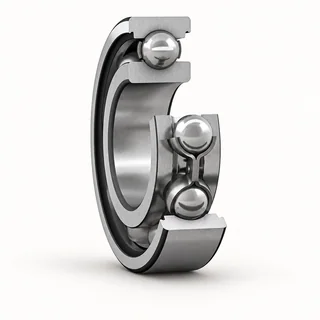
Small and medium deep groove ball bearings, such as 6008 or 6010, are usually mounted cold. The basic rule is to always push the ring that has the tight fit: if the inner ring is pressed onto the shaft, the force is applied to that ring and never through the balls. If the force passes through the rolling elements, the raceways are marked even if the bearing looks healthy at first glance.
To do it right, use a mounting sleeve that supports the entire face of the ring, together with a soft-face hammer or a press. Hitting directly with a steel hammer, or with a punch at a single point, tilts the bearing and jams it in the seat. Mounting kits with sleeves of different diameters solve most bearings in this subcategory.
When both the inner and outer rings have a tight fit at the same time, the sleeve must support both rings at the same time. Once mounted, the bearing must turn smoothly by hand, without hard points or noise. If something scrapes or brakes, the correct thing is to dismount and check before starting the machine.
Hot mounting and spherical roller bearings
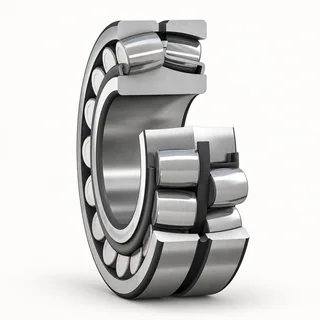
Larger bearings, such as spherical roller bearings of the 22325 series, need too much force to be mounted cold. In those cases, the inner ring is expanded by heating and slid onto the shaft without effort. The indicated tool is an induction heater, which heats evenly, controls the temperature and demagnetizes the bearing at the end.
What is not recommended is heating with a torch or direct flame, because it generates overheated zones that can alter the material and damage cages and seals. Nor should it be immersed in dirty oil. Respect the maximum temperature indicated by the manufacturer for that type of bearing, use thermal gloves and hold the bearing against the shoulder while it cools so it does not come loose.
Tapered bore bearings, which carry the K suffix, are mounted on a tapered shaft or with an adapter sleeve. There the fit depends on how much the ring is pushed onto the taper, and it is controlled by measuring the reduction of internal clearance or axial displacement. Tightening the nut by eye is the most common mistake: an excess leaves the bearing without clearance and a defect leaves it loose on the shaft.
SKF Y bearings: mounting with set screws
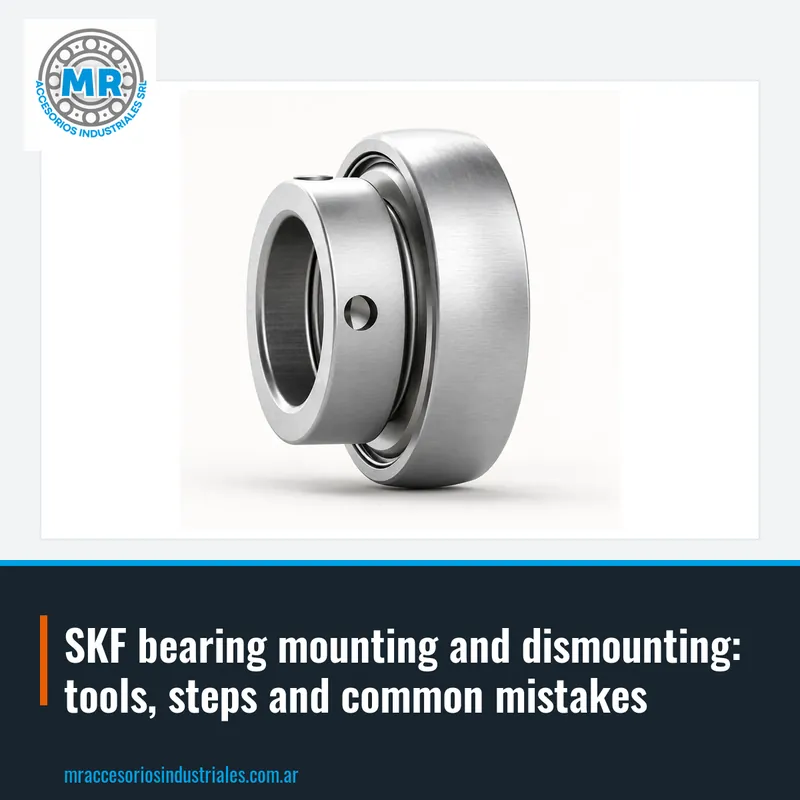
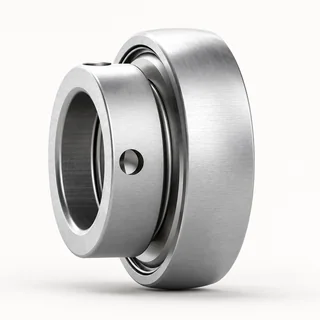
Y bearings, also called inserts, are used in pillow block and flange housings for conveyors, fans and agricultural machinery. Codes such as UC 212 or UC 216 correspond to inserts with extended inner ring and shaft fixing by set screws. Their advantage is that they are mounted quickly on commercial shafts, without tight fits or special tools.
The step to take care of is the order: first fix the housings to the structure with the shaft already aligned, and only then tighten the set screws. If tightened before, any alignment correction loads the bearing and deforms the shaft in the area of the screws. The set screws are tightened to the torque indicated by the manufacturer, without over-tightening.
In equipment with vibration or frequent starts, it is advisable to check the tightness after the first hours of operation. A loose set screw lets the shaft rotate inside the inner ring and marks the surface, and that damage also requires changing the shaft. When quoting an insert, send us the code engraved on the ring and that of the housing, so we can provide the correct assembly.
Dismounting without damaging the shaft or housing
Dismounting follows the same rule as mounting: the force is applied to the ring that has the tight fit. For small and medium bearings, use a jaw or plate puller that takes the inner ring from behind and pulls evenly. Placing the jaws on the outer ring to remove a bearing fitted on the shaft transmits the force through the balls and usually breaks the cage.
For large bearings or very tight fits, hydraulic pullers, heating rings or the oil injection method are used, which separates the ring from the shaft with pressure. For bearings mounted with adapter sleeves, loosen the nut and release the sleeve before pulling. Forcing with levers or blows on the shaft marks the seat and complicates the next mounting.
If the bearing is to be analyzed to find out why it failed, it is advisable to dismount it carefully, mark its position on the machine and store it without cleaning. The marks on the raceways and the condition of the grease say a lot about the cause. A bearing destroyed by a brusque dismounting erases that information.
Common mistakes and how to quote your SKF bearing with MR
The mistakes that most shorten service life are repeated: hitting the bearing with a steel hammer, heating with a torch, mounting on a worn shaft, over-tightening the nut of an adapter sleeve and over-greasing or with an incompatible grease. To this is added misalignment between housings, which loads the bearings even if they are well mounted. Correcting these points usually pays more than changing the bearing.
Another frequent mistake is ordering the replacement only by size and not by the complete code. Two bearings with the same diameter can differ in internal clearance, seal type or cage, and those differences matter when mounting. That is why it is always advisable to read the code engraved on the ring, with all its suffixes, before ordering.
At MR we distribute genuine SKF bearings for industrial maintenance from Buenos Aires, Argentina. Send us by WhatsApp or email the code, the shaft and housing measurements or a photo of the part, and we will quote you promptly. If you bring the code of another brand, we will indicate the SKF equivalent.
Frequently asked questions
How do you mount an SKF bearing without damaging it?
By always applying force on the ring that has the tight fit, with a mounting sleeve or a press, never through the balls or rollers. Large bearings are mounted by heating them with an induction heater.
Can a bearing be heated with a torch?
It is not recommended. The direct flame heats unevenly, can alter the material and damage cages and seals. The indicated method is an induction heater respecting the manufacturer's maximum temperature.
What tool is used to remove a bearing?
For small and medium bearings, a jaw or plate puller that takes the ring with the tight fit. For large bearings, hydraulic pullers or the oil injection method.
When are the set screws of a Y bearing tightened?
After fixing and aligning the housings. If tightened before, any correction loads the bearing and deforms the shaft in the area of the screws.
What data do I send to quote an SKF bearing?
The complete code engraved on the ring, with its suffixes, or the shaft and housing measurements, or a photo of the part. We will quote you promptly by WhatsApp or email.
Products with photos in the catalogue
Keep reading
- SKF Chains: Reliable Power Transmission for Industrial Applications
SKF roller chains offer strength and precision for power transmission in industrial machinery. Learn about the PHC series, ASA and BS standards, and how to identify the correct chain for your equipment.
- SKF tools for industrial maintenance: pullers, heaters, aligners and calibrated shims
SKF tools simplify bearing mounting and dismounting, shaft alignment and instrument calibration. Discover TMMA and TMHP pullers, induction heaters, TKSA aligners and calibrated shims.
- How to Choose SKF Bearings by Application: Load, Speed, Environment, and Mounting
Choosing the right SKF bearing requires analyzing load, speed, environment, and mounting. We explain the main types and how to get a quote with the exact code.
Continue here
Need a quote?
Send us the code, size or a photo of the part and we'll quote you shortly.