
Blog
Gummi: common failures of elastic couplings, how to recognize them in time and how to prevent them
Misalignment, worn elastic element, poor shaft fit and lack of inspection: the most common failures of an elastic coupling and the assembly and maintenance routine that prevents them.
Technical team at MR Accesorios Industriales · Updated on October 16, 2026
What an elastic coupling does and why it fails
An elastic coupling joins two shafts, for example a motor shaft and a pump shaft, and transmits rotation through an elastic element that absorbs part of the vibrations and starting shocks. That element is precisely the part that is sacrificed to protect the bearings, seals and shafts. Therefore, when a coupling fails, there is almost always a prior cause worth finding.
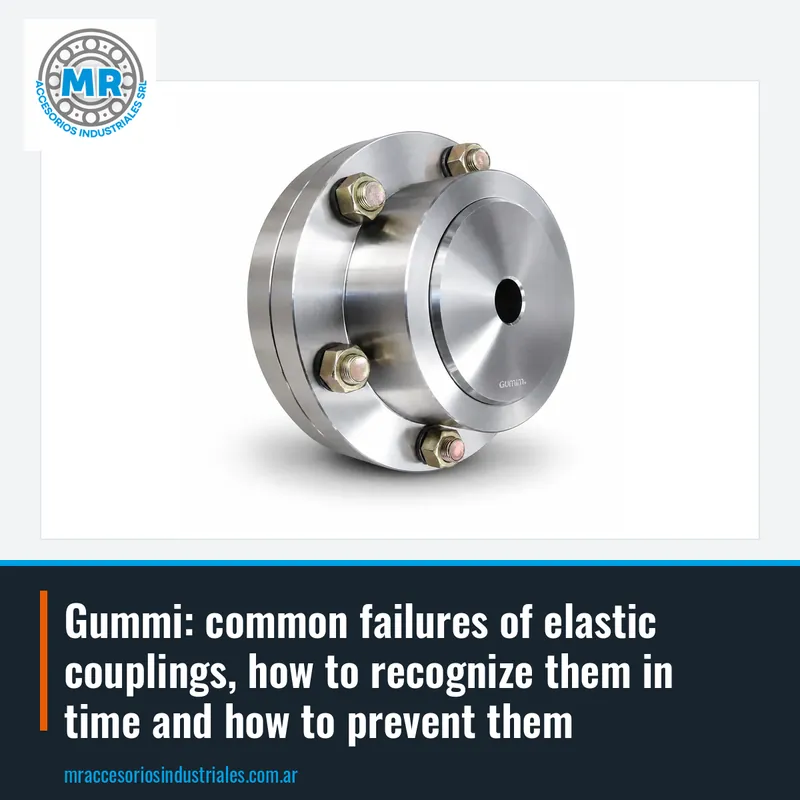
In the Gummi coupling line we distribute in Buenos Aires, Argentina, there are models with two standard hubs such as the A-20, A-25 and A-60, which share the same operating principle. They are type A elastic couplings: two metal hubs mounted on each shaft and an elastic center between them. Understanding that construction helps read the symptoms, because each wear pattern leaves a different mark.
Failures group into a few causes: misalignment between shafts, aged or damaged elastic element, poor fit of the hubs on the shaft and excess load relative to what the coupling supports. Almost all are detected with a simple inspection before the machine stops. Prevention starts with a good coupling selection and continues with careful assembly.
Misalignment between shafts: the most common cause
When the two shafts are not in the same line, the elastic element deforms on every turn and works harder than it should. That repeated stress heats it, hardens it and eventually cracks it. The elastic coupling tolerates a small misalignment, but it is not designed to compensate for poor machine setup.
There are two types of misalignment that combine in practice: angular, when the shafts form an angle with each other, and parallel, when they are offset from one another. They are measured with a dial indicator, with a ruler and feeler gauge or with a laser aligner, depending on the precision the equipment requires. After aligning, it is advisable to measure again with the machine secured to its base, because tightening the bolts usually moves things slightly.
A typical sign of misalignment is heating of the coupling or nearby bearings, along with vibration that was not there before. Rubber dust around the coupling guard also appears. If you see any of those signs, check the alignment before changing the part, because otherwise the new replacement will suffer the same.
Worn or damaged elastic element
The elastic element is the part that wears the most in a coupling. With use it hardens, loses flexibility and cracks. A periodic visual inspection, with the machine stopped and the guard removed, is enough to see cracks, deformations or missing parts.
Besides normal use, there are agents that accelerate it: oils and greases falling on the element, heat near the motor or a process, and environments with chemical products. If the coupling works in a place with lubricant splashes, it is advisable to protect the area or correct the leak at its source. A swollen, soft or sticky-looking element usually indicates contact with oil.
When replacing the elastic element, it is best to do it before it falls apart, because a break while running can damage the hubs and shafts. To order the correct replacement we need the code engraved on the coupling hub, for example A-60, or a photo of the complete part. With that data we will quote the element or the complete coupling shortly.
Poor fit of the hubs on the shaft
The coupling hubs are fixed to the shaft with a key and one or more set screws. If the hole is loose, if the key does not fit properly or if the set screws are not tightened, the hub moves on the shaft and wears it. That play is noticed as knocking and, over time, as a marked shaft or an enlarged keyway.
The diameter of the hub hole must match that of the shaft, within the corresponding fit. The hubs of type A couplings, such as the A-25, come with a pilot hole to be machined to the shaft size, always within the maximum allowed for each size. Machining too much, or doing it without caring for concentricity, weakens the hub and causes imbalance.
When assembling, clean the shaft and the hole, check the key and tighten the set screws to the torque indicated by the coupling manufacturer. After the first hours of operation, check the tightness again, because initial settling can loosen it. It is a few-minute check that prevents shaft breakage.
Overload and incorrectly sized coupling
Each coupling size is designed to transmit a certain torque. If the machine demands more than the coupling supports, the elastic element works at its limit and wears much sooner than expected. A coupling too small for a motor that starts under load is one of the most frequent causes of repeated replacements.
To choose well, consider the motor power, rotation speed and type of driven machine: a centrifugal pump works differently from a compressor or a conveyor belt with starts under load. In equipment with shocks or frequent starts, it is common to go up one size. The torque data for each model is in the product sheet, for example in that of the A-20.
If you are not sure which coupling corresponds, send us the power, revolutions, diameter of each shaft and the separation between ends. With that data we help you identify the appropriate Gummi model to quote. When replacing an existing part, the fastest way is to send the engraved code or a photo of both hubs.
How failures are recognized in time
Most failures warn before causing a stoppage. A new noise, increasing vibration, a smell of hot rubber or dark dust under the guard are signs to stop the machine and look. The sooner it is checked, the less damage the failure can do.
A simple maintenance round includes four checks: look at the condition of the elastic element, check the tightness of the set screws, listen for knocking and carefully touch the housing to detect abnormal heating. Writing down what is seen in each round allows comparison and discovery of slow changes. That habit is more useful than any sophisticated instrument if done regularly.
When a coupling is disassembled due to a failure, it is worth keeping the parts and looking at them calmly. An element cracked on one side points to misalignment; an element with a shiny or melted surface points to heat or rubbing; a hub with play on the shaft points to a defective fit. That reading prevents repeating the mistake with the replacement.
Assembly and maintenance that prevent failures
A good assembly starts with the bases: the machine must rest without a loose foot, with shims well placed and bolts tightened before measuring alignment. Then the hubs are mounted on each shaft, the separation between ends indicated by the manufacturer is left, and the elastic element is placed without forcing it. A rushed assembly is almost always paid for with an early failure.
Preventive maintenance is reduced to checking alignment periodically, inspecting the elastic element, controlling tightness and keeping the area clean. It is advisable to always keep the coupling guard in place, both for safety and to prevent dust or splashes from entering. If the equipment is critical, having a spare element on hand reduces downtime.
Gummi couplings are used in pumps, fans, gearboxes, compressors and conveyor belts in industrial plants. For each application, selection and assembly follow the same logic described here. If you want to review your installation or prepare a replacement, write to us and we will look at it with your machine data.
Frequently asked questions
Why does the elastic element of a coupling break?
The most common causes are misalignment between shafts, overload due to an undersized coupling, contact with oils and heat. Before changing the part, correct the cause, or the new replacement will fail the same way.
How do I know if my coupling is misaligned?
The signs are heating of the coupling or nearby bearings, new vibration and dark dust under the guard. It is confirmed by measuring with a dial indicator, ruler and gauge or laser aligner.
How often should an elastic coupling be checked?
It is advisable to include it in the machine maintenance round: look at the elastic element, check the set screws and listen for knocking. The frequency depends on working hours and site conditions.
What data do I need to order a Gummi coupling?
The code engraved on the hub, such as A-20 or A-60, or a photo of the part. If you do not have the code, send us power, revolutions and diameter of each shaft, and we will quote shortly.
Can I change only the elastic element?
In many couplings yes, as long as the hubs are in good condition and without play on the shaft. If the hubs are damaged, it is advisable to quote the complete coupling.
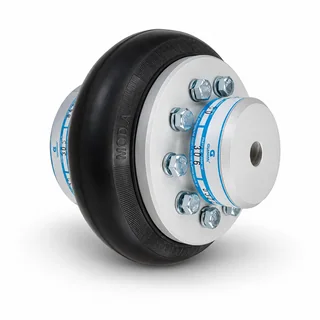
Products with photos in the catalogue
Keep reading
- GUMMI Couplings: Vibration Absorption and Reliable Power Transmission for Industry
GUMMI elastic couplings absorb vibrations and misalignments, protect machinery, and ensure reliable power transmission. Learn about their configurations and how to choose the right model.
- How to Read Gummi Codes: Designation Structure, Prefixes, Suffixes and Real Examples
Practical guide to understand Gummi coupling nomenclature. Decode codes and designations to identify the correct coupling for your application.
- Gummi Couplings: applications, selection and maintenance to make them last
Discover where Gummi couplings are used, how to choose the right model for your application and the best assembly and maintenance practices to extend their service life.
Continue here
Need a quote?
Send us the code, size or a photo of the part and we'll quote you shortly.