
Blog
EMMAR Measurements: How to Identify the Code from the Part and What Data to Send for a Quote
We explain how to read the measurements and markings of EMMAR pulleys and chains to identify the exact code, and what data to send us for a quick quote.
Technical team at MR Accesorios Industriales · Updated on October 25, 2026
Why measurements are the key to identifying an EMMAR part
When you have a worn pulley or chain and need to replace it, the first thing is to gather all the measurements you can. In the case of EMMAR, product codes usually derive directly from those dimensions, so measuring well saves you back-and-forth. You don't always need to remove the part: with a caliper and a tape measure you can get the main data. Then, with that information, we help you identify the exact code for a quote.
EMMAR pulleys are identified by the measurement in millimeters, the number of grooves, and the belt section. Roller chains, on the other hand, are defined by the pitch, the inner width, and the roller diameter. If you have the old part on hand, check if it has any number or letter engraved: many times the code is stamped on the metal. If it's not legible, don't worry, the measurements are enough.
A common mistake is sending only a photo without any size reference. The photo helps, but without measurements we can't confirm the model. Another mistake is confusing the pulley diameter with the bushing hole diameter: they are different things and both matter. Take a few minutes to measure carefully and send us all the data together, so the quote comes faster.
EMMAR pulleys: how to measure them and what the codes mean
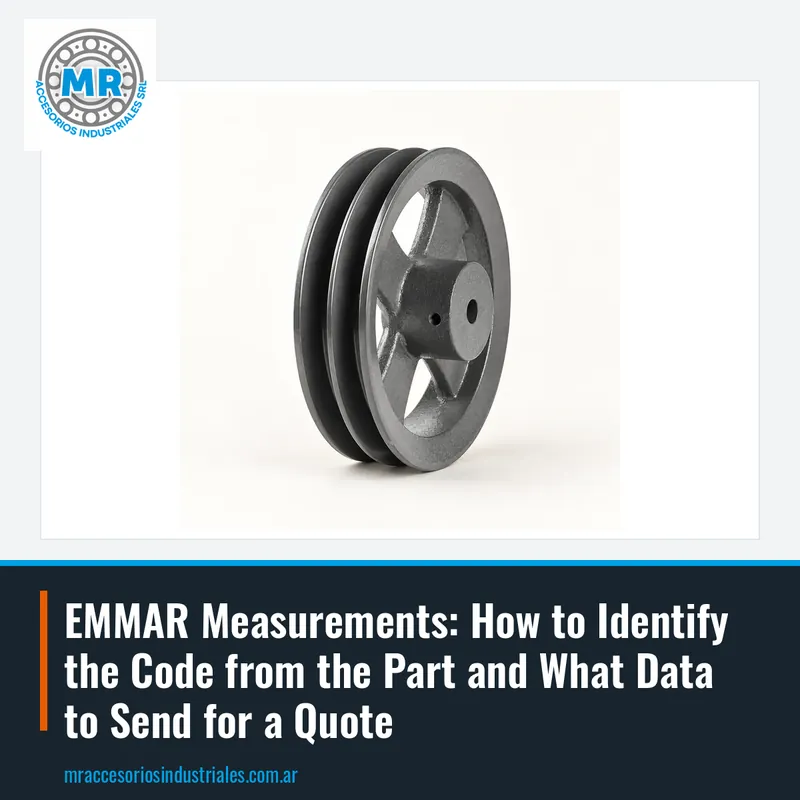
EMMAR pulleys are manufactured in Buenos Aires and are used in V-belt drives. To identify them, you need the measurement in millimeters, the number of grooves, and the belt section that defines the groove width (A or B). With those three data you can get close to the code.
For example, the codes POLEA 50 1A and POLEA 50 1B correspond to pulleys of 50 mm measurement, single groove, with section A and section B respectively. The final letter (A or B) indicates the belt section. If you have a pulley with two grooves, such as POLEA 60 2A, the number 2 indicates the number of grooves and the letter A the section. It's always advisable to verify the width of each groove to confirm the section.
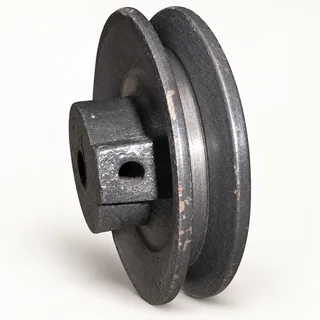
When measuring an EMMAR pulley, don't forget the hole diameter and the total hub width. If the pulley has a tapered bushing, note the bushing type if you see it engraved. If not, measure the hole diameter and the hub height. Send us all those measurements along with a front and side photo, and we'll quote you the pulley.
EMMAR roller chains: pitch, width, and how to read the code
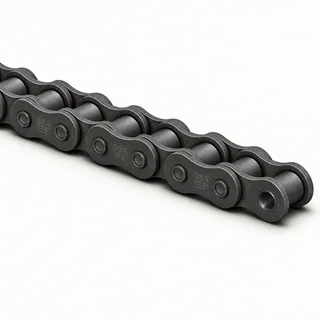
EMMAR roller chains are used in power transmissions. To identify them, the main measurement is the pitch, which is the distance between centers of two consecutive rollers. You also need the inner width between plates and the roller diameter. With those three values you can determine the standard (ASA or BS) and the chain number.
EMMAR chain codes follow a standard format: for example, 10-B1 indicates a chain with 5/8 inch pitch (series 10) according to BS standard, with a single row of rollers. 10-B2 is the same chain but double row. 20-B1 is a chain with 1 1/4 inch pitch, single row. If you have an old chain, measure the pitch with a caliper and compare with a standard pitch table: 3/8, 1/2, 5/8, 3/4, 1, 1 1/4, etc.
An important detail: chains stretch with use, so measuring the pitch on a very worn chain can give a value greater than nominal. If the chain is very stretched, measure several pitches and divide by the number to get closer to the original value. Also check if it has any number engraved on the side plates: sometimes the code is stamped. If not, with the measurements and a clear photo we help you identify it.
Differences between EMMAR pulleys and other brands: what to look at
Although EMMAR pulleys are own-manufactured, many times the customer brings a pulley from another brand and needs a replacement. In that case, measurements are the best guide: outer diameter, groove width, bushing type, and hole. The pulley doesn't need to be identical in the hub, but it must match the belt dimensions and the hole diameter to fit on the shaft.
If you have a pulley from another brand with a different code, you can send us that code and the measurements. We'll indicate the equivalent EMMAR pulley. For example, if you have a 60 mm pulley with two A grooves, POLEA 60 2A may be the option. Always verify that the groove width matches the belt section you use.
A common mistake when replacing pulleys is choosing one with the same outer diameter but different groove width. That makes the belt work poorly and wear prematurely. Another mistake is not checking the shaft fit type: if the original pulley had a tapered bushing and you put one with a straight hole, you'll have mounting problems. So, send us all the measurements and the bushing type if you know it.
How to identify the EMMAR code without a catalog on hand
If you don't have the EMMAR catalog, you can identify the code with the measurements and a bit of logic. For pulleys, the code usually starts with the word POLEA followed by the measurement in millimeters, the number of grooves, and the belt section letter. For chains, the code is a series number (10, 20, etc.) followed by a letter (B for BS standard) and a number indicating the number of rows.
For example, if your pulley is 50 mm and has a single groove for A belt, the code is POLEA 50 1A. If it's 60 mm and has two grooves for A belt, it's POLEA 60 2A. In chains, if you measure a 5/8 inch pitch and it's single row, the code is 10-B1. If it's double row, 10-B2.
Don't worry if you're not sure of the exact code: with the measurements and a clear photo, we confirm it. You can also send us the old part code if you have it, even if it's from another brand. With that information, we quote you the correct EMMAR part. Avoid guessing the code without measuring, because a misinterpreted number can lead to a wrong order.
What data to send to quote EMMAR pulleys or chains
To quote an EMMAR pulley, send us these measurements: outer diameter, groove width (or belt section), hole diameter, bushing type if you know it, and number of grooves. If you have the old pulley, take a front photo and a side photo showing the hub. With that we can identify the code and give you the quote.
To quote an EMMAR chain, we need the pitch (distance between rollers), the inner width between plates, the roller diameter, and the number of rows. If the chain is on the machine and you can't remove it, measure the pitch over several links and take a photo of the chain and the sprocket. With that data we indicate the code, for example 10-B1 or 20-B1.
It's always helpful if you tell us what machine the part goes on and what it's used for. That helps us confirm that the selection is correct, especially if there are doubts with the measurements. Send us everything by WhatsApp or email, and we'll respond promptly with the quote. You don't need to come in person: photos and measurements are enough.
Common mistakes when measuring and ordering EMMAR parts
One of the most frequent mistakes is measuring the pulley outer diameter with a ruler instead of a caliper. The ruler can give an error of one or two millimeters, and in small pulleys that changes the code. Use a caliper if you have one, or measure with a flexible tape measure and take the average of two or three measurements. The same for the bushing hole: an error of half a millimeter can make the pulley not fit on the shaft.
In chains, the typical mistake is measuring the pitch on a single very worn link. As we said, the chain stretches and the measured pitch can be greater than nominal. Measure several links (for example, ten) and divide by the number to get the average pitch. It's also common to confuse the inner width with the total chain width: the inner width is between the inner plates, not the outer width.
Another mistake when ordering is not specifying the number of grooves in pulleys or the number of rows in chains. A single-groove pulley is not the same as a double, and a single chain does not replace a double. If you have doubts, send us photos from various angles and all the measurements you can. That way you avoid returns and wasted time.
Frequently asked questions
How do I identify the code of an EMMAR pulley if it has no engraving?
Measure the outer diameter, groove width, hole diameter, and number of grooves. With that data we help you identify the code, for example POLEA 50 1A for a 50 mm single-groove A-section pulley.
What measurements do I need to order an EMMAR chain?
You need the pitch (distance between rollers), the inner width between plates, the roller diameter, and the number of rows. For example, a 10-B1 chain has 5/8 inch pitch and single row.
Can I replace a pulley from another brand with an EMMAR one?
Yes, if the measurements match: outer diameter, groove width, bushing type, and hole. Send us the old pulley code and measurements, and we'll indicate the equivalent EMMAR.
How do I measure the pitch of a worn chain?
Measure the distance between several rollers (for example, ten pitches) and divide by the number. That gives you the average pitch and avoids error from chain stretch.
What data do I send to quote an EMMAR pulley or chain?
Send us the main measurements, photos of the part from various angles, and, if you have it, the old code. With that we quote you promptly by WhatsApp or email.
Products with photos in the catalogue
Keep reading
- EMMAR Industrial Pulleys: Power Transmission Solutions for Argentine Industry
EMMAR industrial pulleys are manufactured in Buenos Aires, Argentina with sections A, B and C, in different numbers of grooves and also custom-made. Discover the options for your transmission system.
- How to Read EMMAR Codes: Designation Structure, Prefixes, Suffixes, and Real Examples
Understanding the nomenclature of EMMAR pulleys and chains helps you identify the correct replacement part. We explain how the codes are composed and what each part means.
- EMMAR: applications, selection and maintenance for lasting performance
EMMAR is MR's own brand for pulleys and roller chains. Learn where they are used, how to select them and maintain them to extend their service life.
Continue here
Need a EMMAR quote?
Send us the EMMAR part number, the size or a photo of the part and we will get back to you with a quote.