
Blog
How to choose EMMAR pulleys and chains by load, speed, environment and mounting
Practical guide to choosing EMMAR pulleys and roller chains, MR's own manufactured brand, by working conditions, with real catalog codes.
Technical team at MR Accesorios Industriales · Updated on October 9, 2026
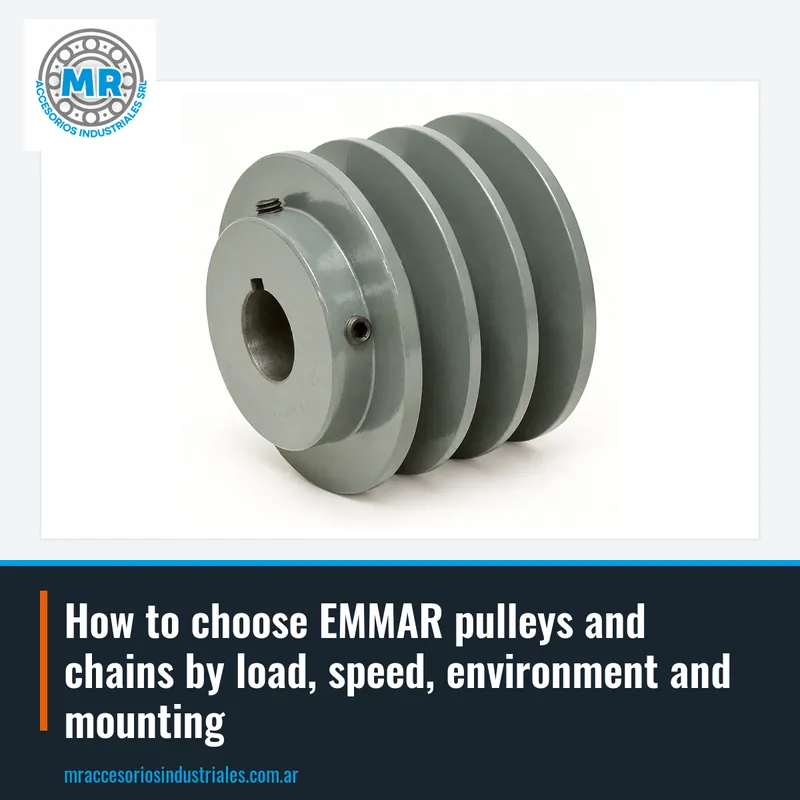
EMMAR pulleys: types and applications by load
EMMAR pulleys are manufactured by MR in Buenos Aires, from 1 to 18 grooves, and specials are also made to drawing. In a V-belt drive, the right choice depends on the belt profile, the diameter required by the transmission ratio, the number of belts and the shaft where it is mounted. A small single-groove pulley, such as POLEA 50 1B, works for light drives; when more power must be transmitted, grooves are added, as in POLEA 80 3B or POLEA 70 4B.
In an EMMAR pulley code, the number is the pulley diameter size and what follows indicates the number of grooves and the belt profile. Thus, POLEA 50 1B is a single-groove pulley for B belt, and POLEA 70 4B has four grooves for the same profile. This naming makes it possible to see at a glance whether the pulley matches the belts already on the machine. When ordering, it is advisable to add the shaft diameter and how it is fixed: keyway, set screw or another system.
In equipment such as fans, centrifugal pumps and conveyors, pulleys work under continuous loads. It is not advisable to oversize the number of grooves without reviewing the rest of the drive, because more tensioned belts also load the shaft and bearings more. If the original pulley is worn or vibrates, measure its diameter, count the grooves, identify the belt profile and take the shaft diameter. With that data, at MR we quote the EMMAR pulley you need.
EMMAR roller chains: selection by speed and power
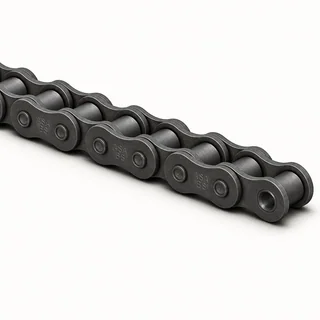
EMMAR roller chains are manufactured by MR: ASA chains in single and multiple strands, up to sextuple. They transmit motion between parallel shafts and selection starts with the pitch, which defines the size of the chain and sprockets, and with the number of strands, which is added when more power must be transmitted without increasing the pitch. The catalog lists codes such as 12-C1, 10-C2 and 08-C2.
As a general rule, at higher speed a smaller pitch is advisable, and if power is insufficient, move to a double, triple or more-strand chain before a larger pitch. For heavy loads and slow rotation, larger pitches can be used. In all cases, lubrication must match the working speed: a chain that runs fast and dry stretches and makes noise much sooner.
EMMAR chains are used in conveyors, agricultural machinery, elevators and industrial drives. When replacing a chain, it is essential to measure the pitch and count the number of strands, as well as know the length in links. A common mistake is ordering a chain only by roller diameter, when the key data is the pitch. With the code or the pitch and strand measurement, we quote the correct EMMAR chain.
How to identify the correct code in EMMAR pulleys and chains
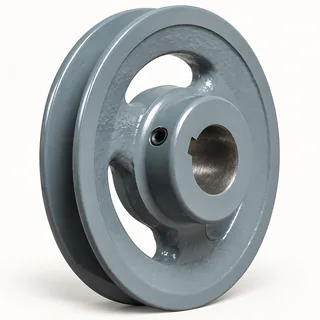
To identify a pulley, three data are needed: diameter, number of grooves and belt profile, which is what a code such as POLEA 50 1B summarizes. The profile is taken from the belt that is mounted, which carries its designation printed. It is also advisable to measure the shaft diameter and the total pulley width with a caliper.
In roller chains, measure the distance between centers of two consecutive pins to obtain the pitch, in millimeters or inches. To avoid mistakes, measure several consecutive pitches and divide. Then count the number of strands. With the pitch and strands, the corresponding EMMAR chain is defined, such as 12-C1 or 10-C2.
When ordering a part, it is advisable to send a photo showing the measurements taken. At MR we manufacture EMMAR pulleys and chains and help you identify the exact model. There is no need to disassemble the whole equipment: with the pulley measurements and belt profile, or with the chain pitch and strands, it is enough to quote. If you have doubts, write to us by WhatsApp or email and we will guide you.
Environmental conditions: how they affect the choice of EMMAR
The working environment influences the selection and care of pulleys and chains. In environments with dust, humidity or chemicals, surface protection and cleaning weigh as much as size. Dust mixes with chain lubricant and forms an abrasive paste, and humidity attacks unprotected surfaces.
In outdoor applications, such as agricultural or construction equipment, corrosion is a critical factor. Roller chains require periodic lubrication, and in aggressive environments intervals should be shortened and cleaning done before relubricating. If the application has a particular requirement, tell us the use when requesting the quote.
Temperature also conditions the choice: in ovens or dryers, parts must tolerate expansion and the chain lubricant must be suitable for that heat. If you work in a demanding environment, tell us the conditions and we will recommend the appropriate EMMAR pulley or chain.
Mounting and maintenance of EMMAR pulleys and chains
Correct mounting of an EMMAR pulley begins by verifying the fit between the bore and the shaft. Too loose a fit causes vibrations and keyway wear; too tight a fit can damage the hub. A suitable keyway must be used and the pulley fixed with set screws or locking bushings. Alignment between pulleys is critical to avoid premature belt wear.
In EMMAR roller chains, correct tension is essential. A chain that is too tight overloads the bearings and causes accelerated wear; a loose chain can jump the sprocket teeth. It is advisable to leave a small sag on the slack side and check it after the first hours of work. Lubrication must be regular, with oil or grease depending on speed and environment.
Preventive maintenance includes periodically checking the condition of pulley grooves and link wear. If chain elongation or cracks in the pulley are observed, the part must be replaced. At MR we manufacture EMMAR pulleys and chains and guide you on mounting and care. Send us a photo of the worn part and we will quote the replacement.
Common mistakes when ordering EMMAR pulleys and chains
One of the most frequent mistakes is ordering a pulley only by shaft diameter, without stating the pulley diameter or belt profile. Another is not counting the number of grooves correctly: POLEA 80 3B and POLEA 70 4B are not interchangeable even if they use the same profile. The code must always be verified or measured accurately.
In chains, pitch is often confused with roller diameter, and they are different measurements. It is also common to order a chain by total length in meters, when the correct way is to indicate the number of links or the center distance. If you are not sure, send a photo of the old chain or measure the pitch with a caliper.
Another mistake is not considering how the pulley is fixed to the shaft. When ordering, it is advisable to clarify the shaft diameter, whether it has a keyway and its size. At MR we help you avoid these mistakes: with the correct code or measurements, we quote the exact EMMAR pulley or chain.
How to quote EMMAR pulleys and chains at MR
To quote an EMMAR pulley, we need the complete code, for example POLEA 70 4B, or the measurements: pulley diameter, number of grooves, belt profile and shaft diameter. If you have the old pulley, a photo with measurements helps identify it. If you need a special pulley, send us the drawing. With that data we send you the quote shortly.
For EMMAR roller chains, we ask for the code such as 10-C2 or the pitch and number of strands. If you do not know the pitch, measure the distance between centers of two consecutive pins. We also need to know the length in links or the center distance of the sprockets. At MR we quote the EMMAR chain you need, without hassle.
You can write to us by WhatsApp or email with the code, measurements or a photo of the part. EMMAR pulleys and chains are manufactured by MR in Buenos Aires, Argentina. We reply with the quote shortly.
Frequently asked questions
How do I know which EMMAR pulley I need for my machine?
You need the pulley diameter, number of grooves, belt profile and shaft diameter. With that data the code is identified, for example POLEA 50 1B for a single-groove pulley for B belt. If you have the old pulley, a photo with measurements helps.
What data do I need to order an EMMAR chain?
The pitch, number of strands and length in links or the center distance of the sprockets. If you have the code, such as 12-C1, send it along with those measurements by WhatsApp or email and we will quote it shortly.
Can I use an EMMAR pulley with more grooves than the original?
Yes, as long as the rim width and power allow it. Increasing grooves allows transmitting more power with more belts, but you must verify that the shaft and bearings support the additional load.
How do I measure the pitch of a roller chain?
Measure the distance between centers of two consecutive pins with a caliper. That measurement in millimeters or inches gives you the pitch. For more precision, measure several consecutive pitches and divide by the quantity.
What do I do if I cannot find the code on the EMMAR pulley or chain?
You can measure the key dimensions: for pulleys, pulley diameter, number of grooves, belt profile and shaft diameter; for chains, pitch and number of strands. Send those measurements or a photo to MR by WhatsApp or email and we will help you identify the model.
Products with photos in the catalogue
Keep reading
- EMMAR Industrial Pulleys: Power Transmission Solutions for Argentine Industry
EMMAR industrial pulleys are manufactured in Buenos Aires, Argentina with sections A, B and C, in different numbers of grooves and also custom-made. Discover the options for your transmission system.
- How to Read EMMAR Codes: Designation Structure, Prefixes, Suffixes, and Real Examples
Understanding the nomenclature of EMMAR pulleys and chains helps you identify the correct replacement part. We explain how the codes are composed and what each part means.
- EMMAR: applications, selection and maintenance for lasting performance
EMMAR is MR's own brand for pulleys and roller chains. Learn where they are used, how to select them and maintain them to extend their service life.
Continue here
Need a quote?
Send us the code, size or a photo of the part and we'll quote you shortly.