
Blog
EMMAR components for agriculture: how to choose pulleys and chains for combine harvesters, seeders, norias and storage
Practical guide to identify and quote EMMAR pulleys and roller chains in agricultural machinery and storage plants.
Technical team at MR Accesorios Industriales · Updated on November 3, 2026
What EMMAR components are used in agriculture
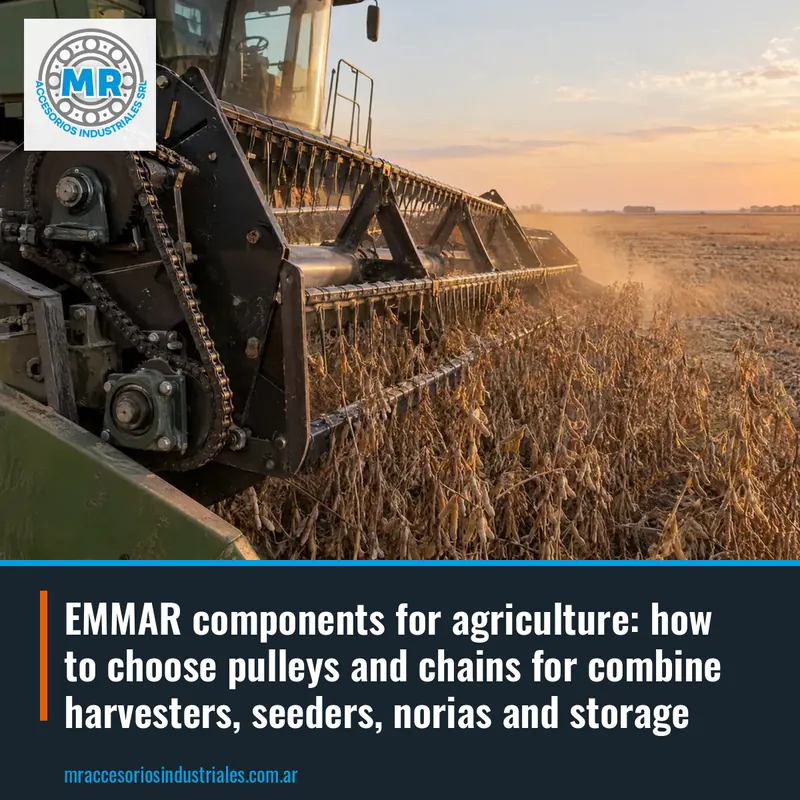
In agricultural machinery, power transmission is critical: EMMAR pulleys and roller chains are manufactured in Buenos Aires, Argentina, and are used in combine harvesters, seeders, norias and storage plants. Pulleys transmit motion between shafts via belts, while roller chains do so between sprockets. Both components must withstand dust, vibrations and variable loads.
EMMAR pulleys are used in threshing, cleaning and grain transport systems inside the combine harvester, as well as in noria elevators. Roller chains, on the other hand, are used in low-speed, high-load transmissions, such as unloading augers or seeder feeding systems.
When quoting these components, it is key to identify the type of pulley or chain, its measurements and the equipment where it is mounted. In agriculture, each machine has specific configurations and a wrongly chosen spare part can cause unplanned downtime. Therefore, it is advisable to send the code engraved on the part or a photo with a ruler to verify dimensions.
EMMAR pulleys for combine harvesters and seeders
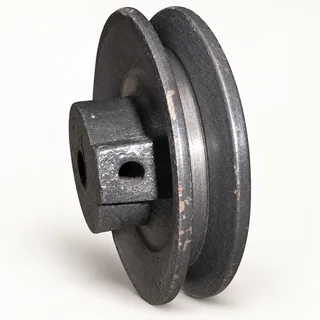
EMMAR pulleys are manufactured in different belt sections, such as A, B or C, and with one or multiple grooves. For example, the codes POLEA 50 1A and POLEA 50 1B correspond to single-groove pulleys for A and B section belts respectively.
In seeders, multi-groove pulleys distribute the load among several belts. A code like POLEA 60 2A indicates a two-groove pulley, section A. It is important to verify the pitch diameter, the number of grooves and the type of bushing or hole to ensure compatibility.
When ordering an EMMAR pulley for agriculture, it is advisable to indicate the exact shaft measurement, the type of keyway and the belt section. Often the original pulley is worn or broken, and the code can only be partially read. In such cases, a photo with a ruler and the shaft diameter are enough for the MR team to help identify it.
EMMAR roller chains in norias and grain transport
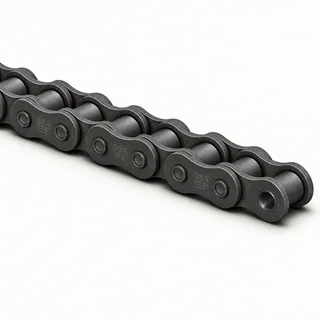
EMMAR roller chains are manufactured according to international standards, in pitch of 5/8 inch (series 10B) or 1 1/4 inch (series 20B), among others. The codes 10-B1 and 10-B2 correspond to single and double chains of 5/8 pitch. For higher capacity elevators, chains such as 20-B1, of 1 1/4 pitch, are used, which support higher working loads.
In norias, roller chains drive the buckets that elevate the grain. They must resist the abrasion of the cereal and constant tension. Therefore, it is essential to choose the correct pitch and number of rows: a double chain distributes the load better and reduces wear in demanding applications. Additionally, stretch and lubrication must be periodically checked.
To quote an EMMAR chain, the pitch, number of rows and required length are needed, either in meters or number of links. If the original chain is very worn, the pitch between pins can be measured with a caliper and the links counted. Sending a photo of the sprocket also helps confirm the pitch and type of chain.
How to identify an EMMAR pulley or chain on your equipment
EMMAR pulleys may have the code engraved on the hub, for example POLEA 50 1A. If the part is very dirty, it should be cleaned with a cloth and the embossed engraving looked for. On chains, the code may be stamped on the side plates of some links, although it often wears off with use.
When the code cannot be read, key dimensions must be measured: on pulleys, the outer diameter and hole diameter; on chains, the pitch between pins and the width between inner plates. With that data and a photo, the MR team can identify the equivalent EMMAR part. It is important not to confuse the outer diameter with the pitch diameter, since the latter defines the transmission ratio.
A common mistake is to order a pulley only by outer diameter, without verifying the belt section. An A-section pulley does not work with a B-section belt, even if the diameter is similar. The same happens with chains: confusing 5/8 pitch with 3/4 can prevent the chain from seating on the sprocket. Therefore, it is always advisable to verify measurements with the catalog or consult a specialist.
Frequent mistakes when ordering agricultural spare parts
One of the most common mistakes is to order a pulley or chain without specifying the equipment where it is mounted. In agriculture, the same measurement can have variants depending on the machine manufacturer. For example, a pulley of the same section can have a different type of bushing or hole depending on the machine.
Another mistake is not considering the direction of rotation or mounting position. In norias, chains work vertically and require suitable connecting links. In pulleys, the keyway must match that of the shaft, and the fit must be firm to avoid vibrations. If a pulley is replaced with one of a different material, the dynamic behavior of the system may change.
It is also common to confuse the chain series: a 10B chain is not interchangeable with a 10A, even if they have the same pitch. B and A standards differ in the width between inner plates and in the roller diameter. Therefore, when quoting, it is advisable to send the exact code or precise measurements, and not just say 'a 5/8 chain'.
Advantages of using EMMAR components in agriculture
EMMAR components are manufactured in Buenos Aires, Argentina, and are quoted by code or measurement.
Being of own manufacture, at MR you can inquire about the pulley or chain you need and we will guide you to choose the correct component.
For maintenance, it is important to follow lubrication and tensioning recommendations. A poorly tensioned chain wears prematurely and can damage the sprockets. A misaligned pulley causes vibrations and belt breakage. With good maintenance, EMMAR components perform their function reliably during the campaigns.
How to quote EMMAR pulleys and chains for your equipment
To quote an EMMAR pulley or chain, the most practical way is to send via WhatsApp or email the code engraved on the part, if visible. For example, POLEA 50 1A or 10-B1. If the code cannot be read, you can send a photo of the part with a ruler next to it and the main measurements: outer diameter and hole for pulleys; pitch and width for chains.
It is also advisable to indicate the equipment where it is mounted, with make and model of the combine harvester or the noria data. This helps verify the application and suggest the correct part. At MR we work with EMMAR pulleys and chains and can quote the spare part you need for your agricultural machinery or storage plant.
You don't need to be a transmission expert to place the order: with the basic data and a photo, the MR team guides you. We respond promptly with the quote and indicate how to proceed. This way you avoid prolonged downtime and keep your equipment operational during the campaign.
Frequently asked questions
What EMMAR pulley does a combine harvester use?
It depends on the model and the system where it is mounted. EMMAR pulleys are manufactured in sections A, B and C, with one or multiple grooves. For example, POLEA 50 1A is single-groove, section A. To identify it, look at the code engraved on the hub or measure the outer diameter and the hole.
How do I know if an EMMAR chain is 10B or 20B?
The number indicates the pitch in eighths of an inch: 10B is 5/8 pitch and 20B is 1 1/4 pitch. The letter B indicates the British standard. You can measure the distance between pins with a caliper: if it is 15.875 mm it is 10B; if it is 31.75 mm it is 20B.
Can I use an EMMAR pulley with a belt of another brand?
Yes, as long as the belt section matches that of the pulley (A, B, C, etc.) and the pitch diameter is suitable for the transmission ratio.
What data do I need to quote an EMMAR chain for a noria?
You need the pitch, the number of rows (single, double, triple) and the total length in meters or number of links. If you don't know the pitch, measure the distance between pins and count the links. A photo of the sprocket also helps confirm the type.
Products with photos in the catalogue
Keep reading
- EMMAR Industrial Pulleys: Power Transmission Solutions for Argentine Industry
EMMAR industrial pulleys are manufactured in Buenos Aires, Argentina with sections A, B and C, in different numbers of grooves and also custom-made. Discover the options for your transmission system.
- How to Read EMMAR Codes: Designation Structure, Prefixes, Suffixes, and Real Examples
Understanding the nomenclature of EMMAR pulleys and chains helps you identify the correct replacement part. We explain how the codes are composed and what each part means.
- EMMAR: applications, selection and maintenance for lasting performance
EMMAR is MR's own brand for pulleys and roller chains. Learn where they are used, how to select them and maintain them to extend their service life.
Continue here
Need a EMMAR quote?
Send us the EMMAR part number, the size or a photo of the part and we will get back to you with a quote.