
Blog
Dodge assembly and disassembly: tools, steps, and common mistakes that shorten service life
Practical guide to assembling and disassembling Dodge insert bearings, housings, pulleys, reducers, and tapered bushings, avoiding mistakes that reduce service life.
DODGE bearings in Argentina: guide and quotes
Technical team at MR Accesorios Industriales · Updated on October 22, 2026
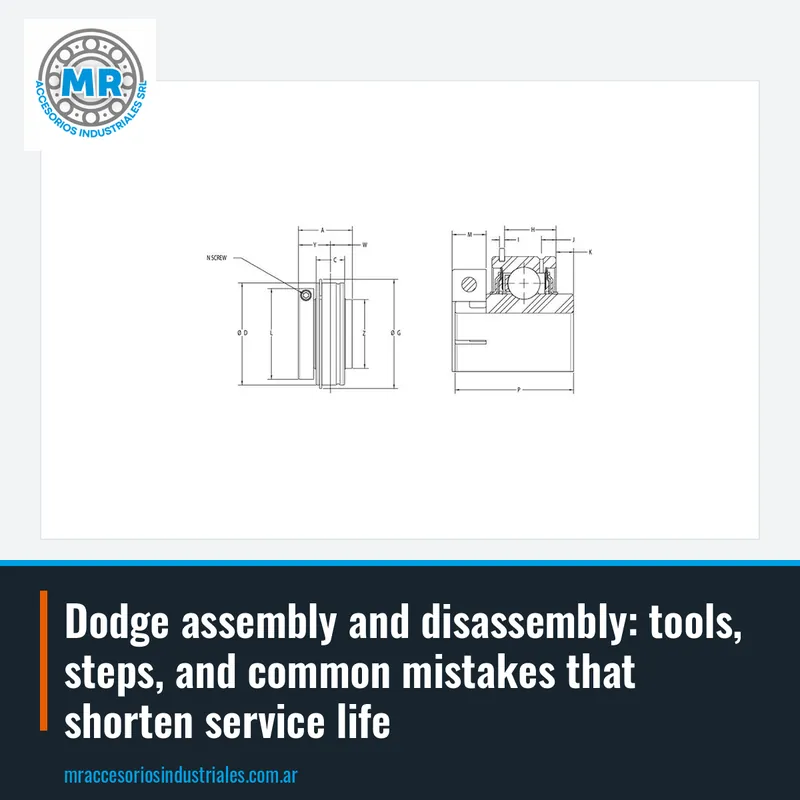
Y-bearings (inserts): correct mounting on the shaft
Dodge insert bearings, such as INS-ER-DL-102, are mounted directly on machined shafts with specific tolerances. Before installing, verify that the shaft is clean, free of burrs or scratches that prevent the inner ring from sliding. The fit should be firm but not forced: if you need to strike, use a rubber mallet or a press with a sleeve that supports only the inner ring. Never strike the outer ring or the seals, because you can deform the raceways and generate premature vibrations.
To secure the insert to the shaft, Dodge mainly uses set screws or locking eccentric, depending on the model. For inserts with set screws, tighten them in a cross pattern with the proper wrench, respecting the recommended torque to avoid stripping the threads. If the bearing has an eccentric ring, turn it in the direction of shaft rotation and then secure it with the set screw. A common mistake is over-tightening the set screws, which deforms the inner ring and creates hard spots that lead to fatigue failure.
After mounting, turn the shaft by hand to check for rubbing or abnormal resistance. If the bearing is off-center or the shaft is misaligned, you will notice a hard spot with each revolution. In that case, disassemble and check the cleanliness and condition of the shaft. For disassembly, use a jaw puller that supports the inner ring. Send us the insert code and shaft size to quote the exact replacement.
Y-housings with insert bearing: alignment and fastening
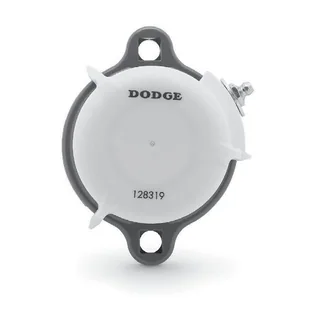
Y-housings with insert bearing, such as 124610, combine a cast iron housing with a self-aligning insert. Before fastening the housing to the structure, verify that the base is flat and that the mounting holes align without forcing. The insert must be able to pivot within the housing to compensate for minor shaft misalignments. If the housing is rigid or the insert does not rotate freely, the bearing works under additional loads and its service life is shortened.
When tightening the housing mounting bolts, do it in a cross pattern and in two passes: first a soft adjustment and then final torque. Do not use spring washers or grower washers under the bolt head, because they can create irregular support points. If the housing is two-piece, first mount the base, then the insert with the shaft, and finally the cap, verifying that the seal is not pinched. A frequent mistake is tightening the cap before seating the insert, which off-centers the bearing.
To disassemble the housing, loosen the mounting bolts and remove the cap. If the insert is stuck on the shaft, use a jaw puller or a hydraulic spreader. Do not strike the housing with a steel hammer, because you can break the casting. If the housing has a grease fitting, lubricate with suitable grease according to the application, without overfilling. We quote complete Y-housings and also inserts separately: give us the housing code or shaft size and we will quote.
Pulleys: mounting, alignment, and belt tensioning
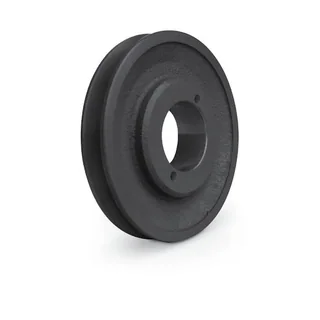
Dodge pulleys, such as MA30, are mounted on shafts with keyway or with tapered bushing, depending on the model. Before installing, verify that the keyway is clean and that the key fits without lateral play. If the pulley uses a tapered bushing, follow the mounting instructions in that section. For pulleys with set screws, tighten in a cross pattern and verify that the pulley does not wobble when rotating. An off-center pulley generates vibration and prematurely wears the belt and the shaft bearing.
Alignment between pulleys is critical: use a metal straightedge or a laser to verify that the faces are in the same plane. Angular misalignment causes lateral wear on the belts and abnormal heating. Belt tension should allow controlled deflection: as a practical rule, press with your finger at the center of the span and verify that the belt yields in a controlled manner without being loose. Excessive tension overloads the bearings and reduces their service life.
To disassemble a pulley with tapered bushing, loosen the bushing screws and use the extraction screws in the corresponding threaded holes. Never use pry bars between the pulley and the housing, because you can deform the rim. If the pulley is rusted to the shaft, apply penetrating oil and let it act before extracting. We supply Dodge pulleys: send us the pulley code or the shaft and belt dimensions to quote.
Reducers: installation and commissioning
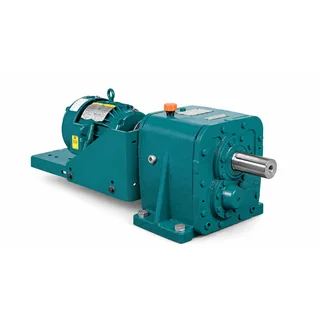
Dodge reducers, such as Maxum XTR 60, require a rigid and level base to avoid deformation of the housing. Before mounting, verify that the support surface is clean and free of peeling paint. Use all the provided mounting bolts and tighten them in a cross pattern with the indicated torque. A poorly supported reducer or with loose bolts generates vibrations that are transmitted to the gears and bearings, shortening their service life.
Alignment between the reducer shaft and the machine shaft is essential: use a flexible coupling that compensates for minor misalignments, but do not abuse that tolerance. If the coupling is forced, radial loads are generated on the output shaft that damage the bearings. Check the oil level before commissioning and respect the recommended lubricant type. A low level or inadequate oil causes premature gear wear.
During the first run, monitor for abnormal noises, temperature, and vibrations. A new reducer may heat up slightly, but if the housing is hot to the touch, stop the machine and check lubrication and alignment. For disassembly, disconnect the power and lock the shaft to prevent unexpected movements. We supply Dodge reducers: give us the reducer code or nameplate data and we will quote the replacement or new equipment.
Tapered bushings and components: installation and extraction
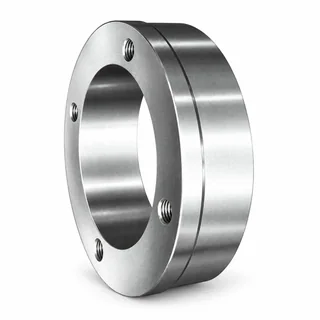
Dodge tapered bushings are used to secure pulleys, sprockets, and other components to shafts without the need for a machined keyway. Mounting is simple: insert the bushing into the component hub, align the holes, and place the mounting screws. Tighten the screws alternately and progressively, because the bushing cone expands and locks the assembly onto the shaft. Uneven tightening off-centers the component and generates vibration.
Before mounting, clean the shaft and the inside of the bushing with solvent to remove grease or dirt residues. Do not use lubricant on the conical surfaces, because it reduces the locking capacity and can cause slippage under load. If the bushing has extraction screws, use them for disassembly: loosen the mounting screws, remove them, and place two in the threaded extraction holes, tightening them alternately until the bushing is released.
A common mistake is striking the bushing with a hammer to remove it, which damages the threads and the cone. If the bushing is stuck, use a plate puller or a hydraulic spreader. Verify that the shaft does not have deep marks after extraction; if it does, polish with fine sandpaper before mounting a new bushing. We supply Dodge tapered bushings: send us the bushing code or shaft diameter and we will quote.
Sprockets and gears: mounting and verification
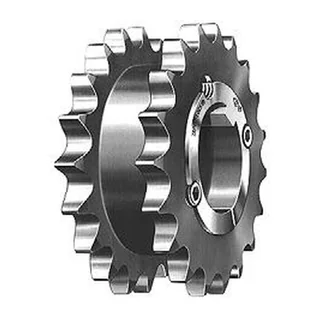
Dodge sprockets and gears are mounted on shafts with keyway or with tapered bushing, just like pulleys. Before installing, verify that the keyway is free of burrs and that the key fits without play. If using a tapered bushing, follow the alternating tightening procedure. A poorly mounted sprocket can misalign with the chain and cause premature wear of both.
Alignment between sprocket and gear is critical: use a straightedge or a laser to verify that the faces are in the same plane. Lateral misalignment makes the chain run crooked and wear on the flanks. Check chain tension: it should have a controlled sag, neither too tight nor too loose. Excessive tension overloads the shaft bearings and shortens their service life.
To disassemble a sprocket with tapered bushing, use the extraction screws as explained above. If the sprocket is fixed with set screws, loosen the set screws and use a jaw puller. Do not strike the teeth with a hammer, because you can break or deform them. We supply Dodge sprockets and gears: send us the code or the shaft and chain dimensions to quote.
V-belts: installation and maintenance
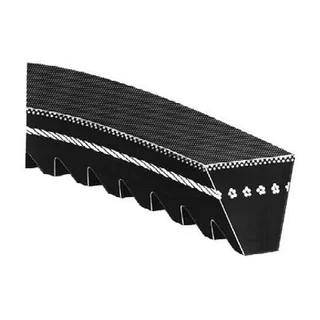
Dodge V-belts are installed in grooved pulleys, respecting the corresponding profile and section. Before mounting, verify that the pulleys are clean and free of wear on the groove flanks. A worn pulley causes the belt to rest on the bottom of the groove and lose traction, generating slippage and heating. Mount the belt without forcing it with sharp tools, because you can damage the flanks.
Correct tension is verified by pressing the belt at the center of the span: it should yield an amount proportional to the center distance. A belt that is too tight overloads the bearings and can break the flanks; a loose belt slips and heats up. In drives with multiple belts, use a set of belts from the same batch and length to distribute the load evenly. If one belt breaks, replace the entire set.
To disassemble, loosen the tensioner or move the motor to release belt tension. Never use pry bars between the belt and the pulley, because you can damage the groove. Inspect the belts periodically for cracks, lateral wear, or glazing. We supply Dodge V-belts: send us the belt code or the pulley dimensions and center distance to quote.
Frequently asked questions
How do you mount a Dodge insert bearing on the shaft?
Clean the shaft, slide the insert into position, and secure it with the set screws or eccentric according to the model. Tighten in a cross pattern and verify that it rotates freely. Never strike the outer ring.
What tools do I need to disassemble a Dodge pulley with tapered bushing?
Loosen the mounting screws, remove them, and use the extraction holes with suitable screws. Do not use pry bars or hammers on the pulley.
How do I align Dodge pulleys and sprockets?
Use a metal straightedge or a laser to verify that the faces are in the same plane. Adjust the component position on the shaft until perfect alignment is achieved.
How often should I check the tension of Dodge V-belts?
It is advisable to check tension at each scheduled stop. A poorly tensioned belt reduces the service life of the belt and the bearings.
Can I mount a Dodge reducer without a rigid base?
No, the base must be rigid and level to avoid deformation of the housing. A flexible base generates vibrations and misalignments that damage gears and bearings.
Products with photos in the catalogue
Keep reading
- Dodge Housings: robust solutions for demanding industrial applications
Discover the SC, GT, D-Lok and SXR series of Dodge housings, how to read their code and in which applications they stand out. We help you choose the right housing for your equipment.
- How to Read Dodge Codes and Designations
Dodge codes follow a logic that combines product type, series, and size. We explain the structure so you can identify the correct part and get a quote without errors.
- Dodge by Industry: Where It's Used, How to Select It, Assembly and Maintenance for Long Life
We review the most common applications of Dodge products in Argentine industry and give you key tips for selection, assembly and maintenance to extend their service life.
Continue here
Need a quote?
Send us the code, size or a photo of the part and we'll quote you shortly.