
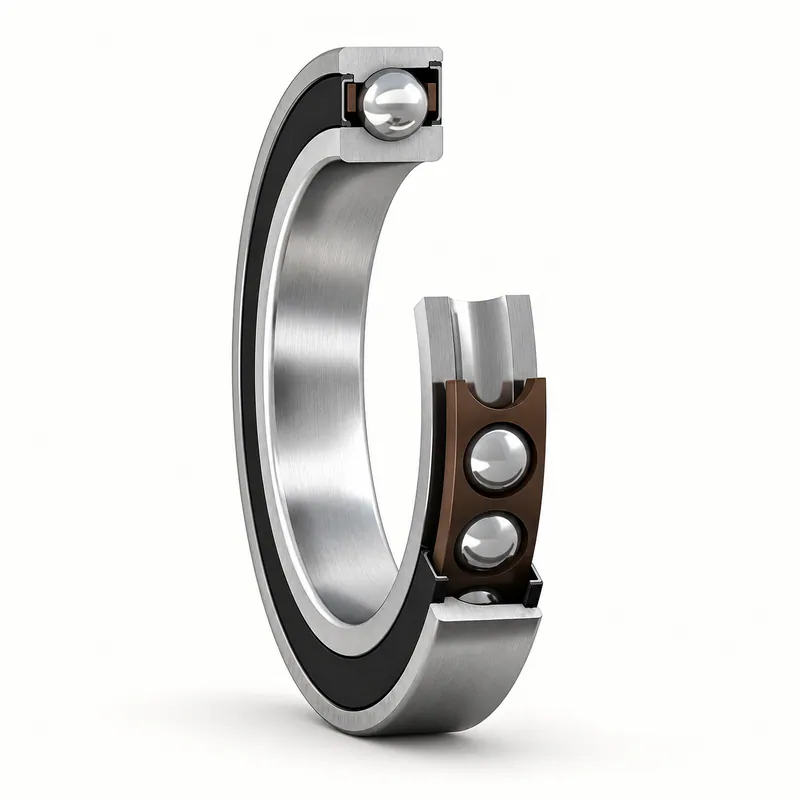

SKF S7017 ACD/P4ADBB angular contact ball bearing
- Brand
- SKF
- Category
- Bearings
- Subcategory
- Angular contact ball bearings
We respond promptly.
Since 1945 · Martínez, Buenos Aires, Argentina
Request your quote via WhatsApp or email, with the quantity you need.
Other brands in this category
Ask us about alternatives. Equivalence is verified for each reference and application.
Can't find the exact model? Write to us with the part number or model you're looking for: we'll find it and quote it, even if it's not listed in the catalog.
Description
SKF S7017 ACD/P4ADBB is a reference of angular contact ball bearing, within Bearings. Request a quote for S7017 ACD/P4ADBB via WhatsApp or email with the quantity you need; we respond promptly with the quote and equivalents.
SKF angular contact bearings are components designed to withstand combined radial and axial loads. Their design with raceways and balls in angular contact allows high speeds and rigidity. They are used in spindles, pumps, compressors and applications where precision and load capacity are critical. MR Accesorios Industriales supplies this line for the Argentine industrial market.
The designation of these bearings is read in blocks. For example, in S7017 ACD/P4ADBB, the initial letter S indicates a special execution with a groove for a retaining ring or similar characteristic; the number 7017 corresponds to the size and dimensional series. The suffix ACD defines the contact angle and the internal cage design. After the slash, P4 indicates the precision class, and ADBB indicates an arrangement of two bearings paired with light preload. Knowing these part numbers is key to ordering the correct replacement.
These bearings are used in machine tool spindles, centrifugal pumps, screw compressors, high-speed electric motors and power transmission equipment. In Argentine industry, they are common in the metalworking, food, petrochemical and automotive sectors. Their ability to withstand combined loads and rotate at high revolutions makes them ideal for assemblies where axial and radial rigidity is required simultaneously.
To select the right bearing, take into account the axial and radial load, the rotation speed and the environmental conditions. Sealing or shields prevent contamination; in dirty environments, choose variants with seals. Internal clearance and preload must be defined according to the application: an ADBB pairing or similar establishes a preload that affects rigidity and service life. Correct lubrication and precise alignment are essential to avoid premature failures.
There are equivalences between brands for angular contact bearings, but they are not automatically interchangeable. Differences in contact angle, tolerances and pairing arrangement can affect performance. Always verify the critical dimensions and the original manufacturer's specifications. At MR Accesorios Industriales we can advise you on the best option for your equipment, respecting the operating conditions.
If you need this bearing or its equivalent, send us the complete part number on WhatsApp. At MR Accesorios Industriales we help you identify it and request a quote.
Dimensions
Dimensions and tolerances: Send us the part number via WhatsApp and we'll confirm the dimensions and version against the manufacturer's data sheet.
Frequently Asked Questions
- What does the ACD suffix mean in an SKF bearing?
- The ACD suffix indicates a design with a 25° contact angle and a polyamide or brass cage, depending on the series. This influences the axial load capacity and the limiting speed. It is important to respect this designation when ordering a replacement to maintain equipment performance.
- Can I replace an angular contact bearing with one from another brand?
- In general, yes, but the dimensions, contact angle, precision and pairing arrangement must match. The series number alone is not enough; tolerances and clearance must be verified. Consult us with the original part number and we will advise you on the right equivalence.
- How are these bearings lubricated?
- They are lubricated with grease or oil, depending on the speed and working temperature. In high-speed applications, circulating oil or oil mist is preferred. The amount and type of lubricant must follow the manufacturer's recommendations to avoid overheating and premature wear.