
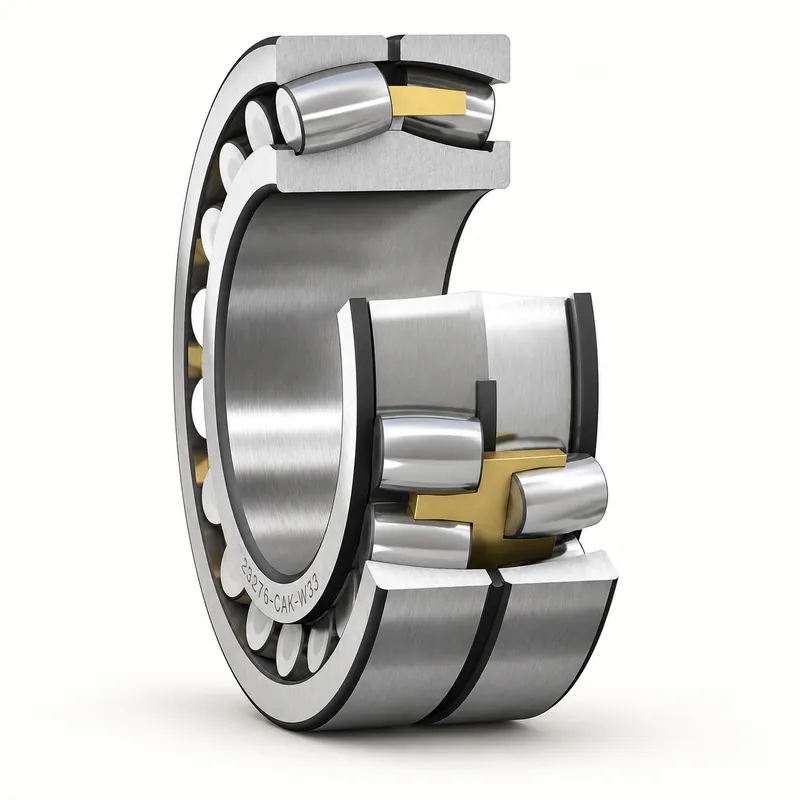

SKF 23088 CAK/C3W33 spherical roller bearing
- Brand
- SKF
- Category
- Bearings
- Subcategory
- Spherical roller bearings
We respond promptly.
Since 1945 · Martínez, Buenos Aires, Argentina
Request your quote via WhatsApp or email, with the quantity you need.
Other brands in this category
Ask us about alternatives. Equivalence is verified for each reference and application.
Can't find the exact model? Write to us with the part number or model you're looking for: we'll find it and quote it, even if it's not listed in the catalog.
How to read SKF 23088 CAK/C3W33
- 230Series
- Spherical roller bearings, 230 series. For the same bore, each series has a different outside diameter and width.
- 88Bore
- 440 mm bore: 88 × 5.
- CAK/C3W33Suffix
- SKF suffix: it defines the variant (sealing, cage, internal clearance or other features).
23088 is the standard (ISO) basic designation: it defines the type, the series and the bore.
Description
The SKF 23088 CAK/C3W33 bearing has a 440 mm bore, a 650 mm outside diameter and a 157 mm width (440 x 650 x 157 mm).
SKF 23088 CAK/C3W33 is a reference of spherical roller bearing, within Bearings. Request a quote for 23088 CAK/C3W33 via WhatsApp or email with the quantity you need; we respond promptly with the quote and equivalents.
SKF spherical roller bearings in the CAK/C…W… series are self-aligning components with two rows of rollers, designed to carry high radial loads and axial loads in both directions. Their self-aligning design compensates for angular misalignment between shaft and housing, making them ideal for applications with shaft deflection or difficult mounting. They are used in heavy machinery, mining equipment, cement, steelmaking and power transmission in general.
The CAK/C…W… designation is interpreted as follows: CAK indicates that the bearing has a tapered bore (1:12 taper) and a groove for a locking ring, which makes mounting on tapered shafts or with adapter sleeves easier. The C followed by a number (for example, C3, C4, C5) specifies the internal radial clearance, which increases with the number. The W indicates that it incorporates a lubrication groove and holes in the outer ring, and the final 33 indicates a stamped steel sheet cage. In the examples, 23088 CAK/C3W33 combines a tapered bore, C3 clearance and lubrication. Some part numbers include additional suffixes such as W507 (special coating) or C08 (special clearance).
These bearings are used in applications where loads are high and misalignment may occur. In Argentina, they are common in speed reducers, cement and mining mills, vibrating screens, pulp and paper machines, steelmaking equipment, cranes and conveyors. They are also found in the food industry and in aggregate processing plants. Their ability to carry combined loads and their self-aligning capability make them suitable for equipment subject to vibration or shaft deflection.
To select the correct bearing, take into account the type of load (radial, axial or combined), the rotation speed and the environmental conditions. The internal clearance C3, C4 or C5 is chosen according to the working temperature and the mounting fit: the higher the temperature or interference, the greater the clearance. Sealing can be open or with seals, depending on contamination. Lubrication must be adequate: grease or oil, respecting the intervals. Initial alignment is critical; although the bearing is self-aligning, incorrect mounting can reduce its service life. Follow the manufacturer's instructions for mounting and axial fixing.
As for equivalents, spherical roller bearings with a tapered bore and similar suffixes are available from other brands under their own nomenclatures. For example, a 23092 CAK/C3W33 may have equivalents in brands such as FAG, NSK or NTN, but the part numbers vary. Always verify the critical dimensions (bore, outer diameter, width) and the clearance and lubrication specifications before replacing. Do not assume that a similar part number from another brand is identical; consult interchange tables or contact a specialist.
If you need an SKF spherical roller bearing from the CAK/C…W… series, at MR Accesorios Industriales we advise you so you can choose the right option. Send us the complete part number on WhatsApp and we will quote you shortly. We are your partner for quality industrial components.
Dimensions
Boundary dimensions of the basic designation 23088 per ISO 15: 440 x 650 x 157 mm (d x D x B).
- Bore
- 440mm
- Outside diameter (D)
- 650mm
- Width (B)
- 157mm
The same size in other brands
Pages from other brands with the basic designation 23088: 440 x 650 x 157 mm (d x D x B) per ISO 15.
- FAG23088-BEA-XL-MB123088-BEA-XL-K-MB1
- LINK-BELT23088LBC323088LBKC3
- NSK23088CAME423088CAMKE4
- NTN23088B23088BK
- RKB23088
- TIMKEN23088YMB
They share the boundary dimensions set by ISO 15, not the technical data: seals or shields, internal clearance, cage and load rating can differ by brand and suffix. We quote each one by its full part number.
Frequently Asked Questions
- What are the dimensions of the SKF 23088 CAK/C3W33 bearing?
- The SKF 23088 CAK/C3W33 bearing has a 440 mm bore, a 650 mm outside diameter and a 157 mm width (440 x 650 x 157 mm). These are the standardised boundary dimensions (ISO 15) of the basic designation 23088.
- What does the C3 suffix mean on an SKF bearing?
- The C3 suffix indicates a greater internal radial clearance than standard. It is used when the bearing will operate at high temperatures or with interference fits that reduce clearance. The C4 and C5 suffixes indicate even greater clearances.
- Is this bearing self-aligning?
- Yes, SKF spherical roller bearings in the CAK/C…W… series are self-aligning. Their two-row roller design compensates for angular misalignment between shaft and housing, which makes mounting easier and extends service life.
- How do I choose between a bearing with a tapered bore and one with a cylindrical bore?
- The tapered bore (CAK) is used with adapter sleeves or tapered shafts, which simplifies mounting and allows the radial clearance to be adjusted. The cylindrical bore requires an interference fit on the shaft. The choice depends on the equipment design and mounting practices.