
Blog
How to choose bearings for machine tool spindles and order the exact code
Machine tool spindles require precision angular contact bearings. We explain what to consider for selecting, mounting, and replacing them without errors.
SKF bearings in Argentina: guide and quotes
Technical team at MR Accesorios Industriales · Updated on October 22, 2026
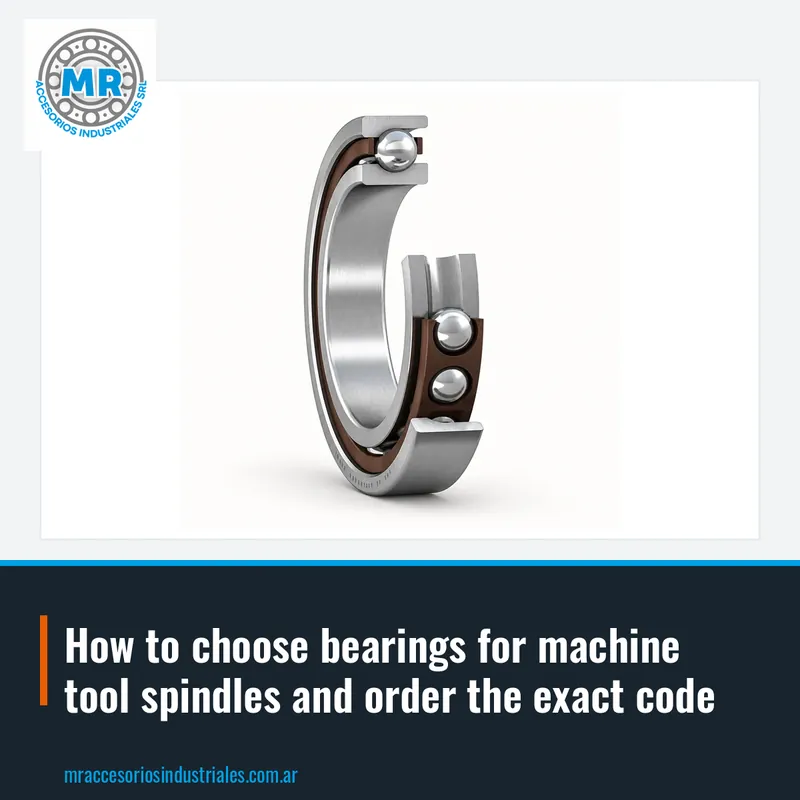
Why spindles use angular contact bearings
Machine tool spindles work under very different demands than a common industrial bearing. They must support combined loads, maintain rotational precision, and withstand high speeds without vibrating. That is why precision angular contact bearings are used, combining rigidity and rotational accuracy. In a lathe, milling machine, or machining center, the spindle is the heart of the machine, and any deviation translates into out-of-tolerance parts.
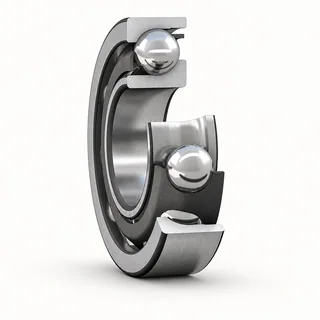
An angular contact bearing has raceways arranged to support radial and axial loads simultaneously. In a spindle, axial load arises from tool feed, and radial load from shaft weight and cutting forces. The contact angle defines how much axial load it can absorb and how stiffness is distributed. Therefore, it is not enough to use any rigid ball bearing: the spindle needs a design aimed at maintaining the exact shaft position.
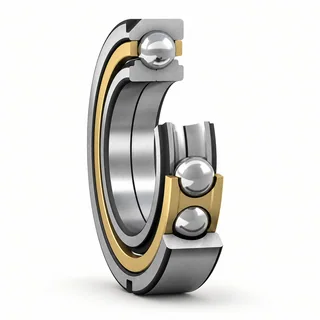
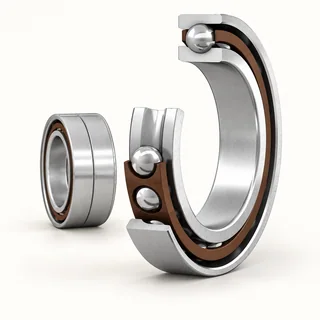
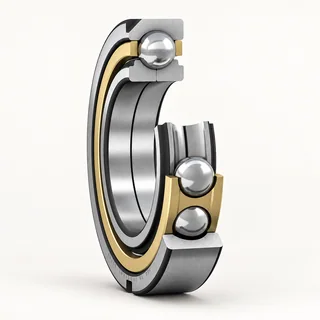
Machine tools use sets of two, three, or four angular contact bearings depending on rigidity and load direction. The most common arrangement is duplex mounting, with bearings face-to-face or in tandem to distribute forces. When replacing a spindle bearing, the original arrangement and exact code must be respected, because a variant with a different angle or preload changes the behavior of the entire assembly. At MR we distribute SKF bearings for spindles and help you identify the correct code from the part or the machine manual.
How to identify the spindle bearing you need to replace
Before ordering a spindle bearing, it is advisable to gather all the data of the part you are going to replace. The code engraved on the ring is the main reference, but in precision spindles it is sometimes partially erased or covered by grease. If it cannot be read completely, you can measure the inner diameter, outer diameter, and width with a caliper, and take photos of both sides. With that data, at MR we help you identify the equivalent SKF bearing.
Spindle bearings often have additional markings in the code indicating the precision class and preload. That information is key for replacement: it is not enough for the dimensions to match; the precision and internal arrangement must also match. If you change a precision bearing for a standard precision one, the spindle loses rotational quality and may damage the part or the tool.
A common mistake is to order only by dimensions and forget the complete designation. In high-speed spindles, preload and contact angle define rigidity and heating. If the original bearing is precision, you cannot replace it with a common one of the same dimensions: the machine will vibrate or lose precision. Send us a photo of the engraved code and the measurements, and we will quote the exact SKF bearing for your spindle. The machine serial number or the manufacturer's manual also helps.
Mounting in sets: how to assemble a spindle with angular contact
Spindle bearings almost never work alone: they are mounted in sets to distribute loads and give rigidity to the assembly. The most common arrangement is duplex, with two bearings face-to-face or in tandem. In tandem mounting, both bearings support axial load in the same direction and are used when there is a predominant force in one direction. In face-to-face mounting, the bearings have opposite contact angles and support axial loads in both directions.
Preload is another critical point in spindles. A precision angular contact bearing can come with light, medium, or heavy preload, indicated in the code or in the manufacturer's documentation. Preload eliminates internal clearance and increases rigidity, but if excessive it generates heat and premature wear. When assembling a set, the original preload must be respected and not over- or under-tightened. Incorrect mounting ruins expensive bearings and can damage the spindle.
At MR we distribute SKF bearings for spindles and advise you on the correct arrangement according to the machine. If you are replacing a complete set, send us the code of each bearing and a photo of the original mounting. With that we confirm the reference and quote the exact set. Do not improvise with loose bearings: a poorly assembled spindle loses precision and can break the tool or the part.
Cleanliness and handling: keys to not ruining a precision bearing
A spindle bearing is a high-precision part and gets contaminated very easily. A dust particle or lint on the raceway generates vibration and premature wear. Therefore, mounting is done in a clean environment, with clean hands and without lint-shedding gloves. Never remove the bearing from its packaging until the moment of installation, and if you set it down, do so on a clean, dry surface.
Cleaning the spindle and neighboring parts is as important as cleaning the bearing. Before mounting, wash the housing and shaft with a suitable solvent and dry well. Any remaining chip, old grease, or dirt will end up inside the bearing. If the bearing comes with anti-corrosion protection, remove it with a clean cloth or mild solvent, leaving no residue. Then lubricate with the grease or oil indicated by the machine manufacturer.
Impacts are the worst enemy of a precision bearing. Never hit the outer ring to insert the bearing into the housing: use controlled-fit mounting, heating the ring, or using suitable mounting tools. If the bearing enters forced or twisted, the raceways get marked and the spindle loses precision. At MR we distribute SKF bearings for spindles and always recommend following the manufacturer's procedure. If in doubt, consult us before mounting.
Lubrication of spindle bearings: grease or oil
Lubrication of a spindle defines its service life and thermal behavior. Machine tools use two main systems: high-quality grease or oil lubrication, sometimes with forced circulation. Grease is simpler and used in medium-speed spindles, while oil allows better heat evacuation and is preferred in high-speed spindles. The choice depends on the machine design and working conditions.
If the spindle uses grease, the exact amount must be respected: excess grease generates friction and heating, and too little grease produces wear. Grease for precision bearings is usually low-noise with special additives. If the spindle uses oil, the level, viscosity, and cleanliness of the circuit must be controlled. Contaminated or degraded oil ruins the bearing in a short time. In both cases, follow the machine manufacturer's indications.
When replacing a spindle bearing, do not mix lubricants of different type or brand without verifying compatibility. If the original bearing came factory-lubricated, respect that lubrication and do not wash it unless necessary. At MR we distribute SKF bearings for spindles and advise you on the proper lubrication for your application. Send us the bearing code and machine type, and we will guide you.
When to replace spindle bearings
Spindle bearings are not changed by mileage: they are changed when symptoms of wear or loss of precision appear. The most common signs are vibration, abnormal noise, excessive heating, or out-of-tolerance parts without apparent cause. If the spindle loses rigidity or marks appear on the machined surface, it may be time to check the bearings. Early diagnosis prevents major damage to the spindle or machine.
Wear of a precision bearing is not always visible to the naked eye. Sometimes the damage is in the races or balls and is only detected with vibration measurement or noise analysis. If the spindle starts making a fine noise or vibrating at high speed, do not ignore it: the bearing may be marked and continuing to use it aggravates the problem. In production machines, a damaged spindle generates rejects and unscheduled stops.
When replacing, it is not enough to change a single bearing if the set is worn. The correct approach is to replace the complete set, respecting the original code and arrangement. At MR we quote the exact SKF bearings for spindles for your machine. Send us the engraved code, measurements, or a photo of the old bearing, and we will confirm the reference. You can also consult us about the spindle condition and the convenience of changing all bearings in the assembly.
How to order your SKF spindle bearing at MR
To quote a spindle bearing, the most practical is to send us the complete code engraved on the ring. If it cannot be read, measure the inner diameter, outer diameter, and width, and take photos of both sides. The machine serial number or the manufacturer's manual also helps. With that data, at MR we identify the exact SKF bearing and send you the quote promptly.
If you are replacing a set, tell us how many bearings it takes and how they are mounted. A photo of the disassembled spindle helps a lot to confirm the arrangement and preload. Do not forget to mention if the bearing has seals or is open, and whether it uses grease or oil. All those details prevent errors and delays in the order.
At MR we distribute SKF bearings for spindles and help you identify the precision code you need. Write to us via WhatsApp or email with the code, measurements, or a photo of the part, and we will quote without obligation. We are in Buenos Aires, Argentina, and handle technical maintenance and purchase inquiries.
Frequently asked questions
What bearing does a lathe spindle use?
Most lathe spindles use precision angular contact bearings, often in sets of two or more. The exact code depends on the machine model; you can send us the engraved code or measurements and we will help you identify it.
Can I replace a spindle bearing with one of the same dimensions but a different code?
It is not recommended. Spindle bearings have specific precisions and preloads that are not visible in the dimensions. A lower-precision bearing or different contact angle will cause the spindle to lose rigidity and precision. Always use the exact code or its manufacturer-validated equivalent.
How do I know if the spindle bearing is worn?
Typical symptoms are vibration, noise, heating, or loss of precision in machined parts. If you notice any, it is advisable to check the spindle and measure clearance. A damaged bearing can mark the shaft or housing and make repair more expensive.
Are spindle bearings lubricated with grease or oil?
It depends on the machine design. Many spindles use high-quality grease, others use oil with forced circulation to dissipate heat. Always respect the original system and the amount indicated by the manufacturer. If in doubt, consult us with the machine model.
Can I mount a spindle bearing by hitting it to make it fit?
No. Impacts mark the raceways and ruin precision. Use proper mounting methods, such as controlled heating or mounting tools. If you lack experience, it is better to have a specialized technician do it.
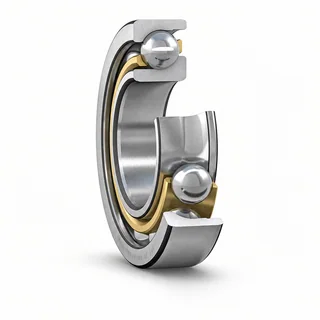
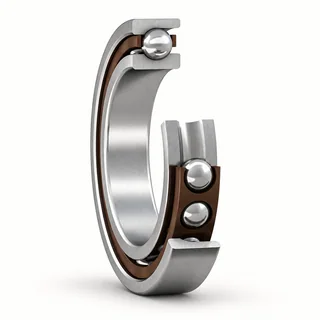
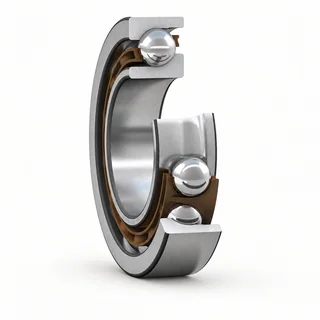
Products with photos in the catalogue

Keep reading
- SKF Chains: Reliable Power Transmission for Industrial Applications
SKF roller chains offer strength and precision for power transmission in industrial machinery. Learn about the PHC series, ASA and BS standards, and how to identify the correct chain for your equipment.
- SKF tools for industrial maintenance: pullers, heaters, aligners and calibrated shims
SKF tools simplify bearing mounting and dismounting, shaft alignment and instrument calibration. Discover TMMA and TMHP pullers, induction heaters, TKSA aligners and calibrated shims.
- How to Choose SKF Bearings by Application: Load, Speed, Environment, and Mounting
Choosing the right SKF bearing requires analyzing load, speed, environment, and mounting. We explain the main types and how to get a quote with the exact code.
Continue here
Need a SKF quote?
Send us the SKF part number, the size or a photo of the part and we will get back to you with a quote.