
Blog
McGill in agriculture: components for combine harvesters, seeders, bucket elevators and storage plants, and how to quote them
McGill bearings appear at critical points in agricultural machinery: cam rollers, needle bearings and spherical rollers. We explain how to identify them and order them.
Technical team at MR Accesorios Industriales · Updated on November 9, 2026
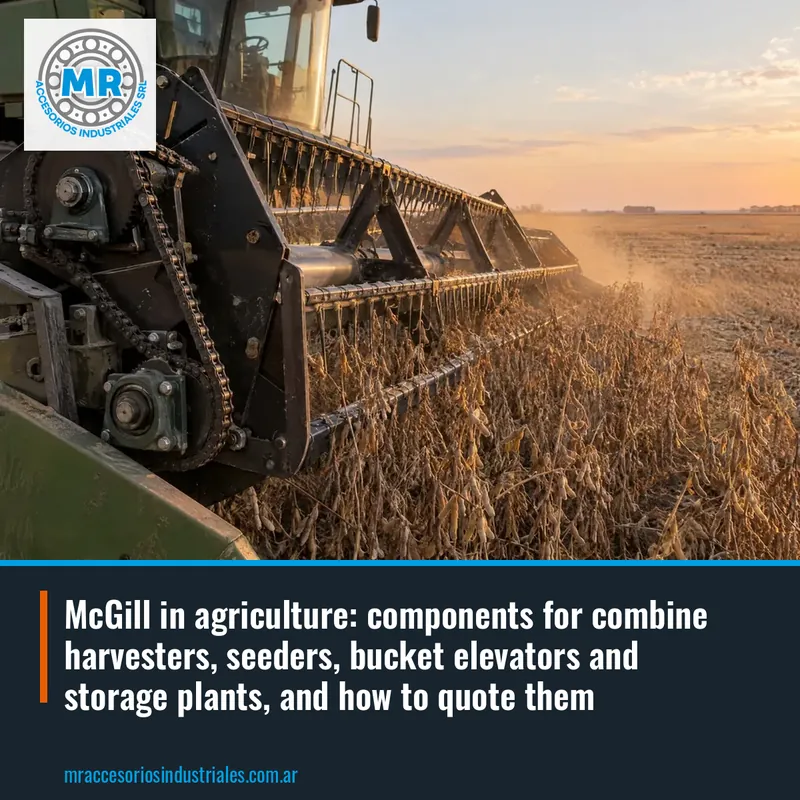
Where McGill components appear in agriculture
In agricultural machinery, McGill bearings are present at points where there are combined loads, oscillating movements or limited space. You find them in combine harvester headers, in seeder arms, in grain elevator bucket elevators and in conveyors at storage plants. They are components that work outdoors, with dust, humidity and constant vibration, which is why their correct selection is key to avoiding unplanned downtime.
Each McGill product line serves a different function: cam rollers withstand the movement of cams and guides; needle bearings fit into small spaces with high radial load capacity; spherical rollers compensate for misalignment in long shafts or structures that deform. Correctly identifying the type of component is the first step to ordering the right spare part, especially when the machine comes from the factory with one brand and the workshop is looking for an equivalent alternative.
To quote a McGill component for agriculture, it is advisable to have on hand the code engraved on the part, the main dimensions (inner diameter, outer diameter and width) and a photo of the mounting location. With that data, it can be verified whether the code corresponds to a cam roller, a needle bearing or a spherical roller, thus avoiding confusion between similar series. At MR we distribute McGill and help you identify the exact reference.
Cam and support rollers: the heart of headers
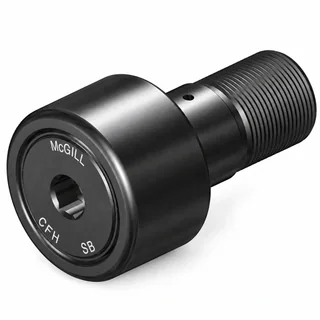
McGill cam rollers, such as those in the CF series, are used in cam and guide mechanisms. They are bearings with a thick outer ring that rolls directly on a track or cam, supporting radial loads and some impacts.
Codes such as CF 1, CF 2 and CF 3 correspond to McGill cam rollers. When ordering them, it is advisable to verify whether the roller has a seal, whether the shaft is threaded or plain, and whether the hole is through or blind, because these variants change the complete code. Often the roller is mounted on a stud or a housing, and the assembly is replaced.
The most common mistake is confusing a cam roller with a rigid ball bearing of similar dimensions. The cam roller has its outer ring designed to roll on a surface, not to be housed in a support. If a standard bearing is mounted in that position, it fails quickly due to point load and lack of lateral support. Therefore, when in doubt, it is advisable to send a photo of the assembly and the engraved code so that we can quote the correct McGill cam roller.
Needle bearings: compact solutions for gearboxes and drives
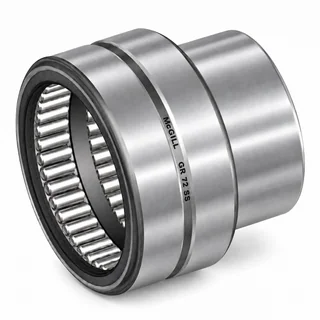
McGill needle bearings stand out for their thin section and high radial load capacity in reduced spaces. In agriculture they are found in seeder gearboxes, in metering drives, in auger transmissions and in hydraulic pump couplings. Because they have very fine rollers, they support significant loads with a small outer diameter, which allows compact designs.
Codes such as GR 88, GR 10 or GR 12 correspond to McGill needle bearings. When quoting them, it is essential to indicate the shaft diameter, the housing diameter and the total width, and thus confirm the exact reference.
A frequent mistake is replacing a needle bearing with a ball bearing of the same external dimensions, thinking they are the same. The needle bearing has greater radial load capacity due to its greater number of rolling elements, but it is more sensitive to misalignment and contamination. If the shaft is worn or marked, the new bearing will fail prematurely, so it is advisable to check the condition of the shaft before mounting. At MR we advise you on the appropriate McGill reference for each gearbox or drive.
Spherical rollers: for misaligned shafts and heavy loads
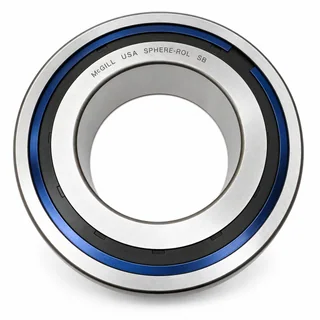
McGill spherical rollers, such as those in the SB series, are used in applications where the shaft may become misaligned due to bending, mounting or thermal expansion. In agriculture they appear in bucket elevators, conveyors and other equipment with long shafts. Their design with two rows of rollers and a spherical outer ring allows them to absorb misalignment without losing load capacity.
An example is the SB-22220, a spherical roller with a cylindrical bore of 100 mm inner diameter. SB-22320 and SB-22204 are also used for different shaft sizes and loads. When ordering them, you must indicate whether the bore is cylindrical or tapered, whether it has an adapter sleeve and whether the bearing has normal or greater internal clearance (C3).
The most common mistake is mounting a spherical roller in a fixed housing without allowing for thermal expansion of the shaft, which generates unwanted axial loads. The designation of the tapered bore (K) is also often confused with that of the cylindrical bore, and that changes the mounting system. If you have the engraved code or the shaft and housing dimensions, we will quote the correct McGill spherical roller for your bucket elevator or conveyor.
Special bearings: when the standard is not enough
McGill has a line of special bearings for applications where standard bearings do not meet load, speed or environmental requirements. They are designs intended for equipment with particular demands, such as those working in the field and in storage plants.
Codes such as D-220, D-320 or D-222 correspond to McGill special bearings. The important thing is not to assume that a special bearing is the same as a standard one of similar dimensions.
When quoting a McGill special bearing, it is advisable to send the complete code engraved on the part, the dimensions measured with a caliper and a photo of the mounting. If the code is erased, you can try to identify it by dimensions and load type, but it is always better to confirm with the equipment manufacturer or the parts manual. At MR we distribute McGill special bearings and help you find the exact reference for your machine.
How to identify a McGill component on your machine
The first step to ordering a McGill spare part is to read the code engraved on the bearing ring or cage. If the part is very worn, it can be cleaned with a cloth and a magnifying glass or raking light can be used to reveal the numbers.
In addition to the code, it is advisable to measure the inner diameter, outer diameter and width with a caliper. These measurements allow you to confirm the series and detect catalog errors or incorrect equivalences. If you order only by shaft size, you can confuse the reference. Therefore, it is always better to send the code and measurements together.
At MR we distribute the McGill brand and work with original factory codes. If you have a bearing from another brand and want a McGill equivalent, we ask you for the original part code and dimensions, and we indicate the correct correspondence. You don't need to know the nomenclature by heart: with a photo of the bearing and the mounting location, we help you identify it.
How to quote McGill components for agriculture
To quote a McGill component, the most practical way is to write to us via WhatsApp or email with the bearing code, dimensions and a photo of the part. If you don't have the code, you can send a photo of the mounting location and the shaft and housing dimensions. With that data, we provide the exact McGill reference and quote the spare part. You can also tell us the machine and model, because the parts manual often contains the original code.
When ordering, it is advisable to clarify whether the bearing works in an environment with a lot of dust, humidity or chemicals, because that influences the choice of seal and lubricant. For example, in a grain bucket elevator, the dust is abrasive and a contact seal is advisable; in a combine harvester header, humidity and mud require an effective seal and a grease resistant to washing out. These details help choose the correct variant within the same series.
At MR we work with the McGill line for agriculture and advise you on the appropriate reference for each application. Whether it is a cam roller for a header, a needle bearing for a seeding gearbox or a spherical roller for a bucket elevator, we quote the exact component and respond promptly. Write to us with your inquiry and we will respond with the information you need.
Frequently asked questions
Which McGill bearings are used in combine harvesters?
Depending on the point on the machine, McGill cam rollers, needle bearings, spherical rollers or special bearings are used. Send the code or a photo of the mounting and we will indicate the reference.
How do I identify a McGill bearing if the code is erased?
If the code is erased, measure the inner diameter, outer diameter and width with a caliper, and take a photo of the bearing and the mounting location. With that data, at MR we help you identify the correct McGill reference.
Can I replace a needle bearing with a ball bearing?
It is not recommended. The needle bearing has greater radial load capacity in the same space, but it is more sensitive to misalignment and contamination. If the shaft is in good condition and the housing is correct, it is advisable to keep the original type.
What does the C3 suffix mean on a McGill bearing?
The C3 suffix indicates that the bearing has greater internal clearance than normal. It is used in applications where there are temperature differences between the shaft and the housing.
How do I order a McGill cam roller for a corn header?
Send us via WhatsApp or email the code engraved on the roller (for example, CF 1), the outer diameter and bore dimensions, and a photo of the mounting. With that we will quote the exact McGill cam roller for your header.
Products with photos in the catalogue
Keep reading
- McGill product guide in Argentina: what lines are available and what they are used for
Discover the McGill product lines we distribute in Argentina: cam followers and yoke rollers, needle bearings, special bearings, and spherical roller bearings. We explain their applications and how to get a quote by code.
- How to Read McGill Codes: Prefixes, Suffixes, and Real Examples
A practical guide to understanding the structure of McGill designations for cam followers, needle bearings, and spherical rollers. With real code examples.
- McGill by industry: where it's used, how to select it, assembly and maintenance for lasting performance
McGill bearings stand out in applications with combined loads, oscillating movements, or limited space. We tell you which industries use them, how to choose the right model, and what care extends their service life.
Continue here
Need a McGILL quote?
Send us the McGILL part number, the size or a photo of the part and we will get back to you with a quote.