
Blog
McGill bearings in mining: what is used in crushers, mills, screens and conveyor belts
We review the most used McGill bearings in mining equipment and what data you should have on hand to order them.
Technical team at MR Accesorios Industriales · Updated on November 4, 2026
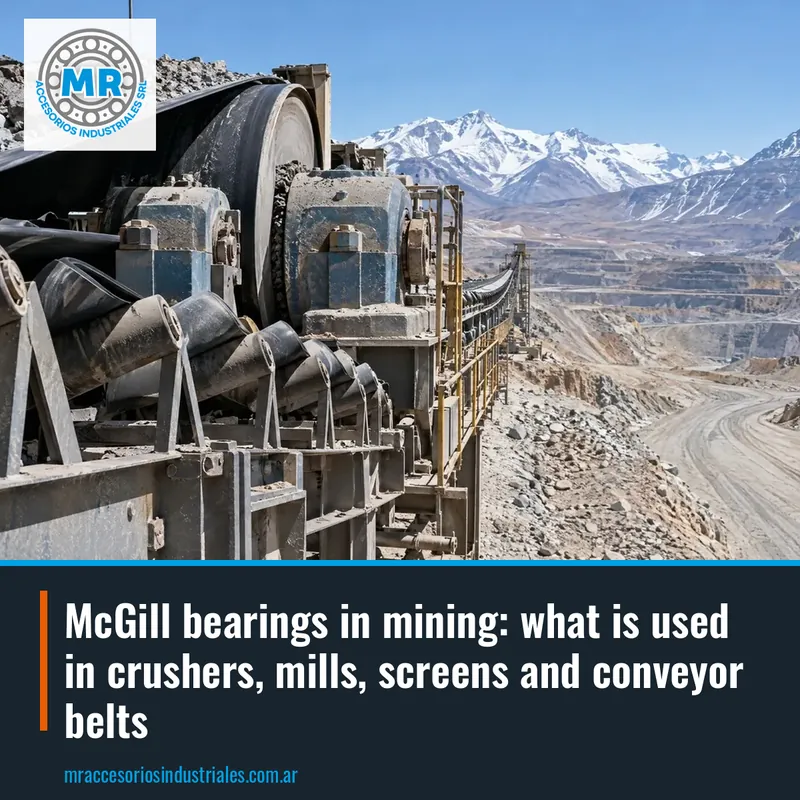
Cam followers and support rollers in mining equipment
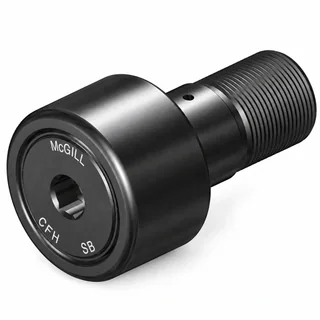
McGill cam followers are used in mechanisms where a cam or a linear guide converts rotation into linear motion. In mining equipment they are consulted for drive and guidance mechanisms. Their design with a thick-walled outer ring withstands high radial loads and some axial load. The code CF 1, for example, identifies a standard CF series cam follower.
To order a cam follower, it is advisable to measure the outer diameter, the total width and the bore or stud diameter. It is also useful to know whether it works with a metal seal or a rubber seal, because that changes the protection against dust. In mining the environment usually has abrasive particles, so an effective seal prevents premature wear. If you have the engraved code, such as CF 2 or CF 3, it is enough to pass it on as is.
A common mistake is confusing a cam follower with a deep groove ball bearing. The cam follower has a thicker outer ring and is designed to roll on a track or a cam, not to be mounted in a fixed housing. When installing it, you must verify that the track is clean and free of burrs. If the track has uneven wear, the new roller will not last long.
Needle bearings for heavy loads in small spaces
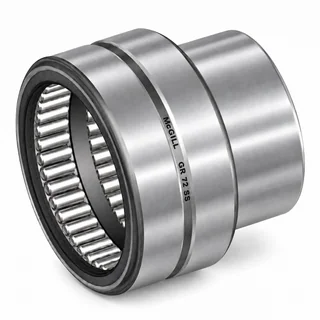
McGill needle bearings are chosen when high radial load must be supported in a reduced radial space. In mining they are found in conveyor gearboxes, in slurry pumps and in mill couplings. The GR series, with codes such as GR 88, GR 10 or GR 12, corresponds to needle bearings.
When ordering a needle bearing, you must indicate the bore diameter, the outer diameter and the width. It is also advisable to clarify whether it needs a seal or whether it works oil-bathed. In mining, the needle bearing often goes inside a gearbox with splash lubrication. If the environment is very dusty, protection against dirt ingress should be considered.
A typical mistake is not checking the condition of the shaft where the needle bearing rests. Since the needles roll directly on the shaft, a scratched surface or one with fatigue marks ruins the new bearing. Before mounting, the shaft must be measured with a micrometer and the roughness verified. If the shaft is worn, it is repaired or replaced before installing the bearing.
Special bearings for severe conditions
McGill has a line of special bearings for applications where standard ones are not enough. The codes of the D series, such as D-220, D-320 or D-222, correspond to the special bearings category in the McGill catalog.
To get a quote for a special bearing, it is advisable to send the complete code and, if possible, a photo of the part. It also helps to know which equipment it works in and what function it performs. If the original bearing does not have a legible code, the main dimensions can be taken and compared with the catalog. At MR we work with the McGill line and help you identify the correct reference.
A frequent mistake is replacing a special bearing with a standard one of similar dimensions. Although it fits into the housing, it may not withstand the load or the working speed. That is why the original design should be respected and not improvised.
Spherical roller bearings for misaligned shafts
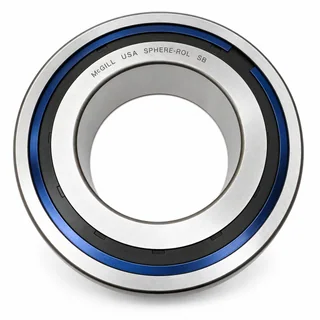
McGill spherical roller bearings are used when the shaft can become misaligned due to deflection or settling of the structure. In mining they appear at the ends of conveyor drums and in mill supports. The SB series, with codes such as SB-22220, SB-22320 or SB-22204, corresponds to spherical roller bearings with cylindrical or tapered bore.
When ordering a spherical roller bearing, you must indicate whether the bore is cylindrical or tapered. The tapered bore is mounted on an adapter sleeve and allows the internal clearance to be adjusted. In mining, many conveyors use spherical roller bearings with tapered bore and sleeve. If you are not sure, measure the shaft diameter and check whether it has taper.
A common mistake is not lubricating the spherical roller bearing before putting it into operation. They must be greased with the appropriate grease for the load and working speed. It is also advisable to check the radial clearance after mounting, especially if the bore is tapered.
How to identify a McGill bearing in a mining machine
To order a McGill spare part, the most practical thing is to read the code engraved on the ring or on the cage. McGill codes usually combine letters and numbers, such as CF 1 or GR 88. If the code is blurry, the part can be cleaned with a cloth and a magnifying glass used. In some cases the code is on the edge of the outer ring.
If there is no visible code, the main dimensions must be taken: bore diameter, outer diameter and width. With those dimensions you can search the McGill catalog or consult a supplier. At MR we sell the McGill line and help you identify the reference. You can also send a photo of the part and of the place where it is mounted.
A frequent mistake is relying only on dimensions and not on the bearing type. A needle bearing and a spherical roller bearing can have similar dimensions but very different behavior. That is why the type of equipment and the position where it works should also be noted. This avoids ordering a spare part that does not correspond.
Mounting and maintenance of McGill bearings in mining
Mounting a McGill bearing in a mining equipment requires cleanliness and precision. Before installing, the housing and the shaft must be cleaned, and it must be verified that there are no burrs or knocks. To mount a bearing with a force fit, the part can be heated evenly, without exceeding the temperature indicated by the manufacturer. You should never strike directly on the rings.
Preventive maintenance includes checking lubrication and internal clearance. In mining, dust and humidity shorten bearing life if they are not well protected. Seals help, but they do not replace a greasing program. It is advisable to record working hours and temperatures to detect incipient wear.
A common mistake is reusing a bearing that has already been removed with force. Although it may look intact, it may have internal damage that is not visible. If the bearing was removed with a poorly supported puller, it most likely must be replaced. In mining, a damaged bearing can stop an entire line and generate costs much higher than the spare part.
How to order McGill bearings for mining at MR
To get a quote for a McGill bearing for your mining equipment, you can write to us by WhatsApp or email. Ideally, send the complete code, for example CF 2 or SB-22220. If you do not have the code, send us the main dimensions and a photo of the part. With that we will indicate the correct reference and send you the quote shortly.
You can also consult us about equivalences if you are using a bearing from another brand and want to switch to McGill. In that case, send us the original code and the dimensions. We will indicate the corresponding McGill option. We work with cam followers, needle bearings, special bearings and spherical roller bearings.
A common mistake is waiting for the bearing to fail before ordering the spare part. In mining, downtime is expensive and it is advisable to have critical spare parts on hand. You can make a list of the bearings used by your equipment and ask us for an annual quote. That way you have the spare parts when you need them, without emergencies.
Frequently asked questions
What McGill bearings are used in crushers?
In crushers, cam followers and support rollers are used for the adjustment and feeding mechanisms. The best thing is to read the code engraved on the original bearing and pass it on for a quote.
How do I identify a McGill bearing if it has no code?
If it has no visible code, measure the bore diameter, the outer diameter and the width with a caliper. Also note the bearing type (needle, spherical roller, cam follower) and the equipment where it works. With that data we help you identify the reference.
What data do I need to order a McGill spherical roller bearing?
Send us the complete code, for example SB-22220, and tell us whether the bore is cylindrical or tapered. If you do not have the code, send us the shaft diameter and a photo of the part.
Can I replace a McGill bearing with one from another brand?
Yes, an equivalence can be sought. For that we need the original code and the main dimensions. We will indicate the corresponding McGill option and send you the quote.
Products with photos in the catalogue
Keep reading
- McGill product guide in Argentina: what lines are available and what they are used for
Discover the McGill product lines we distribute in Argentina: cam followers and yoke rollers, needle bearings, special bearings, and spherical roller bearings. We explain their applications and how to get a quote by code.
- How to Read McGill Codes: Prefixes, Suffixes, and Real Examples
A practical guide to understanding the structure of McGill designations for cam followers, needle bearings, and spherical rollers. With real code examples.
- McGill by industry: where it's used, how to select it, assembly and maintenance for lasting performance
McGill bearings stand out in applications with combined loads, oscillating movements, or limited space. We tell you which industries use them, how to choose the right model, and what care extends their service life.
Continue here
Need a McGILL quote?
Send us the McGILL part number, the size or a photo of the part and we will get back to you with a quote.