
Blog
How to choose Tecma Drive by application: load, speed, environment and mounting
Practical guide to selecting Tecma Drive slewing rings and slewing drives according to working conditions. Includes real codes and mounting criteria.
TECMA DRIVE catalog by part number
Technical team at MR Accesorios Industriales · Updated on October 8, 2026
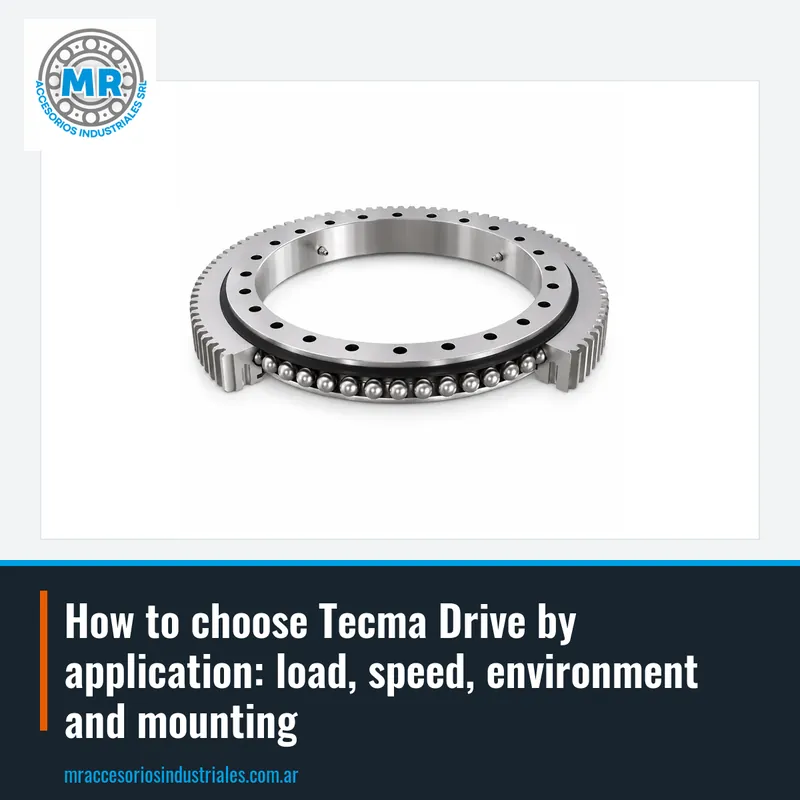
What a Tecma Drive slewing ring is and when to use it
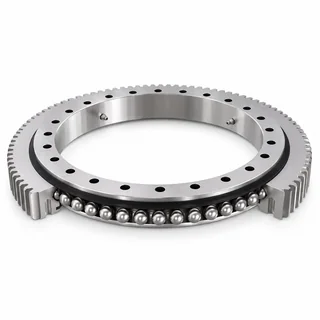
A Tecma Drive slewing ring is a large-diameter bearing that supports axial and radial loads and tilting moments simultaneously. It is used when a structure needs to rotate with precision and stability, such as in cranes, lifting platforms or rotary tables. Unlike a conventional bearing, it integrates the raceway into a toothed or smooth ring, which simplifies mounting. At MR we are the exclusive representatives of Tecma Drive in Argentina and we help you choose the correct model.
These slewing rings appear in equipment where rotation is part of the work cycle: excavators, wind towers, welding positioners and even rotating stages. The choice depends on maximum load, rotation speed and the working environment. For example, a slewing ring for a port crane is not the same as one for a workshop dividing head. That is why it is best to start from the application data before looking at the catalog.
To identify a Tecma Drive slewing ring, look for the code engraved on the ring or on the equipment plate. Codes such as E.750.20.00.C or E.850.20.00.B identify Tecma Drive slewing rings. If the equipment is imported, it may carry a code from another manufacturer; in that case, send us the measurement and the type of gearing to find the equivalent. It is always advisable to verify the pitch diameter and the gear module before requesting a quote.
Tecma Drive slewing drives: integrated rotation solution
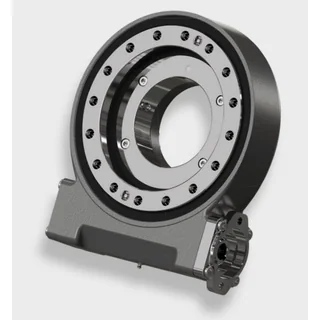
Tecma Drive slewing drives combine a slewing ring with its drive mechanism in a single closed assembly. They are ideal when controlled rotation is needed without designing a separate transmission system. They are used in machining tables, tool changers and automation equipment. By integrating everything, they reduce assembly time and alignment errors.
Within this line, codes such as TD-W9-RA, TD-R7-RL and TD-E7-RL identify Tecma Drive slewing drives, and with the complete code we quote you the exact model. A slewing drive is useful when space is limited or when a plug-and-play solution is sought. In applications with repetitive cycles, it simplifies maintenance.
When ordering a slewing drive, it is key to provide the desired output speed, the required torque and the load to be supported. You also need to define whether rotation is continuous or intermittent, because that affects motor selection. If you have a photo of the equipment plate or the complete code, we quote you the exact replacement. There is no need to disassemble anything: that data is enough to start.
How to evaluate load and tilting moment
Load is the first criterion for choosing a Tecma Drive slewing ring or slewing drive. Not only the total weight matters, but also how it is distributed: pure axial load, radial load or combined with tilting moment. Tilting moment appears when the load is off-center, as in a crane with an extended boom. An incorrect calculation leads to premature wear or structural failure.
To estimate the load, you need the weight of the rotating part, the distance from the rotation center to the application point and the dynamic forces. In applications with impact, such as crushers or demolition equipment, a service factor must be considered. Slewing ring catalogs usually include capacity curves that relate axial load, radial load and moment. With those graphs you verify that the chosen model works within the safe zone.
A common mistake is choosing a slewing ring only by diameter, without verifying the tilting moment. Another is not considering test load or occasional overloads. When requesting a quote, send the maximum weight, the overhang distance and the type of movement. With that data, at MR we help you choose the right model within the Tecma Drive line.
Rotation speed and duty cycle
Rotation speed influences the selection of the bearing type and lubrication. Tecma Drive slewing rings for low speed, such as in cranes or solar trackers, prioritize load capacity. In contrast, for machining tables or sorters, speed can be higher and requires a lower-friction design. The duty cycle also matters: continuous rotation wears differently than intermittent rotation.
In slewing drives, the output speed depends on the chosen drive, so it is best to define it before requesting a quote. You should always verify the maximum permissible speed of the slewing ring, which appears in the technical data sheet. Exceeding that limit generates heat and reduces service life.
When requesting a quote, indicate the speed in revolutions per minute or the time per cycle. Also clarify whether rotation is in one direction or alternating, because that affects tooth wear. If the equipment works continuously, it is advisable to plan lubrication. At MR we advise you on the type of grease and frequency according to the application.
Working environment: dust, humidity and temperature
The environment conditions the choice of seals and lubricants in a Tecma Drive slewing ring. In environments with abrasive dust, such as quarries or steel mills, effective seals are needed to prevent particles from entering. Humidity or pressure washing requires corrosion protection. Extreme temperatures, both high and low, change grease viscosity and internal clearance.
For severe conditions there are variants with special seals and surface treatments. When ordering a slewing ring, clarify whether there is exposure to chemicals, salt air or intense UV radiation. In equipment for the food industry, food-grade lubricant may be required. These details are not always in the code, so it is best to describe the environment when requesting a quote.
A frequent mistake is using a standard slewing ring in a corrosive environment and expecting it to last the same. Another is not relubricating with the proper frequency in dirty environments. If the equipment already has a damaged slewing ring, send photos of the wear and the working environment. That way we can recommend the correct model and maintenance plan.
Mounting and fastening: how to avoid common mistakes
Mounting a Tecma Drive slewing ring requires a flat, rigid support surface. If the base is deformed, the bearing works under stress and wears prematurely. The bolts must be high-strength and tightened in a cross pattern with the torque indicated by the manufacturer. Poor fastening is a frequent cause of field failures.
Before mounting, verify that the gearing is clean and free of burrs. In slewing rings with external gearing, the pinion must be correctly aligned to avoid point loads. Slewing drives, such as TD-R7-RL, arrive as an assembled unit, which simplifies installation. Even so, you must check the flatness of the base and the tightening of the bolts.
A typical mistake is retightening the bolts after some time without verifying the original torque. Another is welding on the slewing ring without protecting the raceways from splatter. If you have doubts about the procedure, consult us before installing. At MR we guide you with Tecma Drive recommendations for your application.
How to order your Tecma Drive slewing ring or slewing drive
To request a quote for a Tecma Drive slewing ring, send the complete code if you have it, such as E.750.20.00.C or I.650.20.00.C. If it is not legible, measure the outer diameter, the bore diameter and the total height. Also indicate the type of gearing: external, internal or without teeth. With that data, at MR we identify the exact model.
In the case of slewing drives, the code is usually on the assembly plate, for example TD-W9-RA or TD-E7-RL. If the equipment is very old, a photo of the plate and the assembly helps identify it. Clarify the application and working conditions to validate the selection. We are the exclusive representatives of Tecma Drive in Argentina, so we handle first-hand information.
You can write to us via WhatsApp or email with the code, measurements or a photo of the part. We reply promptly with the quote. You do not need to disassemble the equipment: basic data is enough to start. If you need technical advice, we also help you choose between a slewing ring and a slewing drive according to your project.
Frequently asked questions
What is the difference between a Tecma Drive slewing ring and a slewing drive?
The slewing ring is only the large-diameter bearing, with or without gearing. The slewing drive includes the slewing ring and its drive mechanism in an integrated assembly. The slewing drive is easier to install and suitable for controlled rotation.
How do I identify the model of my Tecma Drive slewing ring?
Look for the code engraved on the outer or inner ring. It usually has a format such as E.750.20.00.C or I.650.20.00.C. If it is not legible, measure the diameters and height, and send us a photo.
What data do I need to request a quote for a Tecma Drive slewing drive?
We need the slewing drive code, such as TD-W9-RA or TD-E7-RL, or a photo of the plate. It is also advisable to provide the rotation speed, required torque and load to be supported.
Can I use a Tecma Drive slewing ring in a dusty or humid environment?
Yes, there are variants with special seals and anti-corrosion treatments. When requesting a quote, describe the working environment to choose the right protection and correct lubricant.
Is MR the exclusive representative of Tecma Drive in Argentina?
Yes, MR is the exclusive representative of Tecma Drive in Argentina. We sell genuine slewing rings and slewing drives, with technical advice for selection.
Products with photos in the catalogue
Keep reading
- Tecma Drive Slewing Rings: Product Guide in Argentina
Tecma Drive slewing rings are large-diameter bearings for applications requiring rotation and support of combined loads. Learn about their features and how to get a quote.
- How to Read Tecma Drive Codes: Structure, Prefixes, and Suffixes
Understanding the designation of a Tecma Drive slewing ring is key to ordering the correct replacement. We explain the code structure, what prefixes and suffixes mean, and show real examples.
- Tecma Drive by industry: where it is used, how to select it, mounting and maintenance for lasting performance
Tecma Drive slewing rings are critical components in equipment requiring rotation of heavy loads. Learn about their typical applications, how to choose the correct model and best practices for mounting and maintenance.
Continue here
Need a quote?
Send us the code, size or a photo of the part and we'll quote you shortly.