
Blog
How to choose SNR by application: load, speed, environment and mounting
Practical guide to select SNR Y-bearings and housings according to real working conditions, with example codes from the catalog.
Technical team at MR Accesorios Industriales · Updated on October 10, 2026
Selection criteria according to load
When choosing an SNR bearing, the first thing to evaluate is the load it will support. Y-bearings, also called inserts, are designed for radial loads and certain moderate axial loads. In applications such as conveyors, fans or agricultural machinery, the load is usually constant and fixed in direction. Therefore, it is advisable to review the dynamic load capacity of the model and compare it with the actual demand of the equipment.
The load also defines whether a bearing with set screws or eccentric locking is suitable. In equipment with vibration or frequent starts, eccentric locking improves grip on the shaft. A code like UC210G2 corresponds to an insert with set screws, while EX212G2 indicates eccentric locking. The choice between the two depends on the stability required by the mounting.
A common mistake is undersizing the bearing to save space. If the load exceeds the insert's capacity, wear accelerates and premature failures occur. To get a quote, it is advisable to send the complete code, shaft dimensions and a description of the load. At MR, as an official SNR distributor, we help you verify that the chosen model is suitable for the application.
Speed and operating temperature
Rotation speed is another determining factor in selecting an SNR bearing. Y-bearings allow moderate speeds, typical of industrial and agricultural machinery. If the equipment rotates very fast, it is necessary to verify that the model can withstand that condition without overheating. Internal friction and lubrication directly influence high-speed performance.
The ambient temperature and the temperature generated by the bearing itself affect internal clearance and service life. In hot environments, such as ovens or dryers, it is recommended to consult variants with greater internal clearance, identified with the C3 suffix. For example, a Y-bearing with C3 clearance allows thermal expansion without seizing. It is always advisable to confirm the operating temperature before defining the model.
When requesting a quote, it is useful to report the speed in RPM and the estimated temperature. With that data, at MR we suggest the most suitable SNR insert. One should not assume that all Y-bearings withstand the same conditions. A code like UC208G2 may be suitable for many applications, but speed and temperature determine whether it is the best option.
Environment: dust, humidity and contamination
The working environment conditions the choice of seal and protection for the SNR bearing. In places with dust, dirt or humidity, rubber seals are more effective than metal shields. Y-bearings usually come with seals on both sides, a design that retains grease and prevents the entry of contaminants.
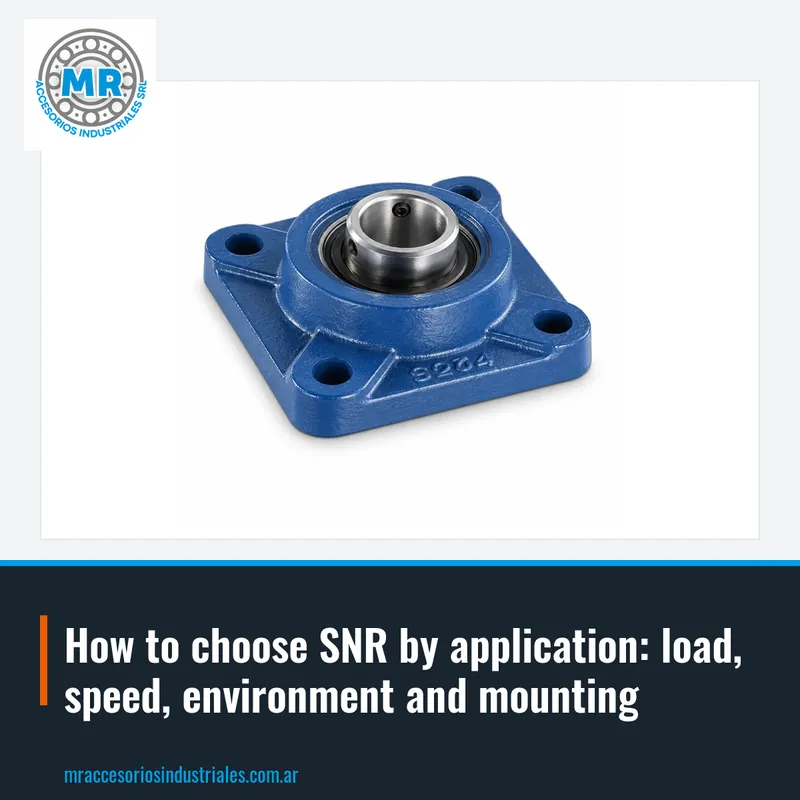
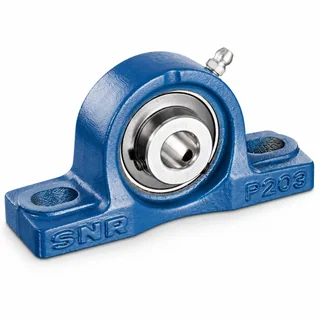
In very dirty applications, such as mills or mining equipment, housings with insert bearings and additional sealing systems can be chosen. The housing protects the bearing and facilitates mounting on the structure. An example is the housing UCP205, which combines a UC insert with a pillow block base. For corrosive environments, it is advisable to consult variants with special treatments.
A frequent mistake is using open bearings or bearings with metal shields in humid environments. That accelerates corrosion and failure. When requesting a quote, describe the working environment: presence of water, dust, chemicals or vibration. With that information, at MR we indicate the most suitable SNR bearing or housing so that the equipment operates without unexpected stops.
Mounting and shaft fixing
Correct mounting is key to the performance of an SNR bearing. Y-inserts are fixed to the shaft by set screws or eccentric collar. Screw fixing is simple, ideal for shafts with little vibration. Eccentric fixing, on the other hand, offers greater resistance to rotation and is recommended for equipment with sudden starts.
The fit between the bearing and the shaft must be adequate to prevent slipping. If the shaft is worn or has out-of-standard tolerances, the insert may spin. In such cases, the shaft can be re-machined or a bearing with a special bore can be used. The code EX212G2 indicates an insert with eccentric locking, while UC210G2 uses set screws.
When mounting, it is important not to strike the bearing directly. Force should only be applied to the ring being fitted. Incorrect mounting damages the seals and raceways. To get a quote for a replacement, send the code engraved on the part and the shaft dimensions. At MR, as an official SNR distributor, we quote the exact insert your machine needs.
Y-housings with insert bearing
SNR Y-housings with insert bearing combine an insert and a pillow block or flange base. They are ideal for quick mounting on structures, as they do not require a machined housing. They are used in conveyors, elevators, mixers and agricultural equipment. The base can be cast iron, stamped steel or thermoplastic material, depending on the demand.
The housing code indicates the type of base and the insert it includes. For example, UCP205 is a pillow block housing with UC insert and 25 mm bore. EXP205 corresponds to a housing with eccentric locking insert. The choice depends on the equipment design and available space.
A common mistake is replacing only the insert and leaving the worn base. If the base is deformed or cracked, the new bearing will not work properly. It is advisable to check the condition of the complete housing during maintenance. To get a quote, send the housing code or a photo of the plate. At MR we indicate the SNR option that best suits your mounting.
Identification of codes and dimensions
SNR bearings and housings have an engraved code that identifies the model and its characteristics. That code is the safest way to order an exact replacement. For example, UC210G2 indicates a UC series insert with 50 mm bore. The code may include suffixes such as 2RS for rubber seal or C3 for greater internal clearance.
In addition to the code, it is advisable to measure the shaft and housing diameters. Those measurements help confirm that the bearing is correct. In housings, the distance between fixing hole centers can be verified. If the code is erased, the measurements and a photo of the part allow identification of the model. At MR we work with the SNR catalog to find the exact reference.
A frequent mistake is ordering a bearing only by shaft size, without verifying the type of fixing or seal. That can lead to an insert that does not fit or seal properly. It is always better to send the complete code and, if possible, a photo. With that data, at MR we quote the SNR bearing or housing that corresponds to your application.
Common mistakes when ordering or mounting
One of the most common mistakes is not considering the actual load of the equipment. If the SNR bearing is smaller than necessary, it fails prematurely. Another mistake is ignoring the environment: using an insert without adequate seals in a place with dust or water. Mounting errors are also made, such as striking the bearing or forcing it onto a worn shaft.
When ordering a spare part, some customers send only the shaft size and not the code. That can cause confusion, because there are inserts with the same size but different fixing or seal. For example, a UC insert with set screws and an EX with eccentric locking are not interchangeable if the equipment requires a specific type of fixing. It is always advisable to verify the code engraved on the part.
At MR, as an official SNR distributor, we help you avoid these mistakes. If you have doubts about which bearing or housing to choose, send us the code, measurements or a photo. We quote the correct option for your application and indicate mounting care. That way you extend the bearing's service life and avoid plant downtime.
Frequently asked questions
What does the 2RS suffix mean in an SNR bearing?
The 2RS suffix indicates that the bearing has rubber seals on both sides. That protects against the entry of dust and humidity, and retains internal grease.
What is the difference between a UC and EX bearing from SNR?
The UC series uses set screw fixing, while the EX series uses an eccentric collar. Eccentric fixing offers greater resistance to rotation in applications with vibration. The choice depends on the type of mounting and working conditions.
How do I identify the code of an SNR housing?
The code is engraved on the base or on the housing plate. For example, UCP205 indicates a pillow block housing with UC insert and 25 mm bore. If the code is erased, measurements can be taken and a photo sent to identify the model.
Can I use an SNR bearing with C3 clearance in any application?
C3 clearance is greater than normal and is recommended when there are high temperatures or interference fits. It is not always necessary: tell us the temperature and mounting, and we will quote the corresponding variant.
Is MR an official SNR distributor in Argentina?
Yes, MR is an official SNR distributor in Buenos Aires, Argentina. We sell Y-bearings and insert bearing housings of the brand, and we quote according to the code or measurements you send us.
Products with photos in the catalogue
Keep reading
- SNR in Argentina: Complete Product Guide and How to Get a Quote
Discover the SNR product lines available in Argentina, their applications, and how to get a quote by code with an official distributor.
- SNR: How to Read Bearing Codes and Designations
Practical guide to understanding SNR bearing nomenclature: what numbers, prefixes, and suffixes mean, with real examples. Learn to identify the correct bearing for your application.
- SNR Bearings: Applications, Selection and Maintenance for Lasting Performance
SNR bearings stand out in demanding industrial applications. Learn where they are used, how to choose the right model, and best practices for mounting and maintenance.
Continue here
Need a quote?
Send us the code, size or a photo of the part and we'll quote you shortly.