
Blog
How to Choose DBH Oil Seals by Application: Speed, Pressure, Environment and Installation
What to look for when choosing a DBH oil seal: dimensions, shaft speed, pressure and fluid, working environment and installation, with examples of real codes.
Technical team at MR Accesorios Industriales · Updated on October 9, 2026
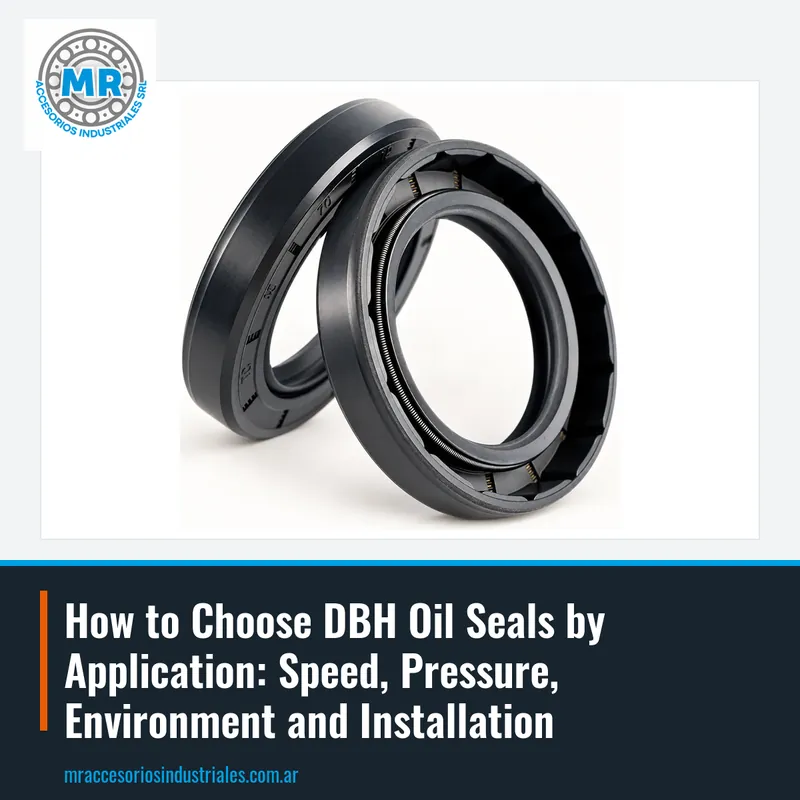
DBH Oil Seals: What to Check Before Choosing
Choosing a DBH oil seal according to the application is more than finding a ring that fits into the housing. The radial oil seal must contain the lubricant and stop dirt from entering while the shaft rotates, and each piece of equipment demands something different. A gearbox, a pump or the wheel hub of agricultural machinery work under very different conditions. That's why it's worth reviewing four things: load, speed, environment and installation.
At MR Accesorios Industriales we sell DBH oil seals for industrial maintenance, agriculture, transport and plant equipment, from Buenos Aires, Argentina. With DBH we work the radial oil seals subcategory, in a wide variety of sizes. Each catalog entry shows the code and the three dimensions of the oil seal. With that data and the information about your equipment, we help you choose the right design.
A poorly chosen oil seal shows up quickly: oil leaks, hardened lip, marked shaft or water and dust entering the bearing. Often the problem is not the oil seal itself but that it was chosen only by size, without looking at how it works. In the following sections we review each criterion with examples of DBH codes. At the end you'll find what data to send us for a quote.
DBH Oil Seal Dimensions: Shaft, Housing and Width
The first filter is always the size, expressed as shaft diameter by housing diameter by width, in millimeters. For example, oil seal 5087 measures 20 x 35 x 7, 5069 measures 40 x 62 x 10 and 1289 measures 90 x 140 x 12. With those three figures the size is identified, and from there the design is defined according to the application.
To measure a used oil seal, take the shaft diameter and not the worn lip diameter, which is usually deformed. The outer diameter is measured on the housing or on the oil seal body, and the width with a caliper on the casing. If the shaft has wear or a groove where the lip was seated, note it, because it changes the choice. A photo with the caliper in place helps a lot.
A common mistake is rounding inch measurements to millimeters or vice versa: an oil seal that fits too tight or too loose leaks oil from day one. It also happens that the code of an oil seal that had already been a wrong replacement is repeated. If the machine has a manual or parts breakdown, the original data is the best reference. With the code engraved on the old part, we quote it directly.
Shaft Speed and Surface Condition
Speed matters because the lip rubs against the shaft all the time and generates heat. What counts is not only the revolutions per minute, but the surface speed, which increases with diameter: a large shaft at low revolutions can demand more from the lip than a small one at high revolutions. That's why, when you consult us, give us the diameter and the revolutions of the equipment.
Shaft finish is as important as speed. A scratched, rusted or grooved shaft wears the lip in a short time and lets oil pass even if the oil seal is new. If the groove is deep, the surface must be restored, either by machining and moving to another size or by placing a sleeve on the shaft. It's best to decide this before ordering the oil seal.
In fast equipment, lip lubrication also matters: an oil seal that runs dry overheats and hardens. In most cases the equipment's own oil or grease fulfills that function. When installing, always lubricate the lip. If the equipment works with little lubrication in the oil seal area, tell us about it and we'll indicate the right design.
Load and Pressure: What Fluid It Must Retain
In an oil seal, the most important load is the fluid pressure on the inner side. The standard radial oil seal is designed to work without pressure or with very low pressure, as in gearboxes, motors and hubs with breathers. If the cavity is pressurized, the lip presses against the shaft, friction increases and leakage appears immediately. In those cases a design prepared for pressure is needed.
What is being retained also matters. Gear oil, bearing grease, hydraulic fluid or water with some additive are not the same. The lip material must be compatible with that fluid and with the working temperature. Nitrile is the most common material for oils and greases, and for high temperatures or certain chemicals fluoroelastomer is used.
Another factor is the load on the shaft: if the bearing is worn or the shaft is misaligned, the shaft moves and the lip doesn't follow that movement. In that case the oil seal leaks even if it's well chosen. Before replacing a leaking oil seal, check the bearing play and alignment. That way the new oil seal works as it should.
Working Environment: Dust, Mud and Water
The environment defines how many lips the oil seal needs. In a clean environment, a single-lip oil seal with spring is usually enough to contain the lubricant. When there is dust, mud or water on the outside, an oil seal with an additional dust lip is better, as it stops dirt before it reaches the main lip. This is typical in agriculture, mining and construction.
In the field, combine harvesters and seeders work among dirt and stubble, and fine dust ends up entering if the oil seal has no protection. In aggregate plants, cement plants and mining, the problem is abrasive dust, which wears the lip and also the shaft. In equipment that is washed with pressurized water, as in the food industry, water ingress is the main risk.
If the environment is very aggressive, sometimes the oil seal is combined with another external protection, such as a deflector or an additional seal. It's also advisable to check that the equipment's breather is clear: a gearbox without a breather builds up pressure and pushes the oil seal. Tell us where the equipment works and we'll quote the DBH oil seal with the design that corresponds to that environment.
Oil Seal Installation: Housing, Direction and Tools
The exterior of the oil seal can be metallic or rubber-coated. The rubber-coated one seals better in housings with small irregularities or light alloy, while the metallic one gives a firm seat in machined housings with good finish. That choice depends on the housing, not the shaft. If you change from one type to another, check that the fit is still correct.
The direction of the oil seal is key: the lip with spring faces the fluid it must retain. Installing it backwards is one of the most frequent mistakes and causes immediate leaks. Before placing it, lubricate the lip, protect keyways and shaft threads with tape or a sleeve and check that the shaft has a chamfered edge so the lip is not cut.
To insert it into the housing use an installation tool or a tube that presses evenly on the entire edge of the oil seal, never direct hammer blows. The oil seal must be square with the shaft and at the original depth. An oil seal that is removed should not be reused: the lip has already taken the shape of the shaft and will not seal the same.
What Data to Send to Quote DBH Oil Seals
To quote a DBH oil seal, the code engraved on the part or on the box is enough. If you can't find it, send us the three dimensions, shaft, housing and width, and a photo of the oil seal in profile showing the lips. With that we identify the code and design. If you bring the code from another brand, we'll give you the DBH equivalent.
To choose according to the application, add the equipment where it goes, the revolutions per minute, the fluid it retains and whether it works with dust, mud or water. If the cavity has pressure or the equipment runs hot, mention that too. That data allows us to recommend the lip material and the number of lips. For orders of several sizes, a list with codes and quantities speeds everything up.
Write to us via WhatsApp or email with the code, size or a photo of the part and we'll reply shortly with the quote. At MR Accesorios Industriales, in Buenos Aires, Argentina, we've been working with industry since 1945 and we sell DBH oil seals along with bearings and transmission components. That way you solve the equipment's spare parts in a single inquiry.
Frequently asked questions
How is the size of a DBH oil seal read?
It is read as shaft diameter by housing diameter by width, in millimeters. For example, 5069 measures 40 x 62 x 10 and 1289 measures 90 x 140 x 12.
When is a double lip oil seal recommended?
When the equipment works with dust, mud or water on the outside. The dust lip stops dirt before it reaches the main lip, which is the one that contains the lubricant.
Does a radial oil seal withstand pressure?
The standard radial oil seal is designed to work without pressure or with very low pressure. If the cavity is pressurized, a design prepared for that is needed: tell us the case and we'll indicate which one.
Which way does the oil seal lip go?
The lip with spring faces the fluid to be retained, generally towards the inside of the equipment. Installing it backwards causes immediate leaks.
How do I quote DBH oil seals at MR?
Send us via WhatsApp or email the code, the three dimensions or a photo of the part, and we'll reply shortly with the quote.
Products with photos in the catalogue

Keep reading
- DBH seals in Argentina: complete product guide and how to quote them
Discover the DBH radial seal line we distribute in Argentina, their typical applications and how to request a quote with the exact code.
- DBH Codes: Guide to Reading Radial Seal Designations
Understanding DBH seal nomenclature helps you order the correct part. We explain the code structure, what prefixes and suffixes indicate, and how to use real examples for your inquiry.
- DBH Oil Seals: Applications, Selection, Installation and Maintenance for Long Life
DBH radial oil seals are critical components in industrial equipment. In this guide, we cover where they are used, how to choose the right model, and what installation and maintenance care extends their service life.
Continue here
Need a quote?
Send us the code, size or a photo of the part and we'll quote you shortly.