
Blog
Gummi in mining: couplings for crushers, mills, screens and conveyor belts
Gummi couplings are used in mining equipment to absorb vibrations and misalignments. We explain how to identify them and order them.
Technical team at MR Accesorios Industriales · Updated on November 2, 2026
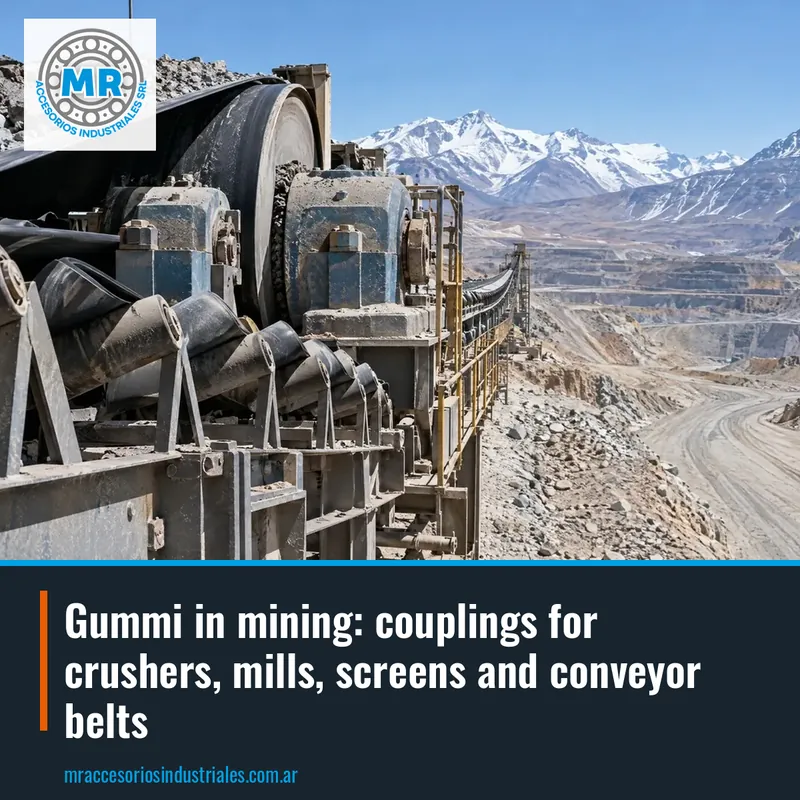
What Gummi couplings are and why they are used in mining
Gummi couplings are power transmission elements that join two shafts to transmit rotational motion. They are designed with an elastomer that absorbs vibrations, shocks and misalignments between the shafts. In mining, where equipment works with heavy loads and sudden starts, this flexibility is key to protecting both the motor and the driven machine.
In crushers and mills, Gummi couplings are installed between the electric motor and the reducer or directly on the input shaft. Their function is to dampen the torque peaks generated when material enters the crushing chamber. Without a suitable elastic coupling, those shocks are transmitted directly to the bearings and gears, shortening their service life.
In screens and conveyor belts, Gummi couplings also play an important role. Screens vibrate constantly, and the coupling must tolerate that movement without transmitting fatigue to the motor. In belts, loaded starts and tension variations generate stresses that the elastomer absorbs. This prevents premature shaft breakage and reduces corrective maintenance. Choosing the right coupling helps protect the rest of the transmission line.
How to identify a Gummi coupling on a mining machine
To order a spare part, the first step is to identify the code engraved on the coupling body. Gummi coupling codes include A-20, A-25 and A-60, which correspond to different models. If the code is not legible, you can take the main measurements: shaft diameter, distance between hole centers and outer diameter of the elastomer. With that data, MR's technical team can identify the equivalent model.
In addition to the code, it is advisable to check the condition of the elastomer. In mining, wear of the flexible element is the most frequent reason for replacement. If the elastomer is cracked, deformed or missing material, it is time to replace it. The condition of the metal sleeves or bushings should also be checked, as they can suffer friction wear. A coupling with a damaged elastomer transmits more vibration and can damage the motor or machine bearings.
When removing the coupling, it is useful to take a photo of the assembly and the code. This makes quoting easier and prevents interpretation errors. At MR we help you identify the correct Gummi model for your application. If you have the equipment manual, the transmission section usually indicates the recommended coupling type. You can also send us a photo of the motor and reducer nameplate to verify power and torque.
Gummi couplings for crushers: what to consider
Jaw and cone crushers work with very high impact loads. The coupling must withstand torque peaks without permanent deformation. It is important to verify that the coupling is sized for starting torque, not just nominal torque. An undersized coupling will fail prematurely.
In gyratory crushers, the coupling is usually between the motor and the countershaft. Space there is limited and maintenance access is restricted. That is why compact, easy-to-mount couplings are preferred. Being elastic, they tolerate some misalignment, which simplifies installation. Even so, it is advisable to align the shafts as well as possible to extend the elastomer's life.
When ordering a coupling for a crusher, indicate the crusher brand and model, motor power and shaft diameters. If you have the previous coupling code, even better. At MR we quote the right Gummi coupling and give you the steps for correct assembly. Avoid reusing old elastomers or mixing parts from different couplings, because that changes the damping characteristics.
Gummi couplings for mills: applications and care
Ball and rod mills are critical equipment in mineral grinding. The coupling between the motor and the reducer must transmit high, constant torque. Depending on power and torque, the Gummi model to use changes, so it is best to send us the equipment data.
In hammer mills, the coupling is exposed to vibrations and pulsating loads. Gummi's elastomer helps smooth those loads and protects the rotor bearings. The coupling commonly works in environments with abrasive dust, so periodic inspection of the elastomer condition is recommended. A visual inspection from time to time allows cracks to be detected before a failure occurs.
To quote a coupling for a mill, send the coupling code or the shaft measurements and the distance between flanges. It is also useful to know the motor power and rotation speed. At MR we help you select the correct model. Remember that a poorly chosen coupling can cause unplanned stoppages and production losses.
Gummi couplings in screens and conveyor belts
Vibrating screens generate oscillating movements that are transmitted through the coupling. Gummi's elastomer absorbs those vibrations and prevents them from reaching the motor. The coupling must be chosen according to motor power and screen size.
In conveyor belts, the coupling is located between the motor and the speed reducer. Belts start under load and can have sudden tension variations. The elastic coupling protects the reducer from those torque peaks. It also allows for a small misalignment that may appear due to structure settling. A rigid coupling in that position would transmit all loads to the reducer, shortening its service life.
When ordering a coupling for a screen or belt, indicate the belt width or screen size, motor power and the coupling code if you have it. At MR we quote the corresponding Gummi coupling and advise you on assembly. It is advisable to check alignment after the first hours of operation.
Common mistakes when ordering or mounting Gummi couplings in mining
One of the most frequent mistakes is ordering the coupling only by shaft diameter, without considering torque. Two couplings can have the same bore but different load capacity. Therefore, it is always better to give the full code or the elastomer measurements. Another mistake is confusing the elastomer code with the complete coupling code; in some cases they are sold separately.
During assembly, a typical mistake is forcing the coupling onto the shaft with blows. That can damage the elastomer or misalign the bushings. The correct way is to slide it gently onto the shaft. It is also important to respect the tightening torque of the fastening screws. A loose screw causes slipping and premature keyway wear.
Another mistake is not checking alignment after assembly. Excessive misalignment, even if the coupling tolerates it, generates additional loads on the bearings. That translates into vibrations and increased temperature. At MR we advise you on the recommended alignment tolerances for each Gummi model. This way you avoid premature failures and plant stoppages.
How to quote Gummi couplings for mining at MR
To quote a Gummi coupling, you can write to us on WhatsApp or send us an email with the coupling code or a photo of the part. If you do not have the code, send us the shaft measurements, the distance between hole centers and the outer diameter of the elastomer. It is also useful to know the motor power and the application (crusher, mill, screen, belt). With that data, we indicate the correct model.
MR is an official Gummi distributor. When quoting, we provide the exact code and technical characteristics so you can verify that it is what you need. If you have doubts about installation, we can also advise you.
Send your inquiry with the code or photo and we will reply promptly. You do not need to remove the coupling before quoting; a photo and measurements are enough to start. We are in Buenos Aires, Argentina, and we serve you directly.
Frequently asked questions
What Gummi coupling is used in a jaw crusher?
It depends on the size and motor power. The best approach is to send the previous coupling code or the shaft measurements to confirm the model.
How do I know if the Gummi coupling elastomer is worn?
If you see cracks, permanent deformation or missing material in the elastomer, it is time to change it. You may also notice more vibration than normal in the equipment. Periodic visual inspection helps anticipate replacement.
Can I use a Gummi coupling on a conveyor belt?
Yes, Gummi couplings are used between the motor and the reducer of conveyor belts. They absorb starting torque peaks and tolerate small misalignments. It is important to size the coupling according to motor power.
What data do I need to quote a Gummi coupling for mining?
The coupling code (for example, A-20, A-25 or A-60) is enough. If you do not have it, send the shaft measurements, the distance between holes and the outer diameter of the elastomer. A photo of the part also works.
Is MR an official Gummi distributor?
Yes, MR is an official Gummi distributor. We can advise you on selecting the correct coupling for your mining application.
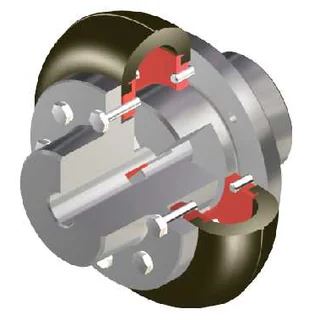
Products with photos in the catalogue
Keep reading
- GUMMI Couplings: Vibration Absorption and Reliable Power Transmission for Industry
GUMMI elastic couplings absorb vibrations and misalignments, protect machinery, and ensure reliable power transmission. Learn about their configurations and how to choose the right model.
- How to Read Gummi Codes: Designation Structure, Prefixes, Suffixes and Real Examples
Practical guide to understand Gummi coupling nomenclature. Decode codes and designations to identify the correct coupling for your application.
- Gummi Couplings: applications, selection and maintenance to make them last
Discover where Gummi couplings are used, how to choose the right model for your application and the best assembly and maintenance practices to extend their service life.
Continue here
Need a GUMMI quote?
Send us the GUMMI part number, the size or a photo of the part and we will get back to you with a quote.